New Year, New Trends: What 2021 has in store for Customer Behavior and e-commerce?

To say that 2020 was a big year for e-commerce would simply be an understatement. With all the changes that were abruptly introduced in our daily lives due to the pandemic, online transactions became the norm and it’s fairly safe to assume that the e-commerce world will never return to its pre-pandemic state.

To say that 2020 was a big year for e-commerce would simply be an understatement. With all the changes that were abruptly introduced in our daily lives due to the pandemic, online transactions became the norm and it’s fairly safe to assume that the e-commerce world will never return to its pre-pandemic state.

Customers who preferred physical to online stores for a number of reasons -before lockdowns dictated the closing of the former- turned to online shopping. Retailers had not been prepared for such a rise in online orders and found themselves implementing a number of changes (e.g. modifications in the supply chain and order processes, call center staffing etc) that would normally take months or years in the course of a few months.

To better illustrate these changes and be prepared for what we can expect in 2021, let’s take a closer look at how consumer behavior and e-commerce are now shaped.


How will consumers think and feel in the next six months?

An event of such proportions, like the global spread of COVID-19, has countless ramifications, but a significant outcome is the reshaping of our priorities and what we consider important. Living with COVID-19 for almost a year, consumers now list the following three main priorities and concerns:

  • Personal health, as well as the health of their loved ones, friends and acquaintances
  • Financial security
  • Safety as a whole

When it comes to safety, our homes are now -more than ever- the point of reference. Working from home and small indoor gathering have substituted office life and other forms of socialization. 

The numbers of a recent study by Accenture speak for themselves:

Work and Socialization

  • 85% of consumers favor working from home in the next six months.
  • 73% of consumers favor socializing at home in the next six months.
  • 59% of consumers favor connecting virtually with friends in the next six months.

Consumer Trends

Consumers seem to be taking a turn towards a more mindful, locally-oriented shopping approach:

  • 72% of consumers are limiting food waste with 90% likely to continue post-crisis.
  • 61% of consumers are making more environmentally friendly, sustainable or ethical purchases with 89% likely to continue post-crisis.

Online buying habits are also expected to be reshaped, with the numbers of infrequent or frequent online buyers expected to rise over 150%. This rise in e-commerce comes with new brand choice criteria which are dictated by the needs and claims of Generation Z. These new criteria include fair employment and brands’ ethical practices and positions on current matters.


What should retailers expect and prepare for in the coming months?

Certainly, not a return to normal, if by “normal” one refers to the pre-pandemic state of affairs. Retailers need to adjust to the new normal, the new consumer trends and demands as they have been shaped and accelerated during 2020.

In-store experiences are now characterized by contactless payments and transactions, maintaining proper distances, setting a maximum number of customers allowed inside and making service as quick as possible. Is it possible that those conditions amount to a better customer experience? 

Things are different when it comes to e-commerce, but simplifying the buyer’s journey and making the process easier still remains an imperative. Online stores with poor UX test the customers’ patience and will thus be avoided. This is why mobile responsiveness has now been transfigured from a trend to a must practice. 

It is also evident that “Buy online, pick up in-store” (BOPIS) practices will not go away in the foreseeable future, but in order to lure customers back to physical stores, retailers should offer the promise of a seamless in-store experience. Face-to-face service will need to be re-built based on new standards and acquire a set of distinct competitive advantages against e-commerce.

That doesn’t mean that the e-commerce world will keep spinning without interruptions. Online retailers and brands should turn towards innovation and invest in UX and CX best practices if they wish to make a difference in this landscape and maintain their loyal customers.  

Those innovative technologies and best practices are nothing new to e-commerce. On the contrary, they are almost inherent to it and include:

  •       Artificial intelligence
  •       Inventory management
  •       Predictive analytics
  •       Personalization and automations
  •       Co-creation functions


Where can retailers go from here?

Since its inception, the digital world has never been faced with more challenges and opportunities. If one thing is clear so far, it is that e-commerce now has the means to offer a holistic customer experience, by stimulating consumers on different stages of their journey, engaging them in a personalized fashion and connecting with them in more meaningful ways.

Furthermore, consumers have never felt their voice as heard as now. Customer feedback, in all its various forms, has turned from something brands feared to a valuable asset, one that comes bearing benefits that should no longer be ignored. 

Face-to-face communications have been straining under the weight of COVID-19, but their online counterparts have strengthened, along with consumers’ demands and habits. And how can retailers and brands learn what this new type of customer wants? The answer is simple and hasn’t changed: by asking the right questions and listening to the answers!

You got 15 minutes? Let our team show you
how we can help your business grow!

    Request a 15min Demo


    BOOK A FREE DEMO NOW

    [Case Study] Gatoskilo.gr: The 3 ingredients for a recipe of hundreds of 5-star reviews!

    Gatoskilo.gr is an online pet shop that started in 2016 with the vision to become known for the excellent experience provided to its little (or not so little) customers and their human bosses.

    Gatoskilo.gr is an online pet shop that started in 2016 with the vision to become known for the excellent experience provided to its little (or not so little) customers and their human bosses. 

    Such a bold vision is the pathway to success since no one can deny the value of a happy customer. After all, according to Bain and Co, a business that achieves a 5% increase in returning customers can expect a 75% increase in revenue!

    This recipe for success is also what made Gatoskilo.gr stand out in a market dominated by bigger pet shop chains with physical stores. The results of its customer satisfaction strategy implementation are also showcased by the e-shop’s strong word of mouth game and from what its customers have to say about their experiences on Google Place, Skroutz and Facebook Reviews.

    It is common knowledge that any successful recipe relies on good ingredients. With that in mind, let’s delve deeper into the three ingredients that made Gatoskilo.gr find its place in the hearts and minds of hundreds of pet lovers!

    Ingredient #1: Personalized Customer Service

    The first and most important ingredient was the personalized customer service approach that Gatoskilo.gr designed for its customers. By setting up and activating a list of systems and processes that use customer info to create a bond between the store and its users from the very first moment, all customers can feel like the store’s personnel is someone that truly knows them and their pets. For instance, when you receive a parcel from Gatoskilo.gr, you will find your pet’s name handwritten on it. When you contact the store via phone/online or when you visit their physical store, they know that you are there for Max, Rex or ____ (insert your pet’s name here!) It’s small, personalized gestures like these can make a big difference!

    Ingredient #2: Customer Experience Measurement

    Feedback plays a crucial role in every customer-centric organization. Through the activation of the omnichannel retail feedback collection mechanism featured in e-satifaction.com, Gatoskilo.gr started collecting feedback from day one.

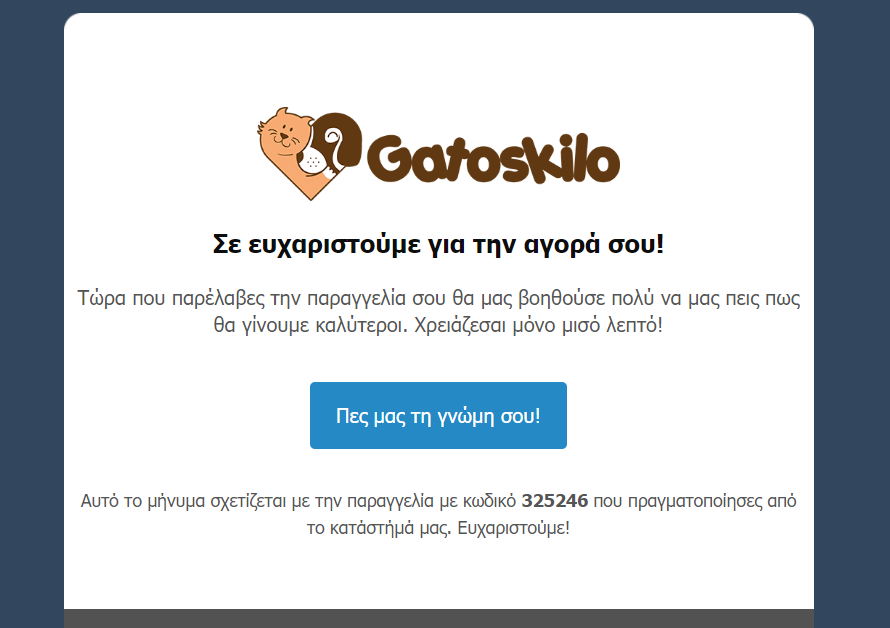
    Example of an email sent by Gatoskilo.gr to customers who received an order. The text and call-to-action prompt the recipient to share his/her opinion on how Gatoskilo.gr can improve its products and service.

    Good communication with customers, which is a collective effort for Gatoskilo.gr employees, resulted in a whopping response rate that exceeds 32%

    Metrics such as Net Promoter Score (NPS), Customer Satisfaction Score (CSAT) and others that measure customer satisfaction from service, packaging, buying process and product range became an indispensable part of frequent reporting. Furthermore, the automated alerts generated by e-satisfaction.com on the event of an unhappy customer are now firmly integrated into the customer service department’s day-to-day activities.  

    And let’s also hear what Christos Kounavis, CEO of Gatoskilo.gr has to say: 

    “The best success metric in our line of work is customer satisfaction. It’s a fair, unbiased metric, one that is inseparably connected to growth. This is why we chose a single goal when we set out: we wanted 99% of customers who receive an order to say that they will repurchase from Gatoskilo.gr. And we reached this goal!”  

    Ingredient #3: Closing the Loop

    Although insights generated from customer feedback collection shed light on the unique selling points of Gatoskilo.gr, its team took things an (essential) step further and used those insights, especially the opinion of satisfied customers.

    How? By activating the Customer Experience Badge, one of the marketing automation mechanisms featured in e-satisfaction.com.

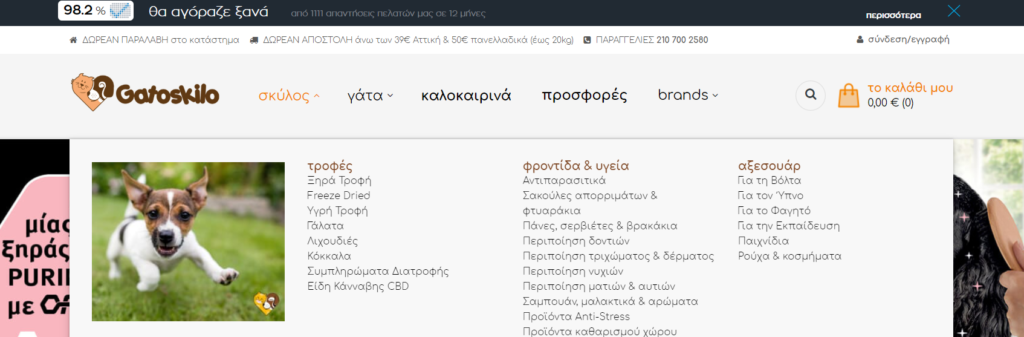
    The Customer Experience Badge is depicted at the top of the page. Translation: 98.2% of customers would repurchase.

    As a newcomer in the market, it was important for Gatoskilo.gr to gain the trust of first-time visitors. The e-satisfaction.com Customer Experience Badge combined with excellent support was the recipe for trust-building! Furthermore, the excellent level of customer service proved to be a worthy investment when put to the test by the activation of the e-satisfaction.com Refer a Friend and Review mechanisms. Simply put, the results where outstanding!  

    In a short amount of time, Gatoskilo.gr became the most reviewed pet shop on skroutz.gr. And it gathered only 5-start reviews!

    To promote its physical store, Gatoskilo.gr asked happy customers to submit a Google Places review. More than 100 reviews were submitted in response!

    Happy Gatoskilo.gr customers recommended the store to friends via the e-satisfaction.com Refer a Friend mechanism more than 200 times!


    Was the recipe followed by Gatoskilo.gr a success?

    The answer is… YES! Gatoskilo.gr proved that investing in Customer Experience is the way to go in OmniChannel Retail. After just 4 years since its foundation, Gatoskilo.gr is now considered a steadily rising Online Pet Shop, one whose growth rate is multiplied on an annual basis. 

    And as an epilogue, let’s have Christos Kounavis describe his company’s path and the importance of customer loyalty in his own words:

    “Right from the start, our main metric was the percentage of revenue generated by returning customers. This % is high and it keeps rising, despite our sudden growth. This only goes to show that we will be around for many years to come. Throughout the path that led us here, e-satisfaction.com played a crucial part since it offered us -fully-formed- a big part of the methodology we use now on every stage of the customer journey.

    What do we talk about when we talk about customer experience (CX)?

    It has been proven that an improved customer experience results in better feedback. Download our new eBook and start working on it for your brand, store and products!


    Best Case Scenario:
    You purchased a product online and you received it, properly packaged, looking exactly like its photos and at the expected time of delivery. Plus, you got a handwritten note from the online store with a personalized message!

    Doesn’t this make you even happier for choosing this particular online store? Now, think of the people that you will recommend this store to: how would you describe your purchase experience to them and what thoughts and feelings will be cultivated by the mention of such a positive experience?

    Worst Case Scenario: You purchased a product online. Your order has been delayed, you have already contacted the store/brand via phone to find out what is wrong. After all this trouble, you received your product, which looks like its online image, but it came in a package whose condition is far from mint. 

    Things could have been worse if the received product did not resemble the one you chose online, but you still feel more or less angry and you will probably recount the whole ordeal to more people in the next few days, as compared to the people you would share your best case scenario experience. It is also highly likely that you will advise your peers to avoid making a purchase at this particular e-shop. 

    Those two scenarios can be used to describe customer experience (also known as CX) in a nutshell! To use a more formal definition, customer experience is the sentiment that is formed from a customer’s overall purchase experience: from e-shop browsing to getting in touch with the contact centre, from placing an order to receiving it, from the delivery method to the after-sales process.

    Now, you may think that you are already offering your customers a satisfactory experience but studies have shown that there is a gap dividing what brands and customers believe:

    And to bridge that gap, brands need to realize that their customers’ perception is influenced by multiple touchpoints in the buyer’s journey. This determines whether they will keep interacting with a brand/product and the ways they will choose to communicate their experience.

    It has also been proven that an improved customer experience results in better feedback.
    Download
    our new eBook and learn more about CX! It is the starting point to make better thinks happen for your brand, store and products!

    Good and bad customer experiences: what characterizes them?

    The general rule is that good experiences are the products of simple processes that are also easy to carry out. These processes mimic the average user’s thinking process and lead him to the desired outcome and the fulfilment of his/her expectations. 


    What makes someone describe a customer experience as good?

    The general rule is that good experiences are the products of simple processes that are also easy to carry out. These processes mimic the average user’s thinking process and lead him to the desired outcome and the fulfilment of his/her expectations. 

    List of good customer experience characteristics:

    • Easy and user-friendly search, purchase, delivery and return processes.
    • Various brand communication options with a low estimated response rate.
    • Access to informational material that helps customers solve a problem or find the answer to a question (e.g. FAQs), since not all customers wish to communicate via telephone, regardless of the average call wait time.
    • Creative, out of the box problem-solving approach, proven not only to reduce churned customers but also to create customers committed for life.
    • Brand communication that shows empathy, understanding and inclusivity.
    • Proactive messaging about known issues.
    • Personalized communication, treating the customer as a human being instead of a number. Knowing your customers’ birthdays, zodiac sign or interests sure shows more interest than just knowing their names.
    • Coherent, comprehensive product description with no grammatical/syntax errors.
    • Short waiting time (delivery, reps response, social media response, customer service response etc.)
    • Brand departments that communicate effectively to provide a seamless and consistent customer experience.
    • Empowered employees with customer insights. This is a sign of a business culture that helps to meet customers’ expectations for personalized, easy and dynamic experiences.

    CX Tip: Keep your word, be consistent, be customer-centric, be creative!

    What makes someone describe a customer experience as bad?

    Anything that makes the buying and after-sales process difficult results in diminishing customer satisfaction and does no wonders WoM-wise.

    List of bad customer experience characteristics:

    • Hidden charges, difficult shipping cost calculation, extra charges on the check out stage.
    • “Siloed” brand departments with no internal communication. In such cases, customers have to repeat information, something that makes their journey longer and complicated.
    • Fragmented customer experience management. A more holistic and organizational approach, where all the relevant factors are taken into account, can lead to better customer satisfaction and loyalty. 

    In a nutshell, a good customer experience is all about reducing the element of unpleasant surprises in business transactions so that there are no recurring after-sales expenses or unpleasant customer grievances.


    Download our eBook and learn more about CX! It is the starting point to make better thinks happen for your brand, store and products!

    What Is Net Promoter Score (NPS) And Why Is It Important?

    Net Promoter Score (NPS): the “holy grail” of Customer Experience (CX metrics). If you are not familiar with it, its pros and cons and ways to incorporate it into your customer satisfaction strategy, you only need to keep reading.

    Net Promoter Score (NPS): the “holy grail” of Customer Experience (CX metrics). If you are not familiar with it, its pros and cons and ways to incorporate it into your customer satisfaction strategy, you only need to keep reading.


    What is Net Promoter Score (NPS)?

    Net Promoter Score is the most used CX metric and measures the willingness of consumers to recommend your product/brand/service to someone they know. It gauges your potential word of mouth (WOM) and it is also employed when you need to check whether your customers are becoming loyal to your brand or can be categorized as passives or even detractors.

    How do you measure NPS?

    The main question on an NPS survey is along the following lines:

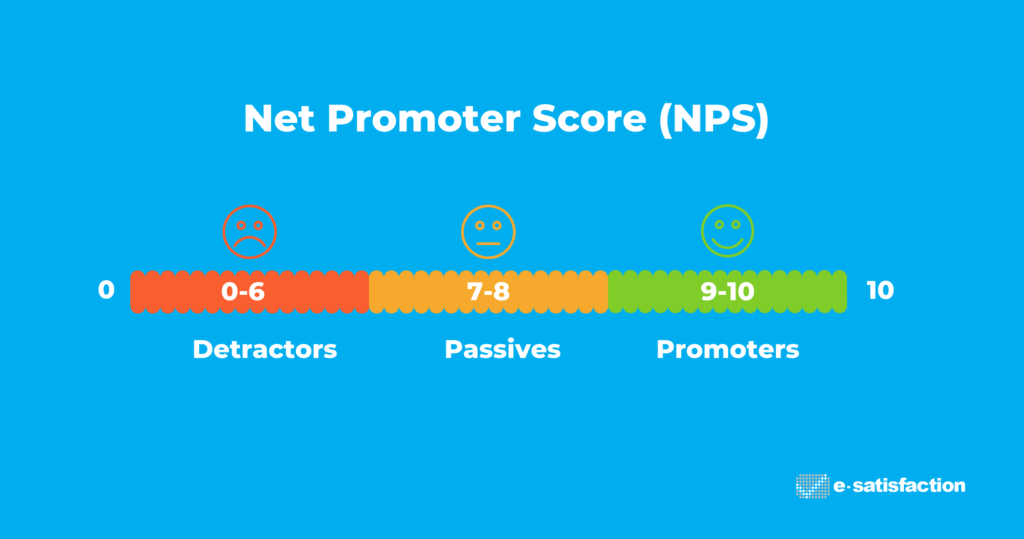
    Based on their answers, survey respondents can fit into 3 different categories:

    • Promoters (Score: 9 or 10)
    • Passives (Scores: 7 or 8)
    • Detractors (Score: 0 – 6)

    By subtracting the percentage of detractors from that of promoters you get your Net Promoter Score.

    % Promoters – % Detractors = Net Promoter Score

    You got 15 minutes? Let our team show you
    how we can help your business grow!

      Request a 15min Demo


      BOOK A FREE DEMO NOW


      What is considered a “good” Net Promoter Score?

      Net Promoter Scores range from -100 to +100, and what is considered ‘good,’ ‘bad,’ or ‘neutral’ can vary greatly across industries. Some count a positive score (i.e. any score over 0) as good, since it shows some customer loyalty and customer satisfaction. But to be more specific, in the e-commerce world a score of 50 or higher is generally considered a very good NPS score. 

      Various factors, such as the time you send an NPS survey, can influence not only your final score but also your surveys’ response rate.


      What are the Pros & Cons of NPS? 

      There are many myths surrounding NPS, but as is the case with other metrics like Customer Satisfaction (CSAT) and Customer Effort Scores (CES), one thing is true: NPS cannot be regarded as your only solution for gathering and analyzing customer feedback. It should be combined with other metrics and strategies that should work together with the aim of offering your customers the best possible level of satisfaction.


      That being said, let’s move on to the best and not so good aspects of NPS:

      NPS Pros (+)

      • It is a simple, easy to compare index that measures the brand’s efficiency and not just the satisfaction from a single transaction. 
      • It employs a clear and specific wording. There are no double meanings or misunderstandings for the customer when asked to answer. 
      • Its measuring is straightforward. NPS is easy to calculate, even without any prior statistical knowledge.
      • It is easy to implement through all survey channels (phone, online, SMS).
      • NPS results may act as the trigger for further investigation of a negative score or as a reminder to apply engagement actions.
      • NPS is an indicator that can enhance internal communication and corporate culture. It can form the basis of a common -measurable- goal equally understood by all departments,
      • It has been proven to be one of the best indicators of loyalty as the customer puts his own reputation on the line when he/she refers a product or service to a peer.

      NPS Cons (-)

      • NPS is by no means a cure-all when it comes to all the customer-related problems that brand is probably facing.
      • NPS surveys need to incorporate open-end questions so that respondents will be able to justify their score.
      • It can become a cause for considerable fireback if customers realize that a brand takes no action even after they have provided their feedback.
      • Its measuring method is a bit more complicated compared to those of CSAT and CES.


      Setting up and running an NPS survey is a great first step towards using customer feedback to your advantage. And with the right tool, the whole process can be streamlined so you can really grasp the power of listening to your customers’ voice.