AI-Powered Sentiment Analysis: How Brands Understand Customers at Scale

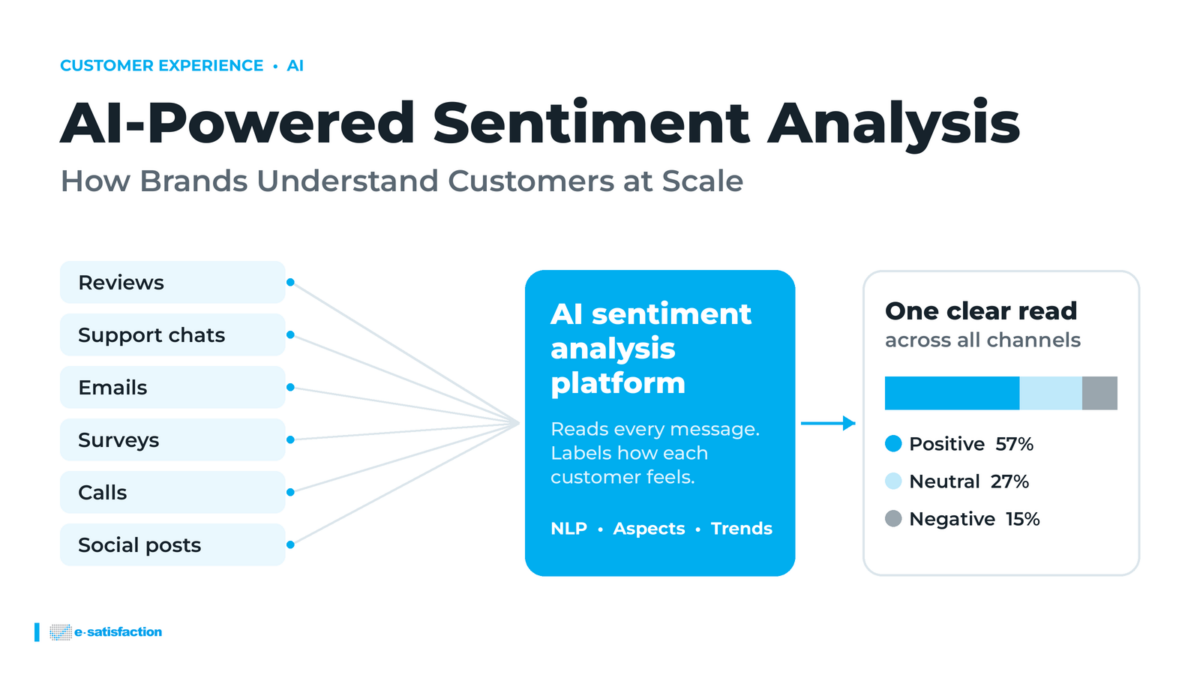
An AI sentiment analysis platform reads customer feedback from every channel, labels the emotion behind each message, and ties it to a specific topic. That lets brands see how customers feel across thousands of reviews, chats, and calls, not just the few they read by hand. This guide covers what these platforms do, how they work, and what separates a real platform from a basic score.


Every day your customers tell you how they feel. They leave reviews, message support, reply to surveys, and post on social. The problem is volume. No team can read all of it. An AI sentiment analysis platform can. It reads customer feedback at scale, labels the emotion behind each message, and shows you the patterns hiding in the noise.

Most brands still sample. They skim a handful of reviews or listen to a few calls, then guess at the rest. That guess gets expensive. Roughly 80 to 90% of enterprise data is unstructured text like reviews, emails, and call notes, and it grows about three times faster than neat database data. This post explains how these platforms turn that flood into something you can use.

What Is an AI Sentiment Analysis Platform?

An AI sentiment analysis platform is software that reads customer feedback across channels and labels the emotion in each message as positive, negative, or neutral. It uses natural language processing, the technology that lets machines read human text, to do this automatically at scale. That way brands understand how thousands of customers feel without reading every message by hand.

A single sentiment score is a feature. A platform is the whole system around it. It connects to your channels, reads every message, groups the results by topic, and pushes what it finds to the teams who can act. Most brands run AI sentiment analysis as part of a wider Voice of Customer program, not as a standalone gadget.

How Does an AI Sentiment Analysis Platform Work?

It works in four steps. First it collects feedback from every channel into one place. Then natural language processing reads each message and labels the emotion. Next it ties that emotion to a topic, like delivery or price. Finally it surfaces trends and alerts so teams can act on what they find.
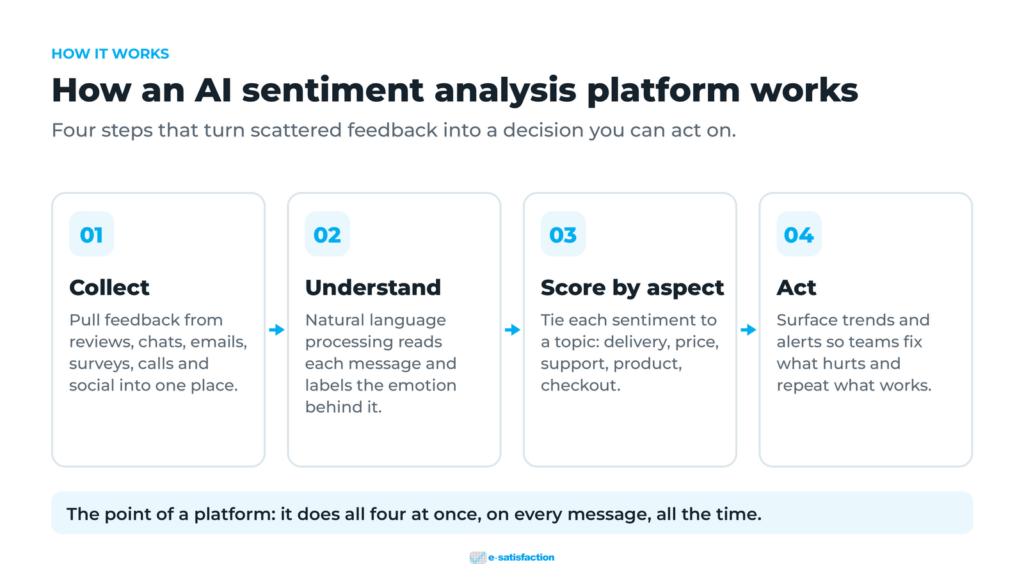
The collection step matters more than it sounds. Feedback lives in silos: reviews on one site, chats in another tool, calls in a third. A platform pulls it together so nothing gets lost. The scoring step is where customer feedback analytics turns raw text into numbers you can chart, compare, and track over time.

Overall Sentiment vs Aspect-Based Sentiment

Here is where most tools fall short. A basic tool gives one score per message. It might tag a review as “negative” and stop there. You know something is wrong. You have no idea what to fix.

Aspect-based sentiment goes deeper. It splits a message into topics and scores each one on its own. Take this review: “Delivery was fast and the staff were lovely, but the jacket felt overpriced for the quality.”
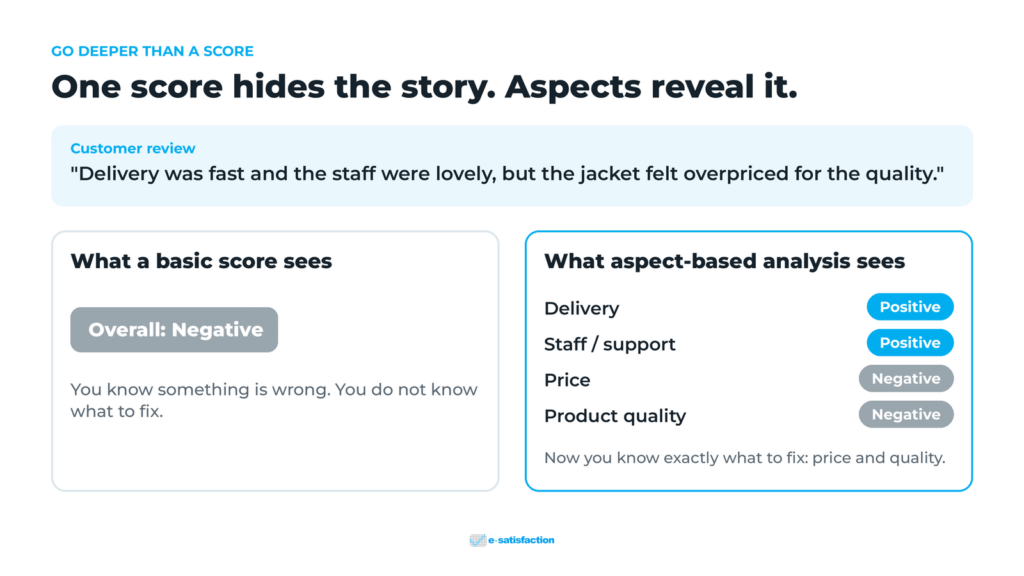
A basic score calls that negative. Aspect-based analysis sees four separate signals: delivery is positive, staff is positive, price is negative, and quality is negative. Now you know exactly where to act. Pairing sentiment with topic detection is what turns a mood reading into a to-do list.

If your current setup gives you scores but no answers, see how brands read feedback at the aspect level.

Which Channels Can It Analyze, and How Much?

A strong platform reads both text and voice: reviews, support chats, emails, surveys, social posts, and call transcripts. It processes all of it, not a sample. That is the real difference between a platform and a person with a spreadsheet.

The scale gap is huge. Manual review methods for contact centers typically cover less than 5% of total call volume. The other 95% goes unread. An AI platform reads every message, every day.
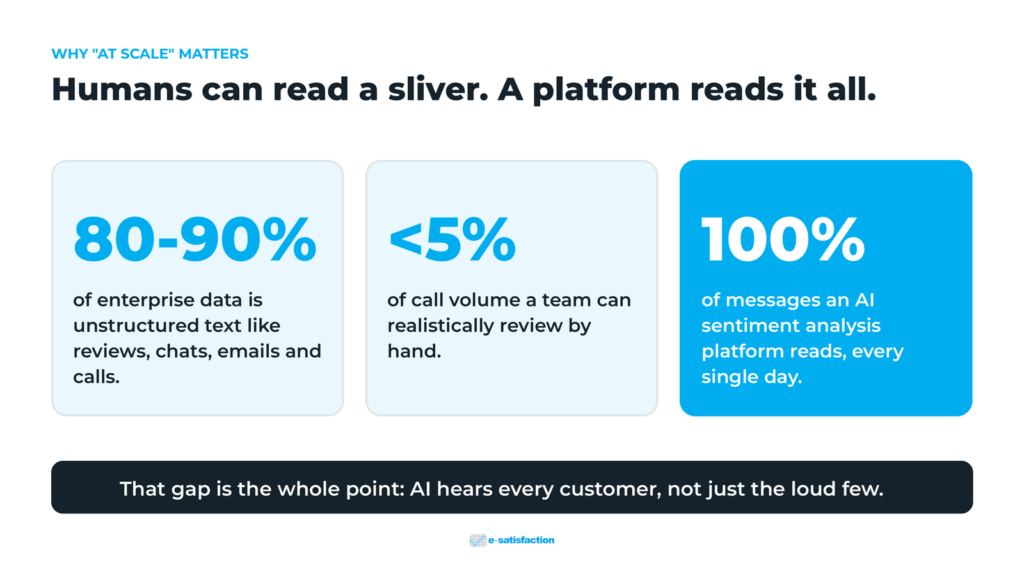
Reading chats and calls well takes conversational analytics, which is built for the messy back-and-forth of real dialogue. When that runs continuously, you get real-time customer insights instead of a report that arrives a month too late.

What Separates a Platform From a Basic Sentiment Feature?

Plenty of tools slap a positive or negative label on text. Four things separate those features from a real platform.

Coverage comes first. A platform listens across every channel, not just one. Second is depth: aspect-level scoring, so you learn what to fix, not just that something is off. Third is accuracy that improves as the model learns your products, slang, and customers. Fourth, and most important, is action.

A score that sits in a dashboard changes nothing. A proper AI Voice of Customer platform routes each finding to the right team and closes the loop. The measure of a platform is not how well it labels feeling. It is whether that feeling reaches someone who can do something about it.

How Reliable Is AI Sentiment Analysis at Scale?

It is reliable enough to guide real decisions, though not perfect. AI is strong on clear language and gets sharper as it learns your data. It still struggles with sarcasm, slang, and mixed emotions in a single sentence.

At scale, that trade-off works in your favor. One misread message barely moves a trend built from thousands of others. The aggregate picture stays reliable even when a single label is wrong. For sensitive or high-stakes cases, most teams keep a human in the loop to confirm before acting. The AI does the reading; people make the judgment calls.

The Takeaway

Three ideas are worth keeping. First, scale is the whole point: a platform hears every customer, not just the loud few. Second, aspects beat scores, because knowing what to fix is more useful than knowing that something is broken. Third, a platform only earns its place when insight turns into action.

Understanding customers at scale is no longer a nice-to-have. It is how AI in customer experience separates the brands that adapt from the ones that guess. Ready to hear what all of your customers are really saying? Request a demo and see sentiment analysis at scale in action.


Frequently Asked Questions

What is an AI sentiment analysis platform used for?

It is used to read customer feedback at scale and turn it into insight. Brands use it to spot rising complaints, track how customers feel about products or service, compare channels, and decide what to fix first. It replaces slow manual review, which can only cover a small sample of feedback.

What is the difference between sentiment analysis and aspect-based sentiment analysis?

Sentiment analysis gives one label per message: positive, negative, or neutral. Aspect-based sentiment analysis breaks the message into topics, like price or delivery, and scores each one separately. The second approach is far more useful because it tells you exactly what to act on, not just the overall mood.

Can an AI sentiment analysis platform handle multiple languages and channels?

Yes. Modern platforms read text and voice across reviews, chats, emails, surveys, social posts, and call transcripts, and many support multiple languages. The value grows with coverage, since sentiment from one channel rarely tells the full story of how customers feel.

How is an AI sentiment analysis platform different from a survey tool?

A survey tool asks structured questions and collects scores. A sentiment platform reads open, unstructured feedback wherever customers already leave it. Surveys tell you what you thought to ask. Sentiment analysis tells you what customers chose to say, including things you never asked about.

How long does it take to see value from an AI sentiment analysis platform?

Many brands see useful patterns within the first weeks, once the platform connects to their channels and starts reading historical feedback. Accuracy on your specific products and customers improves over the following months as the model learns your data.
How Real-Time Customer Intelligence Is Changing CX Strategy

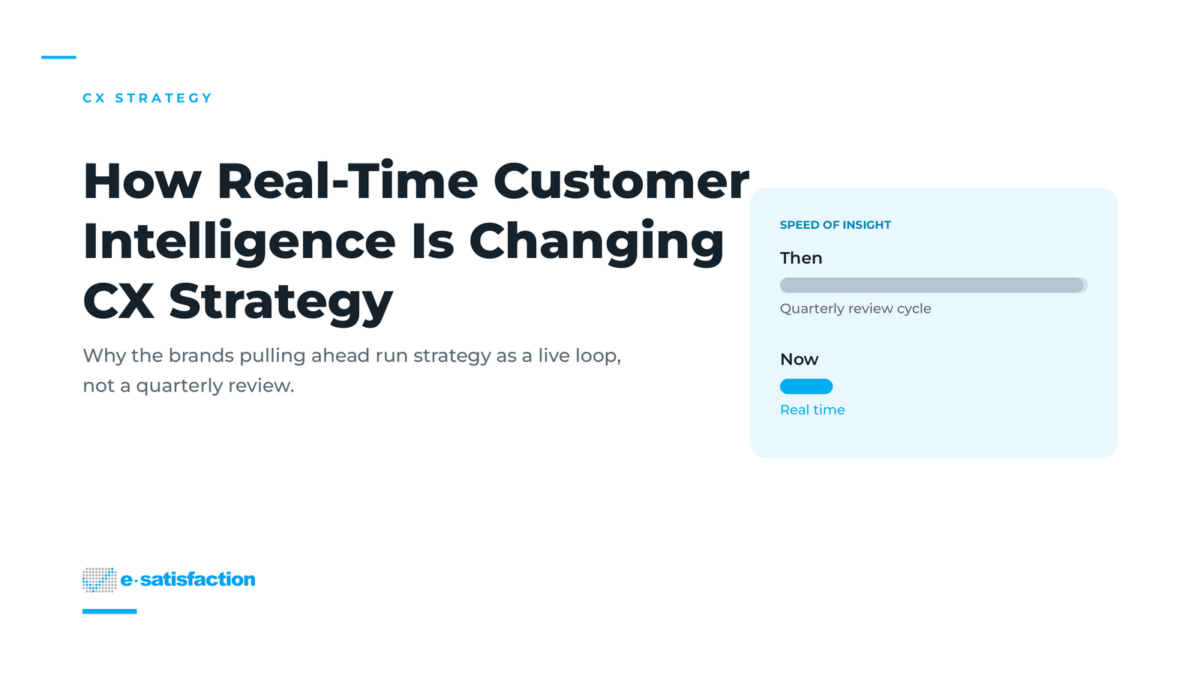
Real-time customer insights are moving CX strategy off the quarterly calendar and onto a live loop. When you can see what customers feel as it happens, the old rhythm of surveys, reports, and annual plans starts to cost you customers. This post explains what real-time customer intelligence is, why periodic strategy is already out of date, and how to close the gap between an insight and an action.


Most CX strategies still run on a calendar. You collect feedback, wait for the report, and adjust the plan next quarter. That rhythm made sense when data was slow. It doesn’t anymore. Real-time customer insights now arrive the moment a customer acts, and that single change is quietly rewriting how CX strategy gets set.

The shift is bigger than faster dashboards. It changes when decisions get made, who makes them, and how a brand competes. Gartner reports that 91% of customer service and support leaders feel executive pressure to adopt AI, much of it aimed at acting faster on what customers are telling them. This is the same current pulling CX toward a more predictive, real-time future. Here’s what that means for how you plan.

What are real-time customer insights?

Real-time customer insights are findings drawn from customer signals the moment they happen, then delivered fast enough to influence a decision while it still matters. They come from surveys, reviews, chats, calls, and behavior, read continuously rather than reviewed after the fact.

The key word is “act.” Fast reporting is not the same thing. A chart that refreshes quickly but arrives after the customer has already left is still a rear-view mirror. Real intelligence means the signal reaches a person who can do something about it, in time to change the outcome. That’s the difference between watching churn and preventing it. It’s also why AI in customer experience has become central: no human team can read every signal as it lands.

Why quarterly CX strategy is already out of date

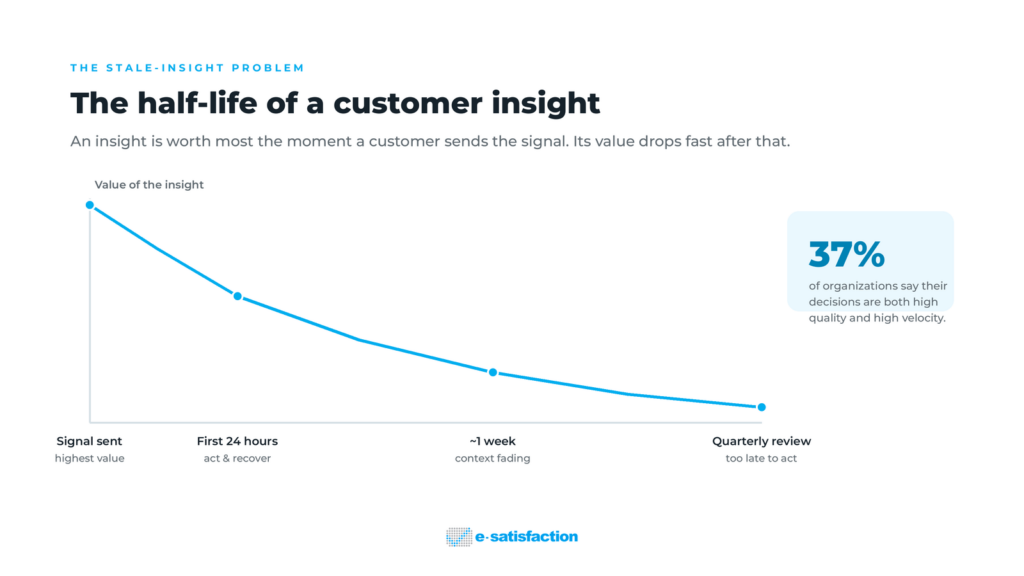
Strategy built on last quarter’s data is describing customers who have already moved on. An insight is worth the most the instant a customer sends the signal, and its value decays fast. By the time it reaches a quarterly review, the moment to act has usually passed.

This is a decision-speed problem, not a data problem. McKinsey found that only 37% of organizations say their decisions are both high quality and high velocity, and that speed and quality together track closely with company performance. Slow decisions don’t just annoy customers. They compound into lost revenue while faster competitors adjust.

The pattern shows up everywhere in CX. A frustrated customer signals in a chat, a review, or a support call. The signal sits in a queue. A week later, the theme surfaces in a report. A quarter later, it becomes a slide. By then the customer is gone, and so are the others who felt the same way but never said a word.

How do real-time customer insights change CX strategy?

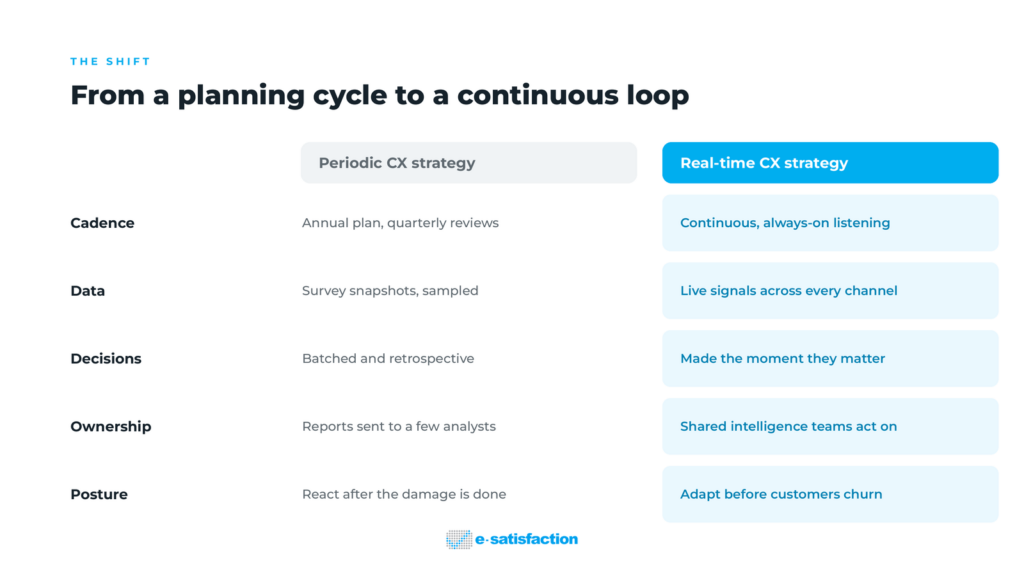
Real-time customer insights turn strategy from a periodic plan into a continuous loop. Instead of setting direction once a quarter and hoping it holds, teams listen constantly, decide in the moment, and adjust as customer reality shifts. Strategy becomes something you run, not something you file.

That changes the operating model, not just the tooling. Cadence moves from annual to always-on. Data moves from sampled snapshots to live signals. Decisions move from batched and retrospective to made when they count. Ownership moves from a report seen by a few analysts to shared intelligence a whole team acts on.

None of this is optional at the platform level anymore. Gartner now treats real-time activation as table stakes for the systems that power customer data. The brands pulling ahead have stopped treating feedback as a report and started treating it as a live input into daily decisions.

If your team is still waiting for the next review cycle to act on what customers are saying, see how brands run this as a continuous loop instead.

What signals feed real-time customer intelligence?

Real-time customer intelligence pulls from every channel where customers leave a trace: survey responses, product reviews, live chats, support calls, and on-site behavior. AI reads all of it at once, scoring tone and grouping themes so nothing waits in a queue.

Most of this feedback is unstructured text and speech, which is exactly where teams used to drown. Modern customer feedback analytics reads open comments at scale, while AI sentiment analysis catches the shift from mildly annoyed to about to leave. Conversational analytics does the same across chats and calls. Together they form an AI Voice of Customer layer that never stops listening.

From dashboards to decisions: closing the insight-to-action gap

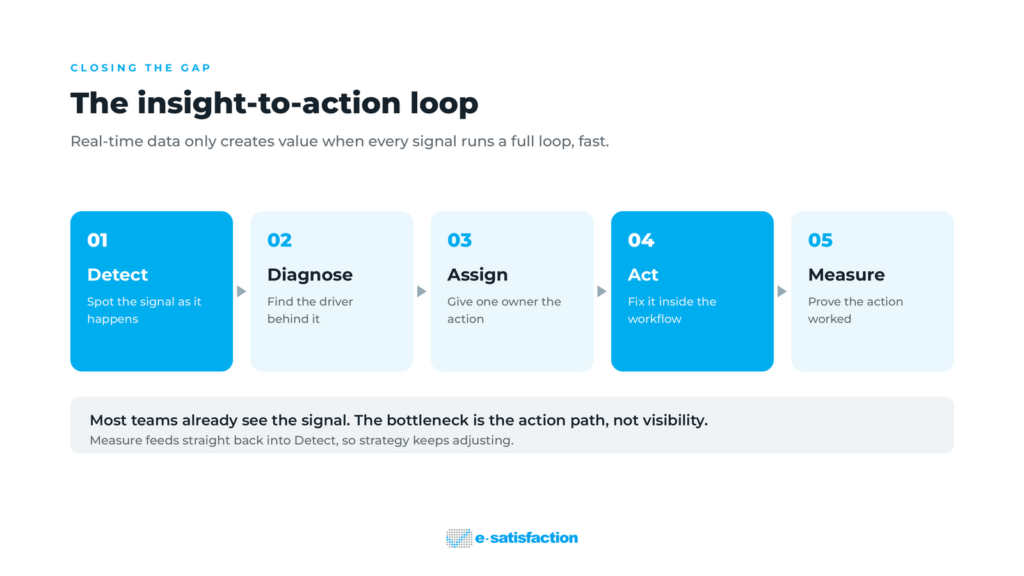
Here’s the uncomfortable truth: most teams already see the signal. As CX Today puts it, visibility is no longer the bottleneck. The gap sits downstream, in prioritization, ownership, and a clear path to act when the dashboard turns red.

The fix is a real loop: detect the signal, diagnose the driver, assign one owner, act inside the workflow, then measure whether the action worked. Feed that result back into detection and strategy keeps adjusting on its own.

AI carries the heavy parts of that loop. Gartner names real-time customer data insights and next-best-action recommendations among the most valuable AI use cases in service, because they help people act without hunting for answers first. Tools that surface emerging themes automatically do the diagnosis step, so an owner sees not just that something changed but why.

What real-time CX strategy looks like in practice

Running strategy as a loop reshapes the team, not just the reports. Insight stops living with a small analytics group and gets embedded where decisions happen, echoing McKinsey’s view of a data-driven enterprise where data informs every decision, interaction, and process.

In practice that means shorter cadences, clearer ownership, and fewer blind spots between “we noticed” and “we fixed it.” It shifts the whole posture from reactive to proactive, which sits at the center of most AI CX trends worth watching. Catch a rising frustration theme this week, act on it this week, and you protect customers before they churn instead of explaining the loss next quarter.

The takeaway

Real-time customer insights don’t just make CX faster. They change what strategy is. The plan stops being a document you revisit each quarter and becomes a loop you run every day.

Three things separate the brands getting this right. They treat feedback as a live input, not a report. They close the gap between insight and action with clear ownership. And they measure whether each action worked, then feed that back in. Do those three, and CX strategy stops chasing customers and starts moving with them.

Ready to run your CX strategy as a live loop instead of a quarterly review? Request a free demo and see real-time customer intelligence in action.


Frequently Asked Questions

What are real-time customer insights?

Real-time customer insights are findings pulled from customer signals the moment they happen, then delivered fast enough to shape a decision while it still matters. They draw on surveys, reviews, chats, calls, and behavior, read continuously instead of reviewed weeks later. The point is acting in time, not just seeing data sooner.

How is real-time customer intelligence different from a fast dashboard?

A fast dashboard refreshes charts quickly but can still surface information after the moment to act has passed. Real-time customer intelligence connects the signal to a person who can respond in time. As industry analysts note, insight only counts as real-time if teams can act before the moment passes.

Why is quarterly CX strategy no longer enough?

An insight loses value fast, so a signal reviewed a quarter later usually describes customers who have already moved on. McKinsey found only 37% of organizations make decisions that are both high quality and high velocity, and that both traits track with performance. A quarterly cadence is simply too slow for how quickly customer expectations shift.

What is the insight-to-action gap?

The insight-to-action gap is the delay between seeing a customer signal and doing something about it. For most teams visibility is no longer the problem; the bottleneck is prioritization, ownership, and a clear path to act. Closing it means running a loop: detect, diagnose, assign an owner, act, and measure the result.

Do I need AI for real-time customer insights?

For any real volume, yes. Customer feedback arrives faster than any team can read it, most of it as unstructured text and speech. AI reads every comment, scores sentiment, and groups themes as they land, so problems reach an owner while there’s still time to fix them.

5 Ways AI Turns Unstructured Customer Feedback Into Actionable Insights

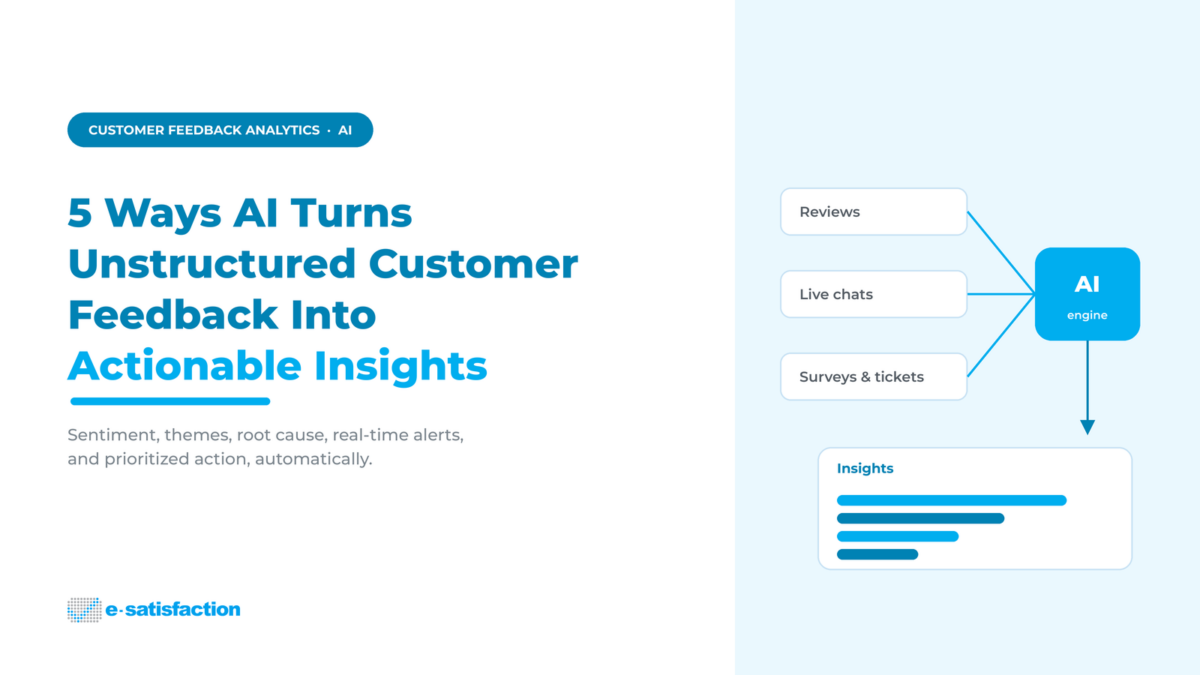
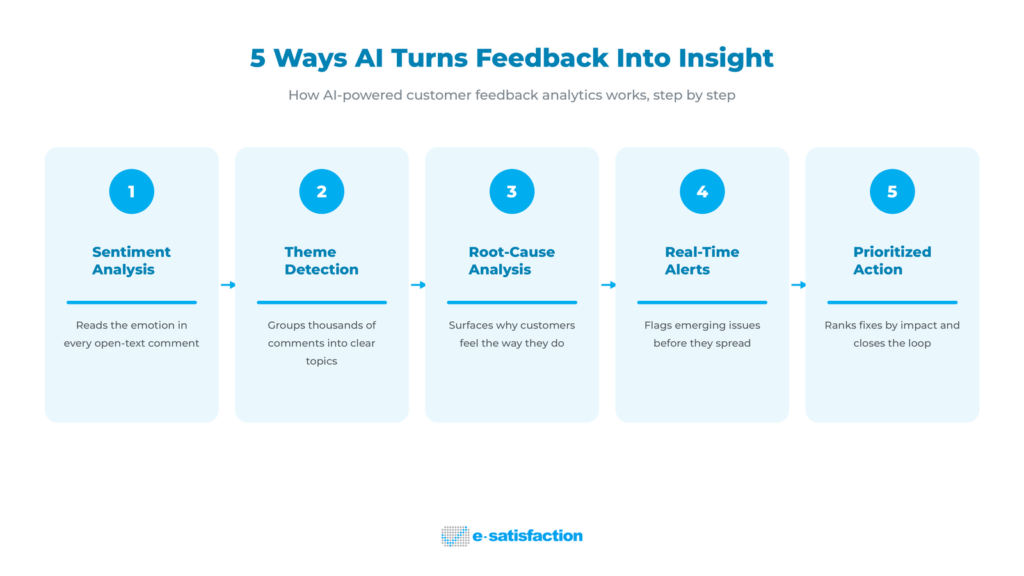
Most customer feedback is unstructured text, and most of it never gets read. AI customer feedback analytics changes that. It reads emotion, groups comments into themes, finds the root cause, flags issues in real time, and ranks the fixes that matter most. The result: faster decisions, fewer blind spots, and feedback that actually drives action.


Your customers are telling you exactly what they want. The problem is that customer feedback analytics powered by AI is now the only realistic way to hear them. Most of what they share lives in open text: reviews, chat logs, survey comments, support tickets, and social posts. That text holds your clearest signals about churn, loyalty, and growth.

But humans cannot read it all. A single store can collect thousands of comments a week. Tagging them by hand is slow, inconsistent, and biased toward whoever does the tagging.

So most teams skim a sample, guess at the rest, and move on. The real insight stays buried. This is why AI is becoming essential to customer experience: it reads everything, finds patterns people miss, and turns raw comments into decisions. Here are five ways it does that.

What Is AI-Powered Customer Feedback Analytics?

AI-powered customer feedback analytics uses natural language processing to read open-text feedback at scale. It detects sentiment, themes, intent, and emerging issues automatically, then turns thousands of unstructured comments into structured insight your team can act on without manual tagging.

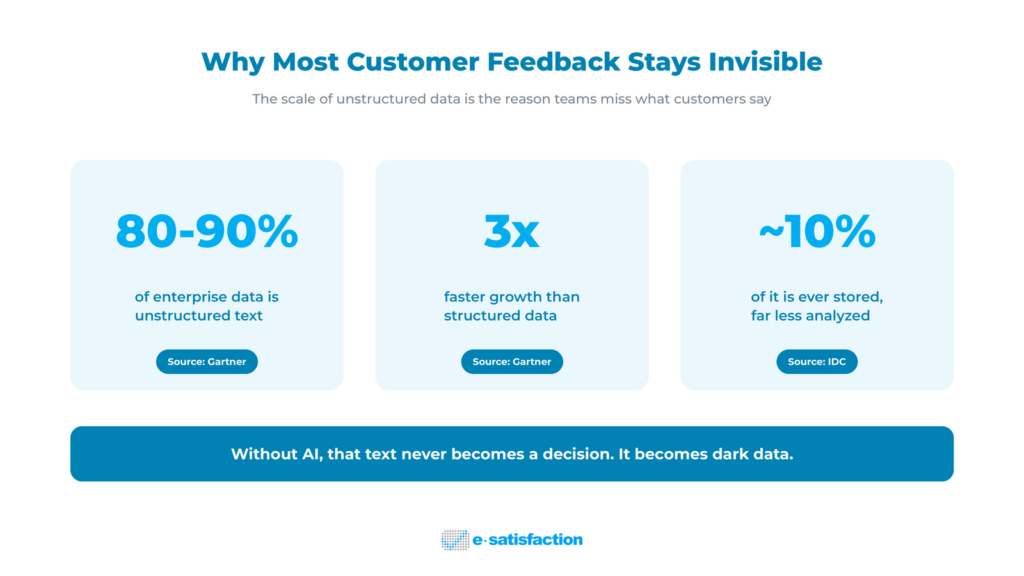
Statistics showing 80 to 90 percent of enterprise data is unstructured and most is never analyzed

The scale problem is bigger than most teams realize. Research shows that unstructured data makes up 80 to 90 percent of all new enterprise data and grows three times faster than structured data, yet only a small fraction is ever stored, let alone analyzed.

That gap is expensive. The feelings, complaints, and ideas inside open text are exactly what a strong Voice of Customer (VoC) program needs. AI closes the gap by reading the text humans never get to.

Five ways AI turns customer feedback into insights: sentiment, themes, root cause, real-time alerts, prioritized action

Way 1: AI Reads Emotion at Scale With Sentiment Analysis

Sentiment analysis uses AI to score the emotion in a comment as positive, negative, or neutral. Instead of a star rating alone, you learn how customers actually feel about delivery, checkout, or support, across every comment, in seconds.

A five-star review can still hide frustration. A three-star one can be loyal and constructive. AI sentiment analysis reads the words, not just the number, so you see the feeling behind the score.

It also tracks tone over time. If sentiment about returns drops sharply this month, you know before it shows up in your NPS. That early read is the first step from raw feedback to action.

Way 2: AI Groups Thousands of Comments Into Themes

Theme detection uses AI to cluster similar comments into clear topics automatically. Rather than skim 3,000 reviews, you see that 412 mention slow delivery, 280 mention sizing, and 95 mention a confusing checkout, ranked and ready to act on.

This is where scale becomes clarity. AI-powered topic detection reads every comment, finds recurring patterns, and labels them without a fixed list of tags. New issues surface on their own.

It works across channels too. Conversational analytics applies the same approach to chat and call transcripts, so a problem raised in support and a problem raised in a survey land in the same theme. You finally see one picture instead of fragments.

Way 3: AI Finds the Root Cause Behind the Feedback

Knowing what customers say is useful. Knowing why they say it is what drives change. AI goes past surface keywords to read intent and context. It tells the difference between “checkout was slow” because of a payment error and “checkout was slow” because of too many steps.

That precision matters. When AI taps the context inside unstructured text, early adopters report large drops in analysis errors compared with working from structured data alone.

So instead of a vague theme like “payment issues,” you get the real driver: a specific bug on one device, or a step customers do not understand. That is the difference between guessing and fixing.

If this sounds like the gap in your own reports, see how AI solves the problems traditional feedback methods cannot.

Way 4: AI Flags Emerging Issues in Real Time

Real-time analysis means AI scans incoming feedback as it arrives and alerts you the moment a new issue spikes. You hear about a broken promo code or a shipping delay within hours, not after the quarterly report, when the damage is already done.

This matters because most unhappy customers stay silent. Research from CX analyst Esteban Kolsky found that only about 1 in 26 unhappy customers actually complain, while the rest simply leave. Real-time signals help you act on the few who speak before the silent majority churns.

It also shifts your whole posture. AI moves teams from reactive problem-solving to proactive action, catching friction early so you can spot churn risk and step in before customers go quiet.

Way 5: AI Turns Customer Feedback Analytics Into Prioritized Action

The final way is the most important. AI does not just report. It ranks issues by how often they appear and how much they hurt, then routes each one to the right owner. Your team spends time fixing the problems that move revenue, not sorting a backlog.

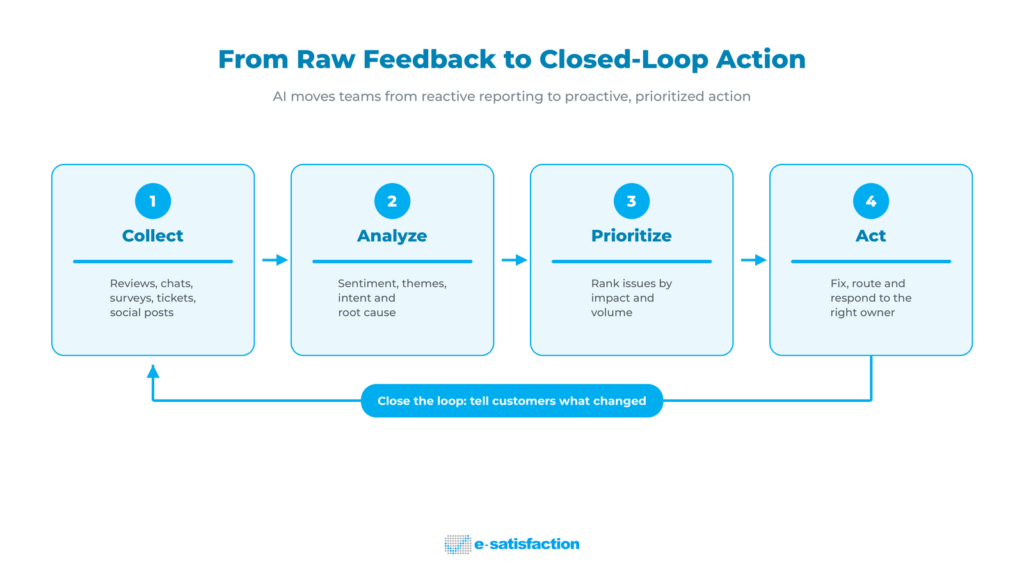
Closed-loop AI feedback analytics process from collect to analyze to prioritize to act

This closes the loop. Feedback comes in, AI analyzes and prioritizes it, the team acts, and customers hear what changed. That last step builds trust and brings the next round of feedback.

The payoff is real. McKinsey reports that personalization, done well, lifts revenue by 5 to 15 percent, and you cannot personalize what you have never read. Acting on feedback at scale is how that lift happens.

Turning Feedback Into Your Biggest Advantage

Unstructured feedback is not noise. It is your richest source of truth, and AI is what finally makes it readable. Three takeaways to hold onto:

First, the value is in the open text, not the score. Sentiment, themes, and intent live in the words. Second, speed wins. Real-time signals let you fix issues before silent customers leave. Third, insight only counts when it drives action, so prioritize and close the loop.

Customers already expect to be heard. McKinsey found that 71 percent of consumers expect personalized interactions and 76 percent get frustrated when that is missing. Reading their feedback with AI is how you meet that bar, and it is where customer experience is heading.

Ready to turn unstructured feedback into action your team can take this week? Book a free demo of e-satisfaction and see your own feedback analyzed live.


Frequently Asked Questions

What is AI customer feedback analytics?

AI customer feedback analytics uses natural language processing and machine learning to read open-text feedback at scale. It detects sentiment, themes, intent, and emerging issues automatically, turning unstructured comments from surveys, reviews, chats, and tickets into structured insight teams can act on without manual tagging.

How does AI analyze unstructured customer feedback?

AI reads each comment, scores its emotion, groups similar comments into themes, and identifies the intent or root cause behind them. It then ranks issues by frequency and impact. This works across channels, so feedback from chat, email, and surveys is analyzed in one consistent view.

Is AI feedback analysis more accurate than manual tagging?

AI applies the same logic to every comment, so it avoids the inconsistency and fatigue of manual tagging. It reads the full volume of feedback rather than a sample, which reduces blind spots. Humans still review edge cases and set strategy, but AI handles the scale and speed people cannot match.

Can AI detect customer issues before they cause churn?

Yes. AI scans feedback in real time and alerts teams when a new issue spikes, often within hours. Because most unhappy customers never complain directly, catching the few who do speak up early gives teams a chance to fix problems before the silent majority quietly leaves.

What types of feedback can AI analyze?

AI can analyze almost any text-based feedback, including survey open-ends, product reviews, support tickets, live chat and call transcripts, emails, and social media posts. Bringing these sources together lets teams see one unified picture of the customer experience instead of disconnected fragments.

How AI Improves Customer Retention and Reduces Churn

AI customer retention works by spotting at-risk customers before they leave. It reads feedback, support chats, and behavior to predict churn weeks in advance, then triggers the right outreach. The payoff is large: small retention gains compound into outsized profit. This guide explains how AI predicts churn, how to act on the signals, and the results brands can expect.


You already know AI can help you keep customers. The real question is how, and how much. AI customer retention is not a single tool. It is a loop that listens to every customer signal, predicts who is about to leave, and acts before they do.

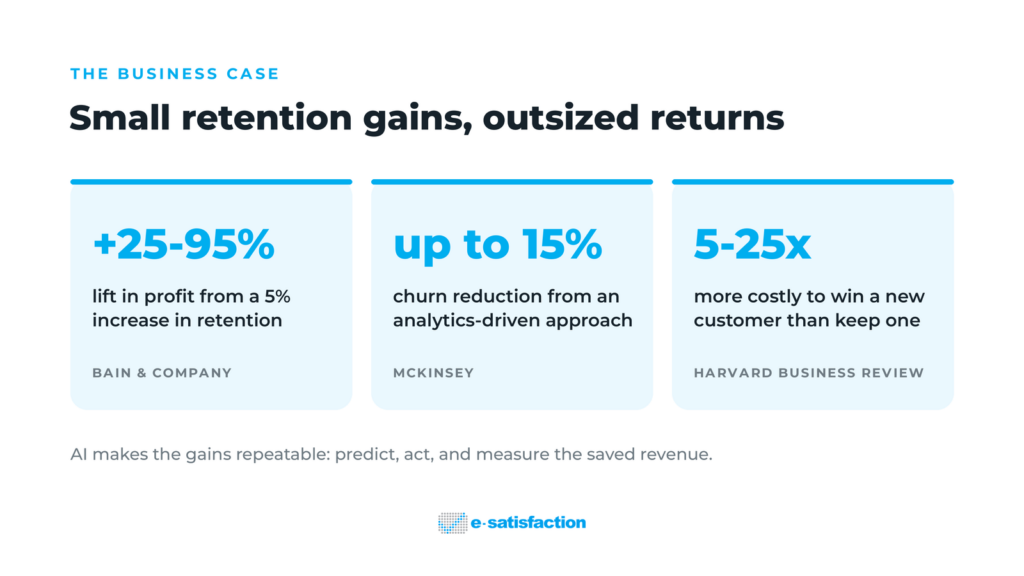
Most teams still work the other way around. They wait for a complaint, a cancellation, or a drop in revenue. By then the customer has already decided. The math makes this painful. According to Bain & Company, a 5% lift in retention can raise profits by 25% to 95%, and Harvard Business Review reports winning a new customer costs five to 25 times more than keeping one.

So the prize is clear. What changes with AI is timing. You stop reacting and start preventing. Here is how that works in practice.

What Is AI Customer Retention?

AI customer retention is the use of machine learning to predict which customers are likely to churn and to trigger timely, personalized action to keep them. It analyzes feedback, support conversations, and usage patterns in real time, then flags risk early enough for your team to respond.

Think of it as an always-on early warning system. Traditional retention relies on lagging signals like missed payments or support escalations. Those surface risk too late. AI reads leading signals instead: a dip in engagement, a frustrated tone in a chat, a survey score sliding down. It connects dots no human could track across thousands of accounts. This is the foundation of modern AI in customer experience, where prediction replaces guesswork.

Why Do Customers Churn Before You Notice?

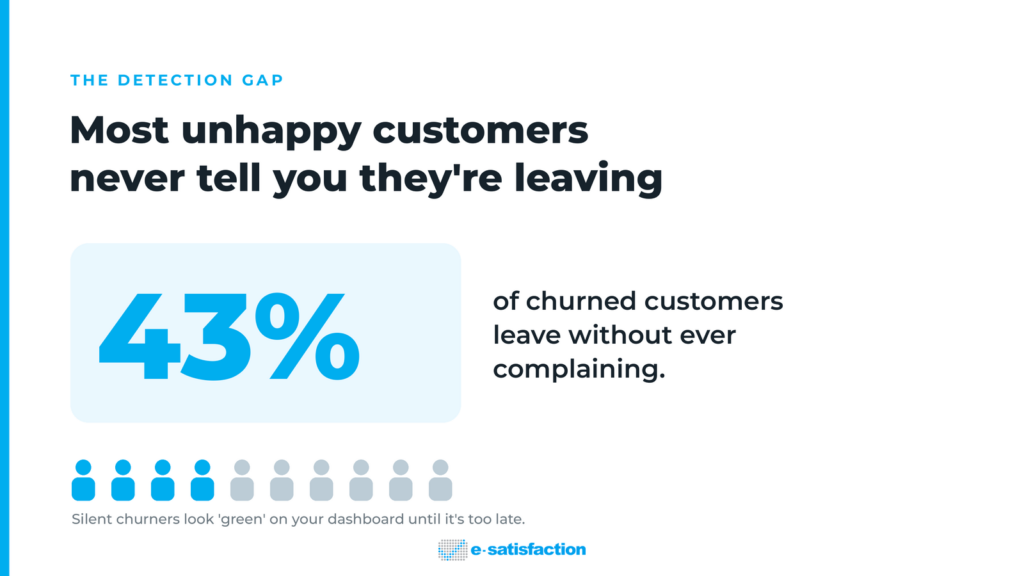
Most unhappy customers never complain. They quietly disengage, then leave for a competitor when the moment is right. Your dashboards stay green while loyalty erodes underneath. This silent churn is the single biggest blind spot in retention.

Silent churn statistic: most unhappy customers leave without ever complaining

Gartner’s guidance on churn prevention stresses the same point: spot issues before they become problems, because a complaint is already a late signal. The customers who say nothing are often your highest risk. They simply weigh the effort of switching against the value they feel, and decide.

AI closes this gap by listening where customers actually express themselves. AI sentiment analysis reads emotion in open-text feedback and reviews. Conversational analytics surfaces frustration buried in support chats. Together they catch the quiet signals long before a cancellation.

How Does AI Predict Customer Churn Before It Happens?

AI predicts churn by scoring each customer on their likelihood to leave, often 30 to 90 days ahead. It learns from past churners, weighs hundreds of behavioral and feedback signals, and updates the score as new data arrives. High-risk customers get flagged for action automatically.

McKinsey describes this as a layered model approach: propensity models score the chance a customer churns, channel models pick the best way to reach them, and value models weigh the revenue at stake. A customer flagged as high risk can be pulled from promotions and moved into a tailored retention journey instead.

The fuel for these models is unified data. A strong AI Voice of Customer program feeds the model real-time signals from surveys, behavior, and conversations, so predictions stay sharp.

Turning Early Warnings Into Retention Action

A prediction only matters if it triggers action. This is where many programs stall. They build accurate churn scores, then leave them sitting in a dashboard while the customer drifts away. The model is the easy part. Closing the loop is the work.

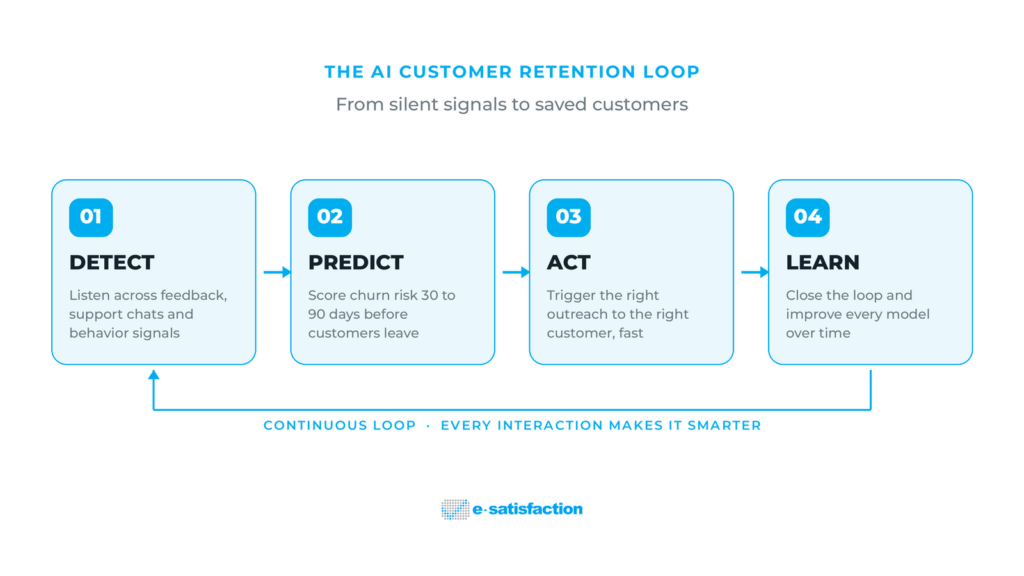
AI customer retention loop: detect, predict, act, and learn diagram

The strongest retention engines run a continuous loop. Detect the signal. Predict the risk. Act with the right outreach. Learn from the outcome. Each cycle makes the next prediction smarter. The action itself should fit the customer: a proactive check-in for a confused user, a value reminder for a quiet one, a fast fix for a frustrated one.

This is where AI-powered CX solutions turn insight into outcomes. They route the right play to the right customer, automatically, so your team spends time on saves instead of spreadsheets. If you are tired of finding out about churn after it happens, see how brands catch at-risk customers in time.

How Much Can AI Customer Retention Reduce Churn?

The gains are real and measurable. McKinsey reports that an analytics-driven approach can cut churn by as much as 15%. Paired with Bain’s profit math, even a single-digit retention improvement can move your bottom line in a big way.

How AI customer retention cuts churn and boosts profit, with data from Bain, McKinsey, and HBR

The results show up beyond churn, too. CMSwire reports that brands using predictive AI in customer experience are seeing tangible gains in satisfaction and efficiency. The pattern is consistent: predict early, act fast, and the saved revenue compounds.

The key is to measure it. Set your baseline retention, churn, and lifetime value first. Then you can prove what AI saves, not just assume it.

Building an AI Customer Retention Engine That Lasts

You do not need to boil the ocean. Start with your highest-value segment, where a single save pays for the effort. Get clean data flowing from feedback, support, and behavior. Build one churn score. Wire it to one clear action. Then expand.

The brands that win treat retention as a system, not a campaign. They turn customer feedback analytics into standing alerts, assign owners to at-risk accounts, and review what worked every cycle. The loop tightens over time.

This is also where the field is heading. As you plan ahead, it helps to track the future of customer experience and the latest AI and CX trends, so your retention engine keeps pace with how customers expect to be heard.

Conclusion

AI customer retention shifts your team from reacting to predicting. It catches the silent signals, scores risk early, and turns each save into a repeatable play. The economics are hard to ignore: small retention gains compound into outsized profit, and acting early costs far less than winning a lost customer back.

The starting point is not more software. It is unified customer signals and one clear loop: detect, predict, act, learn. Build that, measure the saved revenue, and expand from there.

Ready to stop finding out about churn after it happens? Book a demo and see how e-satisfaction predicts at-risk customers in time to keep them.


Frequently Asked Questions

What is AI customer retention?

AI customer retention is the use of machine learning to predict which customers are likely to leave and to trigger timely, personalized action to keep them. It analyzes feedback, support conversations, and behavior in real time, flagging risk early enough for your team to respond before a customer churns.

How does AI predict customer churn?

AI scores each customer on their likelihood to churn, often 30 to 90 days ahead. It learns from past churners and weighs hundreds of signals, from declining usage to negative sentiment. As McKinsey notes, propensity models estimate churn risk while channel and value models decide how and where to act.

How much can AI reduce churn?

Results vary by industry and starting point, but McKinsey reports that an analytics-driven approach can cut churn by as much as 15%. Because Bain & Company found a 5% retention lift can raise profits by 25% to 95%, even modest churn reductions deliver outsized returns.

Why do most customers churn without complaining?

Most unhappy customers never raise a ticket. They quietly disengage and leave when a better option appears, so dashboards look healthy until revenue drops. AI catches this silent churn by reading sentiment in feedback and conversations, surfacing risk that traditional metrics miss.

What data does AI need to predict churn?

AI churn models work best on unified, real-time data: survey and feedback scores, support and chat conversations, product or purchase behavior, and account history. The cleaner and more connected the data, the earlier and more accurate the churn prediction.

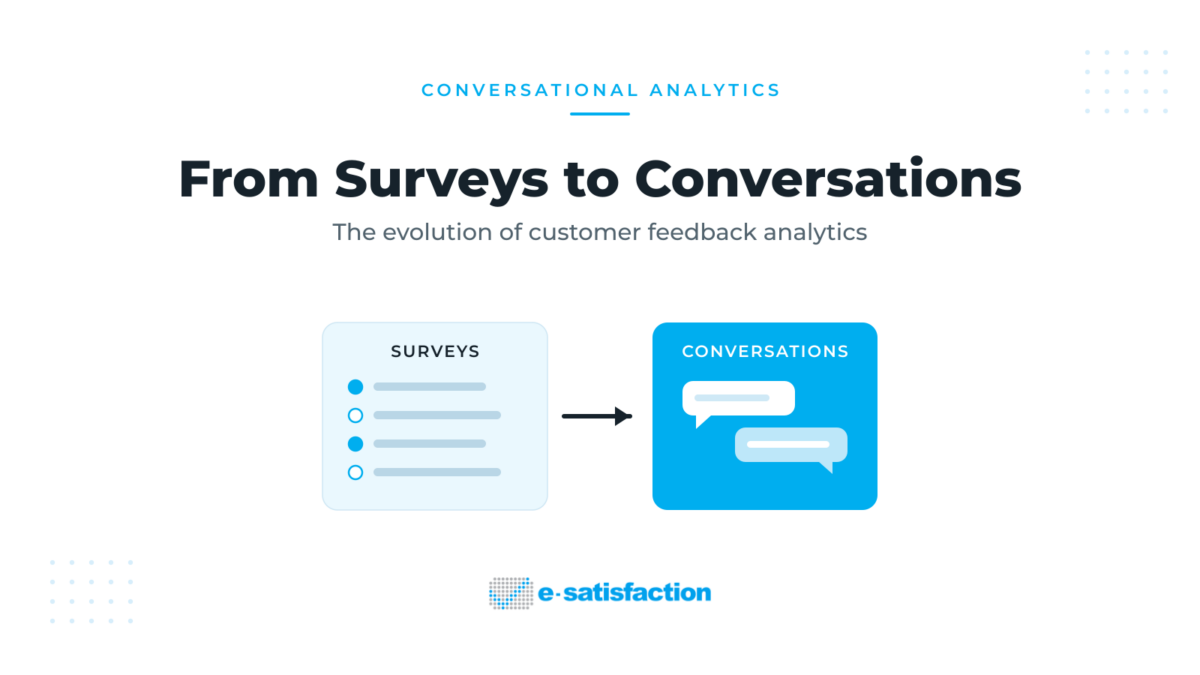
From Surveys to Conversations: The Rise of Conversational Analytics in Customer Feedback

Customer feedback used to mean surveys. Today, most of what customers tell you happens in chats, reviews, and calls. Conversational analytics reads that unstructured talk at scale and surfaces the themes, sentiment, and intent a score can never show. It doesn’t replace surveys; it completes the picture. Here is how feedback analytics evolved, how the technology works, and what to do with it.


Your customers are still talking. They have just stopped filling out your surveys. Response rates keep sliding, and the feedback that does arrive is often shallow or skewed. Conversational analytics flips the model. Instead of asking customers to rate you, it listens to what they already say across chats, reviews, calls, and open text.

This guide traces how customer feedback analytics moved from surveys to conversations. We will cover why the shift matters, how the technology works, and how to act on what it finds. The goal is simple: hear the whole voice of your customer, not just the slice that fills in a form.

What Is Conversational Analytics?

Conversational analytics is the use of AI to read unstructured customer interactions (chats, calls, reviews, emails, and open-ended survey replies) and turn them into clear insight. It detects the themes, emotions, and intent inside real conversations, not just the rating a customer leaves behind.

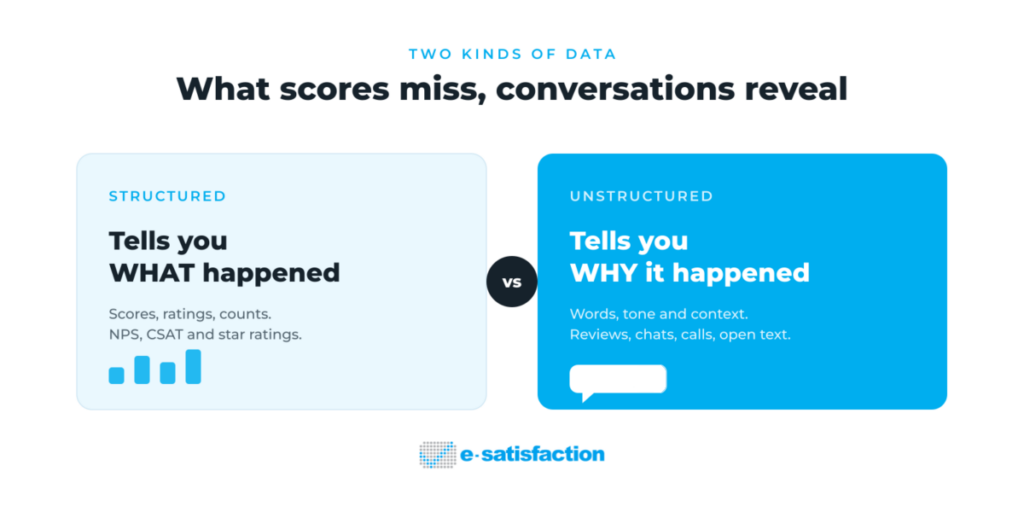
Traditional dashboards track structured data: scores, counts, and timestamps. They tell you what happened. Conversational analytics works on the words themselves, so it tells you why it happened. A 7 out of 10 is a number. The sentence next to it (“checkout was confusing and slow”) is the reason. Conversational analytics reads the reason at scale.

Why Are Traditional Surveys Falling Short?

Surveys still have value, but fewer people answer them. Survey fatigue, the exhaustion customers feel from constant feedback requests, has pushed response rates down across industries. The result is a small, often skewed sample that misses what most customers actually feel.

When customers go quiet, it rarely means they are happy. As one industry analysis put it, many customers have simply given up on surveys, and silence often signals churn rather than satisfaction. Meanwhile, real opinions pile up in support chats, product reviews, and call transcripts. To see the full picture, you need customer feedback analytics that works on those sources, not only the survey form.

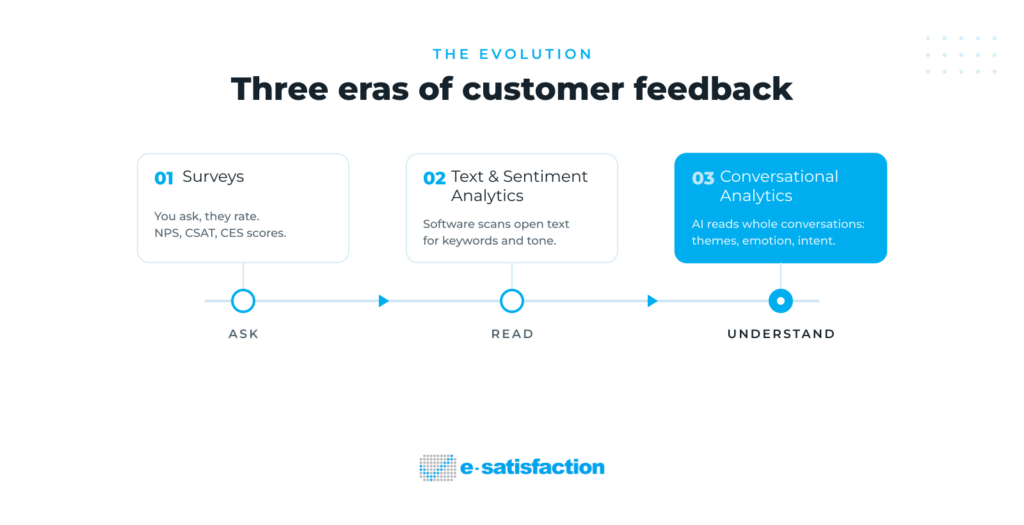
How Did Customer Feedback Analytics Evolve From Surveys to Conversations?

The path runs through three eras.

Era one was surveys. Brands asked structured questions and tracked NPS, CSAT, and CES. Useful, but you only learn what you think to ask, and only from people who reply.

Era two was text and sentiment analytics. Software scanned open-text comments for keywords and tagged them positive or negative. A real step forward, but still shallow. A single label flattens a comment that is happy about delivery and angry about price.

Era three is conversational analytics. AI now reads whole conversations and holds context, emotion, and intent together.

The push behind this shift is volume. Up to 80% of enterprise data is unstructured and mostly goes unused, locked inside messages, transcripts, and notes. Modern AI sentiment analysis reads tone and emotion in context, so that buried feedback finally becomes usable.

How Does Conversational Analytics Work?

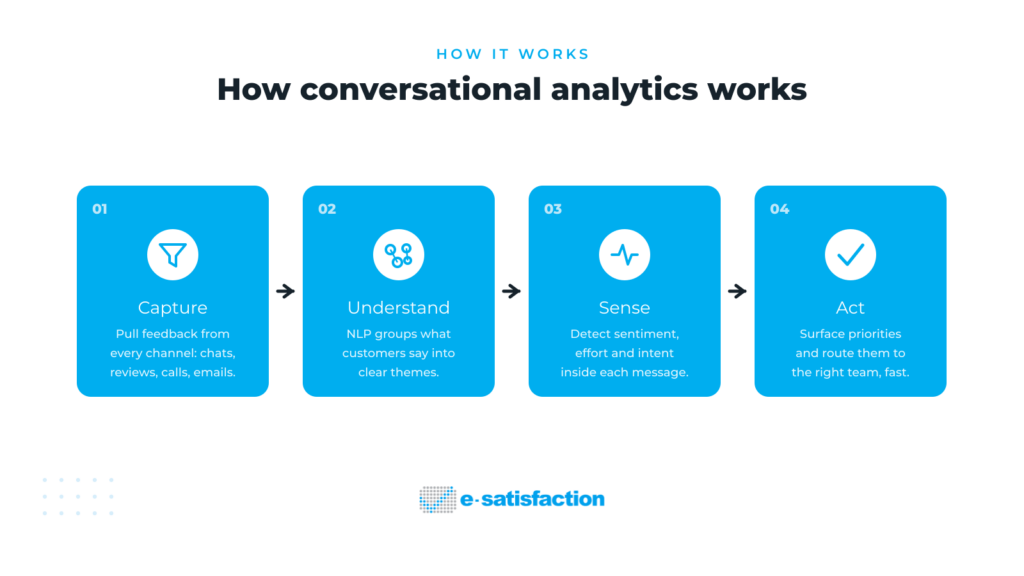
Conversational analytics works in four steps: capture feedback from every channel, use natural language processing (NLP, software that reads human language) to group it into themes, detect sentiment and intent, then route the priorities to the right team.

The capture stage matters most. A modern AI Voice of Customer program pulls from reviews, chats, calls, and open text in one place. NLP then clusters thousands of messages into a handful of clear themes. Sentiment scoring adds the emotional layer, and intent detection flags what the customer wants to do next, such as cancel, complain, or buy again.

Drowning in feedback you cannot read? See how leading retail and e-commerce brands turn scattered conversations into clear, ranked action: explore the approach.

What Can Brands Actually Do With It?

The value shows up in three moves.

First, catch churn early. Rising frustration and effort signals appear in conversations long before they show up in a score.

Second, prioritize by impact. Instead of reacting to the loudest complaint, you see which themes affect the most customers and revenue.

Third, act in real time. Insight reaches the right team while the issue is still fixable.

This is why listening pays off. Data-driven organizations are far more likely to acquire and retain customers, according to McKinsey research, and conversations are the richest data most brands already own. Feed those signals into your wider AI in customer experience strategy and feedback stops being a report. It becomes a daily input to decisions.

Is Conversational Analytics Replacing Surveys?

No. Conversational analytics complements surveys; it does not replace them. Structured scores tell you when something changed. Conversations tell you why. The strongest programs use both.

The balance matters. Forrester advises pairing AI-driven insight with proven human methods rather than handing customer research entirely to automation. Other CX predictions for 2026 warn against over-automating before the foundations are ready. Keep a short, well-timed survey for benchmarks. Use conversational analytics to explain the numbers and to hear everyone who never answers.

The Takeaway

Three points are worth keeping.

Feedback has moved from forms to free-flowing conversation, and your analytics needs to follow. Conversational analytics reads the unstructured talk you already collect and turns it into themes, sentiment, and intent. It works best beside surveys, not instead of them.

The brands that win will not be the ones with the most survey responses. They will be the ones that hear the whole conversation and act on it fast. Ready to turn scattered customer conversations into clear, ranked action? Book a demo and see your own feedback through purpose-built AI customer experience solutions.


Frequently Asked Questions

What is the difference between conversational analytics and sentiment analysis?

Sentiment analysis labels text as positive, negative, or neutral. Conversational analytics is broader. It reads full interactions to surface themes, intent, effort, and emotion together, then connects them to outcomes like churn or repeat purchase. Sentiment is one layer inside conversational analytics.

Does conversational analytics replace customer surveys?

No. It complements them. Surveys give you structured, comparable scores over time. Conversational analytics explains the reasons behind those scores and captures feedback from the majority of customers who never complete a survey. Used together, they give a fuller view.

What data does conversational analytics use?

It works on unstructured feedback: support chats, call transcripts, product reviews, emails, social messages, and open-ended survey comments. Anywhere customers use their own words, conversational analytics can read and organize what they say.

Is conversational analytics only for contact centers?

No. Contact centers were an early use case, but the same approach applies to e-commerce reviews, post-purchase feedback, app messages, and more. Any team that collects customer text or voice can use it, from CX and product to marketing.

How accurate is AI at analyzing customer conversations?

Modern NLP reads context and tone far better than older keyword tools, though accuracy varies by language, industry, and setup. The reliable approach is to pair AI analysis with human review for sensitive or high-stakes decisions, rather than trusting automation alone.