

Why AI in Customer Experience Is No Longer Optional
AI in customer experience has shifted from a nice-to-have to a baseline expectation. Customers now demand fast, personal, consistent service across every channel. AI helps brands listen at scale, predict churn, and act on feedback in real time. The brands that wait risk losing customers who quietly leave for someone faster.
Customer expectations have outgrown what manual teams can deliver. People want answers in seconds, service that remembers them, and offers that fit their needs. AI in customer experience is how modern brands meet that bar without burning out their teams. It is no longer a futuristic add-on. It is becoming the engine behind everyday CX.
The pressure is real.McKinsey research found 71% of consumers expect personalized interactions, and 76% get frustrated when they don’t get them. Surveys alone can’t keep up with that demand. They reach a fraction of customers and arrive too late to fix anything. This is the gap AI fills. Below, we break down what AI in CX really means, why expectations are forcing the change, and where it pays off.
What Does AI in Customer Experience Actually Mean?
AI in customer experience means using machine learning to listen, understand, predict, and respond to customers at scale. It reads every piece of feedback, spots patterns humans miss, flags at-risk customers, and powers personal interactions across channels. It works alongside teams, not instead of them.
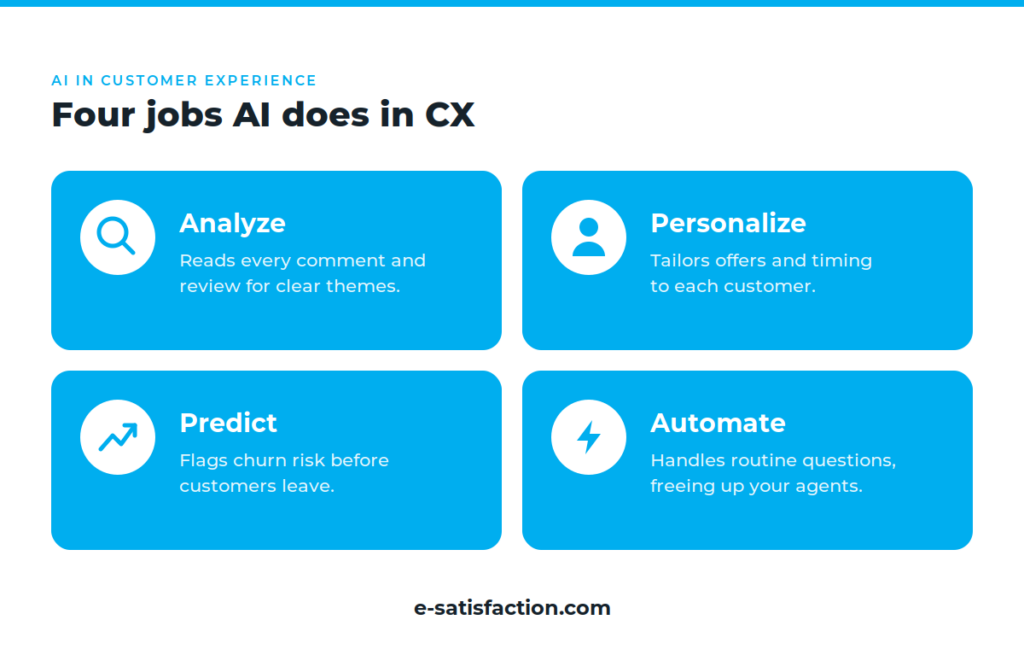
In practice, AI in CX shows up in four ways. It analyzes feedback and reviews to find themes. It personalizes recommendations and messages. It predicts behavior like churn or repeat purchase. And it automates routine support so people can focus on harder problems. Most brands start with one and expand. A solid Voice of Customer framework ties these pieces together so insights flow into action instead of sitting in a dashboard.
Why Are Customer Expectations Forcing the Shift?
Customers now compare every brand to the best digital experience they’ve ever had. They expect speed, memory, and relevance by default. When a brand can’t deliver, they leave quietly and rarely explain why. AI helps brands meet that standard at a scale humans cannot match alone.
The data backs this up. Personalization is no longer a perk. McKinsey found that strong personalization can lift revenue by 5% to 15% and cut acquisition costs by as much as 50%. Doing that across thousands of customers by hand is impossible. AI makes it routine. It tailors content, timing, and offers based on real behavior, then learns and improves with each interaction.
How Does AI Turn Customer Feedback Into Action?
AI turns feedback into action by reading 100% of comments, reviews, and survey responses, then grouping them into clear themes with a sentiment score. Instead of skimming a sample, teams see the full picture in minutes and know exactly which issues hurt loyalty most.
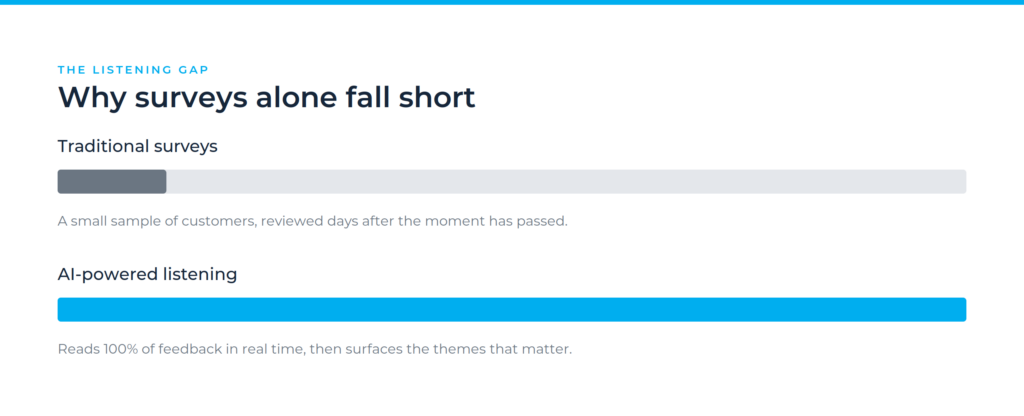
This is the biggest leap over old methods. Traditional surveys capture a small slice of customers and miss the “why” behind the score. AI reads open-text feedback, detects emotion, and surfaces the root cause. A negative trend in checkout, a recurring delivery complaint, a product flaw: all of it becomes visible fast. The point is not the analysis itself but what follows. The strongest programs turn feedback into action by routing each insight to the team that can fix it and closing the loop with the customer.
If this sounds familiar, you don’t have to start from scratch. See how brands have already done this by turning unhappy customers into a clear action plan.
Can AI Predict Churn Before Customers Leave?
Yes. AI predicts churn by spotting early warning signals in behavior and feedback, such as falling engagement, rising complaints, or souring sentiment. It flags at-risk customers while there is still time to act, so teams can intervene before the customer is gone.
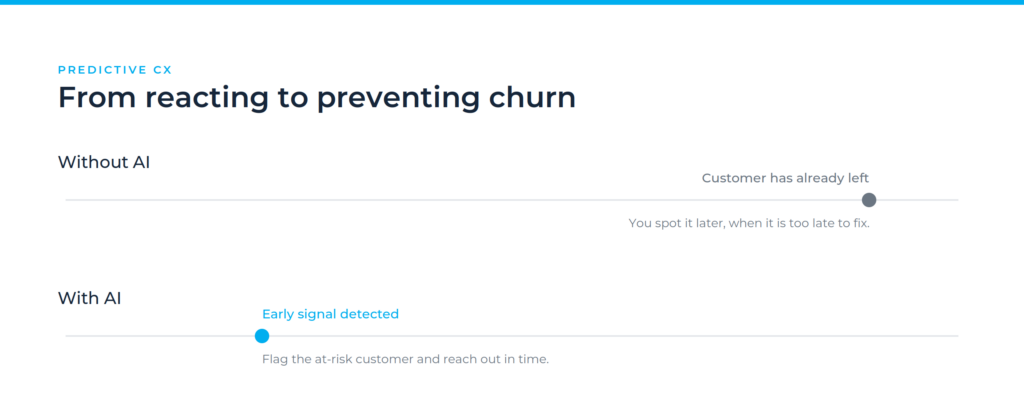
Most churn happens silently. Unhappy customers rarely complain; they just stop coming back. AI changes the timeline by watching the signals that come before a customer leaves. When the model flags risk, the right team can reach out with a fix or an offer. This is the shift from reacting to problems to preventing them. Pairing predictive models with how real-time feedback works lets brands catch issues at the exact moment they form.
The Personalization and Automation Payoff
The return on AI in CX is both financial and operational. On the customer side, faster answers and relevant offers raise satisfaction and loyalty. On the team side, automation handles routine questions so agents can spend time where empathy and judgment matter.
The market is moving fast. A 2026 industry report found that 78% of organizations expect AI agents to handle at least half of customer support interactions within 18 months, and most report measurable gains in retention. Analysts also see AI moving from automation toward anticipation, where systems act before a customer even asks. The goal is not to remove people. It is to free them for the moments that build real relationships. A connected customer experience platform keeps the human and the automated working from the same data.
Where AI in CX Goes Wrong
AI is not a magic fix. It fails when data sits in silos, when automation replaces human care in sensitive moments, or when personalization crosses into feeling intrusive. The brands that win treat AI as a tool for better human decisions, not a way to remove humans.
Trust is the line to watch. Research shows customers are comfortable with AI for routine tasks but far more cautious with sensitive or high-stakes decisions. Push too far and you erode the loyalty you were trying to build. Clean, unified data and clear handoffs to people keep AI helpful instead of harmful. The strategy matters more than the algorithm.
The Bottom Line
AI in customer experience has crossed from optional to essential. Three things are clear. Customers expect personal, fast, consistent service, and they leave quietly when they don’t get it. AI lets brands listen to everyone, predict problems, and act in real time. And the technology only works when it supports human judgment, not replaces it.
The brands pulling ahead are not waiting for AI to be perfect. They are using it now to understand customers better and fix issues faster. The cost of standing still is customers you never hear from again.
Ready to stop guessing and start acting on real customer feedback? Request a demo and see how it works for your brand.
Frequently Asked Questions
What is AI in customer experience?
AI in customer experience is the use of machine learning to listen to, understand, predict, and respond to customers at scale. It analyzes feedback, personalizes interactions, predicts behavior like churn, and automates routine support so teams can focus on complex needs.
Why is AI becoming essential for CX?
Customer expectations now outpace what manual teams can deliver. People want fast, personal, consistent service across every channel. McKinsey found 71% of consumers expect personalized interactions and 76% get frustrated without them. AI is the only practical way to meet that demand at scale.
Can AI really reduce customer churn?
Yes. AI detects early signals of churn, such as falling engagement or negative sentiment, often before a customer complains or leaves. This lets teams step in with a fix or offer while there is still time, shifting the focus from reacting to preventing.
Does AI replace human customer service teams?
No. AI handles routine, repetitive tasks and surfaces insights, but human judgment and empathy still matter most in sensitive moments. The strongest CX programs use AI to support people, not to replace them.
What is the risk of using AI in customer experience?
The main risks are siloed data, over-automation in sensitive situations, and personalization that feels intrusive. Customers trust AI for routine tasks but stay cautious with high-stakes decisions. Unified data and clear handoffs to humans keep AI helpful.