

AI CX Trends for 2026: What Enterprise Leaders Need to Know
The AI CX trends defining 2026 are about execution, not experiments. Agentic AI moves into production, service shifts from reacting to anticipating, and AI reads every piece of customer feedback. Self-service gets smarter, but rushing it erodes trust. The winners treat AI as an operating layer with strong data and clear human oversight.
The AI CX trends worth your attention in 2026 are not the flashy demos. They are the quiet operating decisions that decide who keeps customers and who loses them. AI has already moved from a pilot project to the backbone of how brands listen, predict, and respond. The pressure to act is now intense. A recent Gartner survey found that 91% of customer service leaders feel pressure to implement AI in 2026.
So the question has changed. It is no longer whether to use AI. It is where to use it, how fast, and how to keep customer trust while you do. This guide breaks down the trends that matter most, the data behind them, and the moves enterprise leaders should make now.
What Are the Biggest AI CX Trends for 2026?
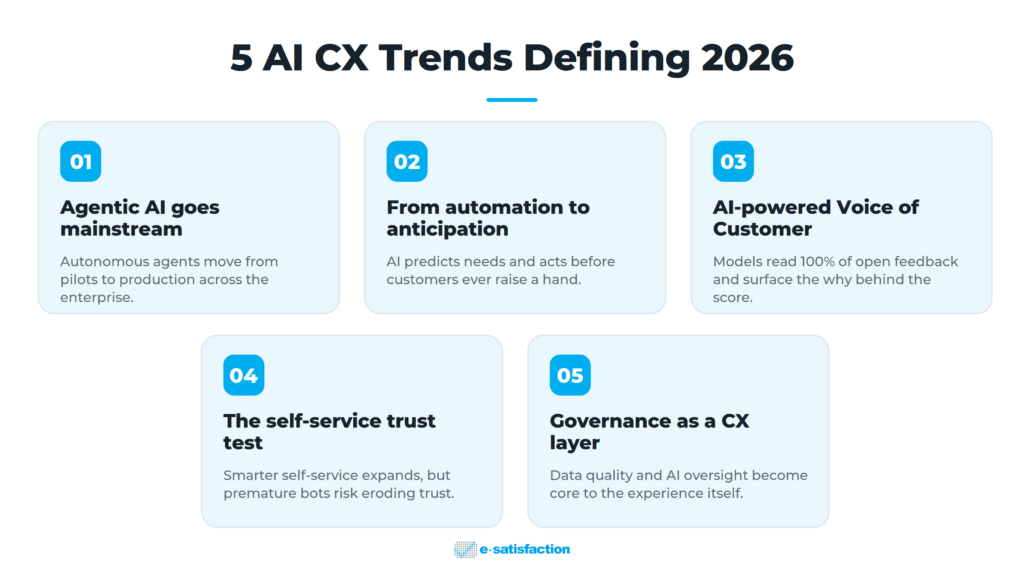
The biggest AI CX trends for 2026 are agentic AI moving into production, a shift from reactive to proactive service, AI reading 100% of customer feedback, smarter but riskier self-service, and governance becoming part of the experience itself. Together they mark AI’s move from a tool to an operating layer.
These shifts are connected. Agentic systems need clean data to act safely. Proactive service needs feedback analysis to know what to predict. And every gain depends on trust. Treating these as one strategy, not five separate projects, is what separates leaders from laggards. The role of AI in customer experience is no longer optional; it is the engine behind everyday CX.
Why Is Agentic AI the Defining CX Trend for 2026?
Agentic AI is the defining trend because it acts, not just answers. Unlike chatbots that reply with text, AI agents complete tasks end to end: resolving requests, updating records, and taking next steps on their own. In 2026 these systems move from pilots into real production across the enterprise.
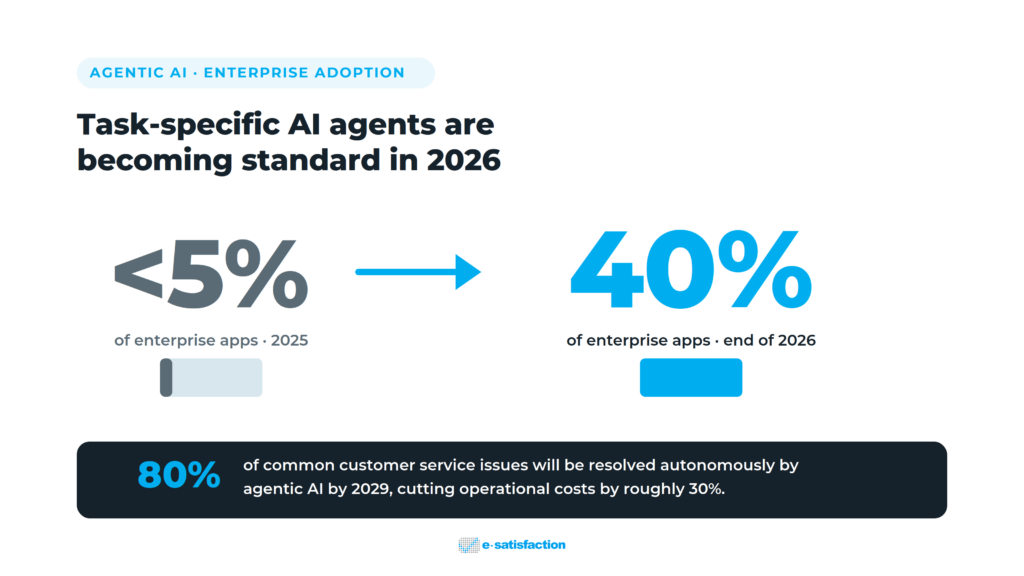
The scale of the shift is striking. Gartner predicts that 40% of enterprise apps will include task-specific AI agents by the end of 2026, up from less than 5% in 2025. The longer arc is bigger still. Gartner also forecasts that agentic AI will autonomously resolve 80% of common customer service issues by 2029, cutting operational costs by about 30%.
This is not about removing people. It is about freeing them for the moments that need judgment and empathy. The right AI customer experience solutions keep humans and agents working from the same data, so handoffs feel seamless to the customer.
How Is AI Changing Voice of Customer and Feedback Analysis?
AI is changing Voice of Customer by reading every comment, review, and survey, then grouping them into clear themes with a sentiment score. Instead of skimming a sample, teams see the full picture in minutes. They know which issues hurt loyalty most and why, not just that a score dropped.
This is the leap over old methods. Surveys reach a fraction of customers and miss the reason behind the number. Modern AI-powered Voice of Customer reads open-text feedback, detects emotion, and surfaces the root cause. Pairing customer feedback analytics with AI sentiment analysis turns scattered signals into a ranked action list. And conversational analytics extends that listening into chats and calls, where customers say what they really mean.
From Automation to Anticipation
The clearest direction of travel is from reacting to anticipating. Analysts describe CX moving from automation toward anticipation, where systems act before a customer even asks. A delayed order triggers a heads-up. A frustrated tone routes the case to a human. A churn signal sparks an offer while there is still time.
The payoff is both financial and human. McKinsey reports that strong personalization can lift revenue by 5% to 15%, and that 71% of consumers now expect tailored interactions. Doing that by hand across thousands of customers is impossible. AI makes it routine and improves with each interaction.
If this sounds like where you want to be, see how brands act on real customer feedback instead of guessing.
Will AI Self-Service Help or Hurt CX in 2026?
It will do both, depending on discipline. Forrester predicts that one in four brands will see a 10% or greater rise in successful simple self-service by the end of 2026, driven by more trusted AI. That is real upside for routine, low-stakes requests.
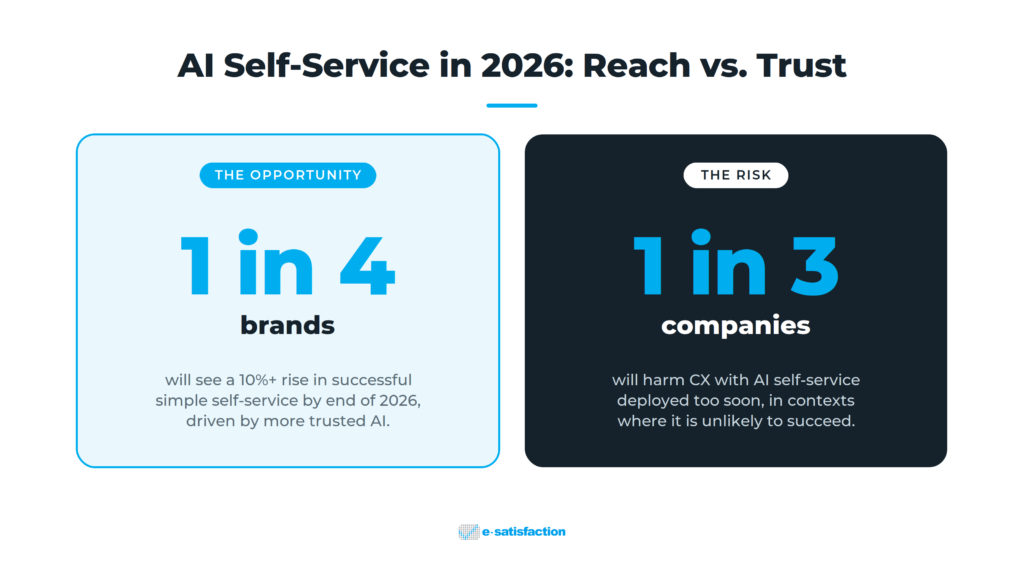
The risk is just as real. Forrester also warns that a third of companies will harm experiences with frustrating AI self-service by deploying it too soon, in contexts where it is unlikely to succeed. The lesson is simple. Automate the simple and repetitive. Route the complex and emotional to a person, fast. Overautomation does not save money; it costs you customers.
How Enterprise Leaders Can Turn AI CX Trends Into Action
Knowing the AI CX trends is the easy part. Acting on them is where most programs stall. Four moves separate the leaders.
First, fix the data foundation before scaling agents. AI acts only as well as the data it reads. Second, start with high-value, well-defined use cases where the ROI is clear, then expand. Third, build governance in from day one, since analysts now treat AI oversight as a compliance layer, not an afterthought. Fourth, keep clear handoffs to people for sensitive moments.
The broader future of customer experience rewards brands that pair speed with trust. The economic mood matters too. CX Dive notes that customers in 2026 are shopping with a recessionary mindset and reward brands that prove value. AI that anticipates needs and respects trust is how you do that at scale.
The Bottom Line
Three things are clear for 2026. Agentic AI is moving from demos to daily operations, so brands preparing now will pull ahead. AI is reading all of your feedback, and the advantage goes to teams that act fastest. And trust is the limit, since premature automation erodes the loyalty you are building.
The leaders are not waiting for AI to be perfect. They use it to listen better, predict sooner, and act faster, with people in the loop where it counts.
Ready to stop guessing and start acting on real customer feedback? Request a demo and see how it works for your brand.
Frequently Asked Questions
What are the top AI CX trends for 2026?
The top AI CX trends for 2026 are agentic AI moving into production, a shift from reactive to proactive service, AI-powered analysis of all customer feedback, smarter self-service, and governance becoming part of the experience. They reflect AI’s move from a single tool to a core operating layer for CX.
What is agentic AI in customer experience?
Agentic AI is software that acts on its own to complete tasks, not just reply with text. In CX it can resolve a request, update systems, and take the next step without a human. Gartner expects agentic AI to autonomously resolve 80% of common service issues by 2029.
Will AI replace customer service teams in 2026?
No. In 2026 AI handles routine, high-volume tasks so people can focus on complex and emotional moments. Forrester warns that automating sensitive issues too soon frustrates customers. The strongest results come from clear handoffs between AI and human agents.
How does AI improve Voice of Customer programs?
AI reads 100% of feedback across surveys, reviews, chats, and calls, then groups it into themes with sentiment scores. This shows the root cause behind a score, not just the number. Teams see which issues hurt loyalty most and can route each insight to the team that can fix it.
What should enterprise leaders prioritize with AI in CX?
Leaders should fix their data foundation first, start with high-value use cases that have clear ROI, build governance in from the start, and keep human handoffs for sensitive moments. McKinsey research shows strong personalization can lift revenue while reducing acquisition costs when done well.