

7 Customer Experience Problems AI Solves Better Than Traditional Methods
AI customer experience solutions now beat traditional methods on the work that slows teams down: instant replies, reading every piece of feedback, personalizing at scale, predicting churn, keeping quality consistent, cutting time-to-insight, and clearing routine tickets. Humans still win on complex, emotional moments. This post breaks down all seven, with the data behind each one.
Most unhappy customers never tell you. They just leave. Around 74% have stopped doing business with a brand after one frustrating experience. Traditional CX methods, like manual surveys, sampled reviews, and business-hours support, rarely catch the problem before it costs you the customer.
AI customer experience solutions close that gap. They handle the speed, scale, and pattern-spotting that human teams can’t manage alone. They don’t replace your people. They remove the grunt work so your people can focus on what matters.
Adoption has already crossed the line: 88% of contact centers now use some form of AI. The question isn’t whether to use it. It’s knowing where AI actually beats the old way, and where it doesn’t.
Here are seven customer experience problems AI solves better than traditional methods, with the data behind each. A modern customer experience platform ties them together.
How do AI customer experience solutions cut response times?
AI answers instantly, around the clock, with no queue. Traditional support runs on business hours and waiting lines. That single shift moves first response from hours to minutes and resolves routine issues in seconds, which is often the difference between a kept customer and a lost one.
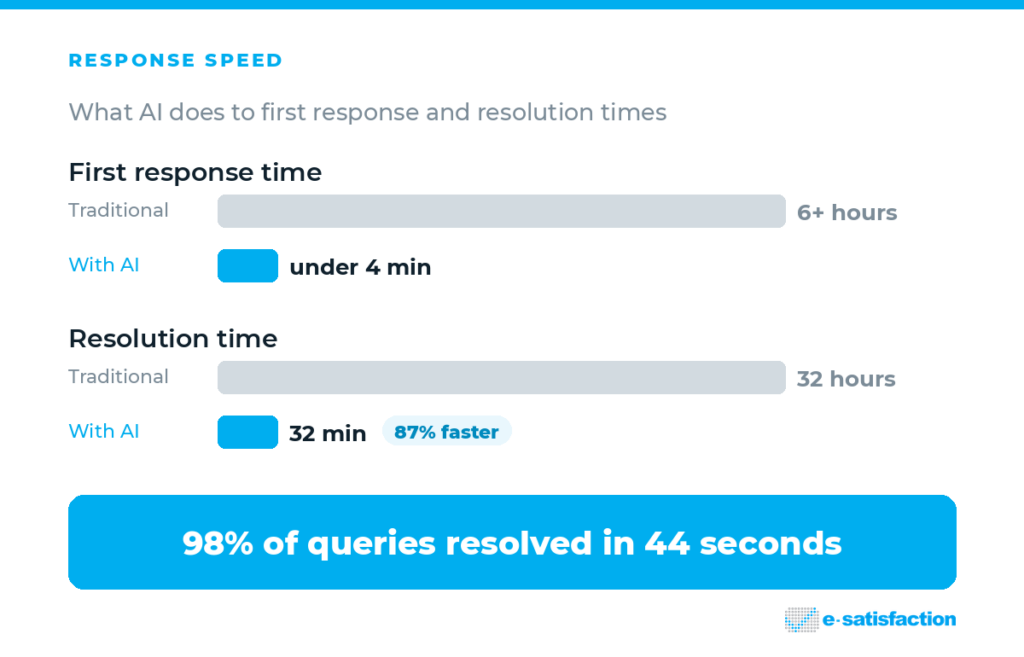
Across industries, AI has cut first response times from over six hours to under four minutes, and resolution times from 32 hours to 32 minutes. Some systems go further: Bank of America’s assistant resolves 98% of queries in 44 seconds. Speed matters because frustration builds while customers wait.
Can AI read customer feedback better than people can?
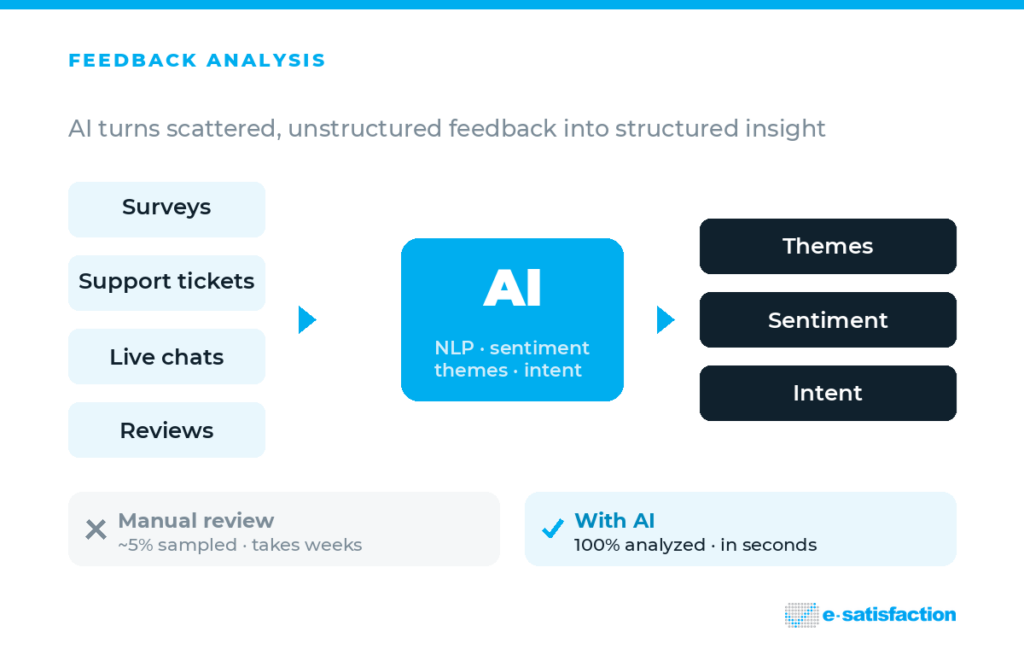
Yes, at scale. AI reads thousands of open-ended comments in seconds and sorts them into themes, sentiment, and intent. Manual review can only sample a fraction. AI processes everything, so no signal gets lost in the pile.
Natural language models turn unstructured comments from surveys, tickets, chats, and reviews into structured insight. The big win is scale: it processes thousands of open-text responses in seconds and finds patterns manual review misses. Aspect-based sentiment goes past positive or negative to pinpoint the exact feature causing frustration and flag churn signals early. This is the engine behind tools like AI-powered topic detection. New to this? Start with what customer feedback actually tells you.
Personalization at a scale humans can’t reach
Customers expect you to know them. 71% expect personalized interactions, and brands that deliver see around 20% higher satisfaction and conversion. Traditional personalization stops at broad segments: age, location, last purchase.
AI works at the level of the individual. It reads behavior, history, and sentiment together, then tailors the next message, offer, or reply in real time. 80% of executives already use AI in their strategy and business decisions. The result feels less like marketing and more like being remembered.
Can AI predict churn before a customer leaves?
Yes. AI scores churn risk from behavior signals, like fewer logins or rising support tickets, before the customer decides to go. Traditional methods rely on exit surveys, which only tell you why someone already left. Prediction lets you act while you still can.
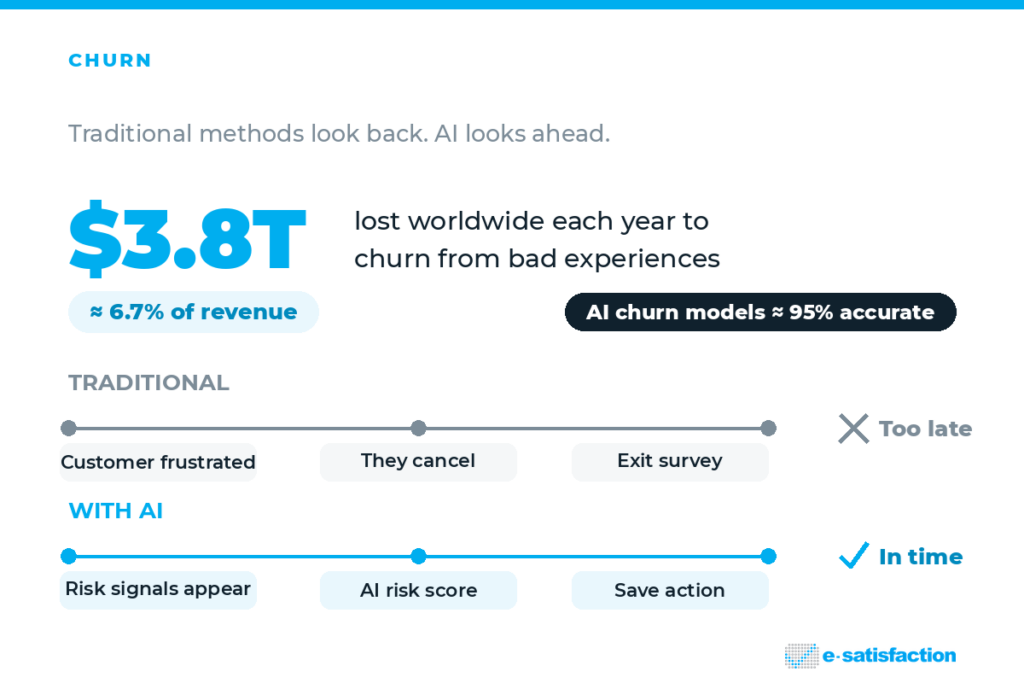
Bad experiences put roughly 6.7% of revenue at risk, about $3.8 trillion globally. In research settings, AI churn models reach around 95% accuracy. The point isn’t the score. It’s the early warning that triggers a save before the relationship ends.
If this sounds familiar, see how brands like yours have fixed it.
Consistent service across every channel and agent
Quality used to depend on which agent picked up or which channel a customer chose. Manual QA only checks a tiny sample of conversations, so most slip by unreviewed.
AI analyzes every interaction and gives agents real-time guidance mid-conversation. That keeps the experience steady whether a customer emails on Monday or calls on Friday. Consistency is quiet, but customers notice when it’s missing.
How AI customer experience solutions speed up time-to-insight
AI delivers insight in real time instead of quarterly reports. It unifies feedback from surveys, reviews, tickets, and calls into one live view. Traditional reporting leaves data in silos and arrives too late to act on. Faster insight means faster fixes.
Scores like NPS tell you where you stand; sentiment analysis tells you why, and what to fix. When a score dips, AI links it to the exact cause, like “checkout wait time,” so operations knows where to look. That turns reporting into actionable VoC insights you can use the same day, built on a clear Voice of Customer framework.
Freeing your team from repetitive work
By 2026, AI is expected to fully handle about 80% of routine interactions, like order tracking and basic troubleshooting. That’s not a threat to your team. It’s a relief.
When AI clears repetitive tickets, agents spend their time on complex, emotional cases where humans win. 77% of customers get better outcomes when they deal with a person on hard problems. The best setup pairs AI speed with human judgment. 92% of businesses report higher satisfaction after adding AI support, but only when humans stay in the loop.
The takeaway
AI customer experience solutions aren’t magic, and they don’t replace your people. They win on the work that overwhelms human teams: speed, volume, prediction, and consistency. Humans still own the moments that need empathy and judgment.
Three things to remember. First, AI’s edge is scale and speed, so use it where volume is the bottleneck. Second, prediction beats reaction; catch churn signals before customers leave. Third, the strongest CX programs blend AI and people, not one or the other. The market reflects this: AI customer service is worth about $15.12 billion in 2026, with an average return of $3.50 for every $1 invested.
Ready to stop guessing and start acting on real customer feedback? Request a free demo
Frequently Asked Questions
What are AI customer experience solutions?
AI customer experience solutions are tools that use natural language processing, machine learning, and generative AI to automate and improve customer interactions. They analyze feedback, predict behavior, personalize messaging, and handle routine support at a scale humans can’t match.
Will AI replace human customer service agents?
No. AI handles routine, high-volume tasks, but customers still prefer humans for complex issues. 77% report better outcomes with a person on hard problems. The strongest teams pair AI speed with human judgment.
How does AI analyze customer feedback?
AI reads unstructured text from surveys, reviews, tickets, and chats, then sorts it into themes, sentiment, and intent in seconds. It surfaces the exact issues driving low scores, something manual sampling usually misses.
Can small e-commerce brands use AI customer experience solutions?
Yes. Many platforms scale to any feedback volume without adding headcount, so a brand collecting feedback from five stores or five hundred gets the same real-time analysis.
How fast is the ROI on AI customer experience solutions?
Returns are strong when implemented well. Companies see an average of $3.50 back for every $1 invested in AI customer service, with leaders reaching up to 8x.