

AI-Powered Sentiment Analysis: How Brands Understand Customers at Scale
An AI sentiment analysis platform reads customer feedback from every channel, labels the emotion behind each message, and ties it to a specific topic. That lets brands see how customers feel across thousands of reviews, chats, and calls, not just the few they read by hand. This guide covers what these platforms do, how they work, and what separates a real platform from a basic score.
Every day your customers tell you how they feel. They leave reviews, message support, reply to surveys, and post on social. The problem is volume. No team can read all of it. An AI sentiment analysis platform can. It reads customer feedback at scale, labels the emotion behind each message, and shows you the patterns hiding in the noise.
Most brands still sample. They skim a handful of reviews or listen to a few calls, then guess at the rest. That guess gets expensive. Roughly 80 to 90% of enterprise data is unstructured text like reviews, emails, and call notes, and it grows about three times faster than neat database data. This post explains how these platforms turn that flood into something you can use.
What Is an AI Sentiment Analysis Platform?
An AI sentiment analysis platform is software that reads customer feedback across channels and labels the emotion in each message as positive, negative, or neutral. It uses natural language processing, the technology that lets machines read human text, to do this automatically at scale. That way brands understand how thousands of customers feel without reading every message by hand.
A single sentiment score is a feature. A platform is the whole system around it. It connects to your channels, reads every message, groups the results by topic, and pushes what it finds to the teams who can act. Most brands run AI sentiment analysis as part of a wider Voice of Customer program, not as a standalone gadget.
How Does an AI Sentiment Analysis Platform Work?
It works in four steps. First it collects feedback from every channel into one place. Then natural language processing reads each message and labels the emotion. Next it ties that emotion to a topic, like delivery or price. Finally it surfaces trends and alerts so teams can act on what they find.
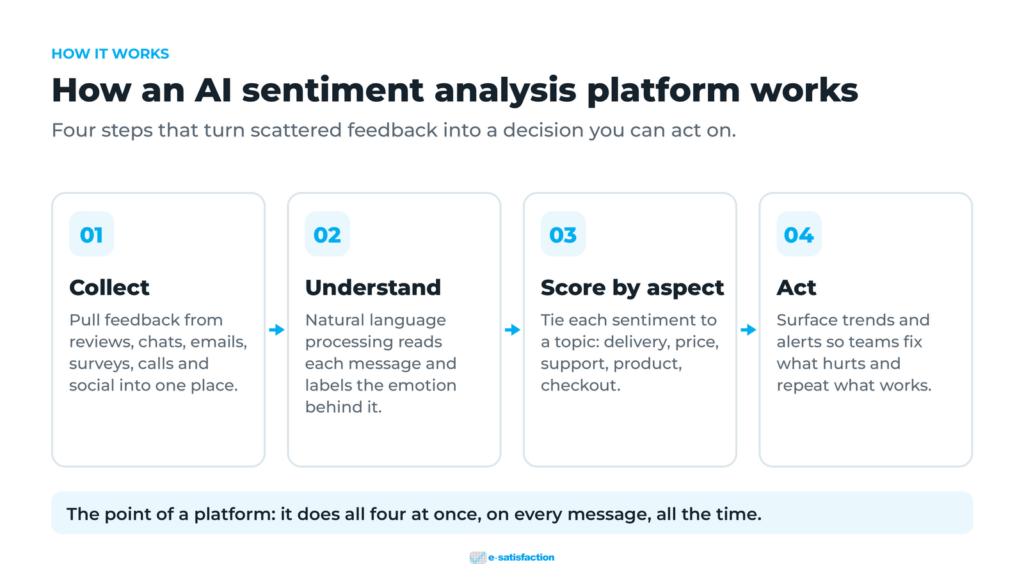
The collection step matters more than it sounds. Feedback lives in silos: reviews on one site, chats in another tool, calls in a third. A platform pulls it together so nothing gets lost. The scoring step is where customer feedback analytics turns raw text into numbers you can chart, compare, and track over time.
Overall Sentiment vs Aspect-Based Sentiment
Here is where most tools fall short. A basic tool gives one score per message. It might tag a review as “negative” and stop there. You know something is wrong. You have no idea what to fix.
Aspect-based sentiment goes deeper. It splits a message into topics and scores each one on its own. Take this review: “Delivery was fast and the staff were lovely, but the jacket felt overpriced for the quality.”
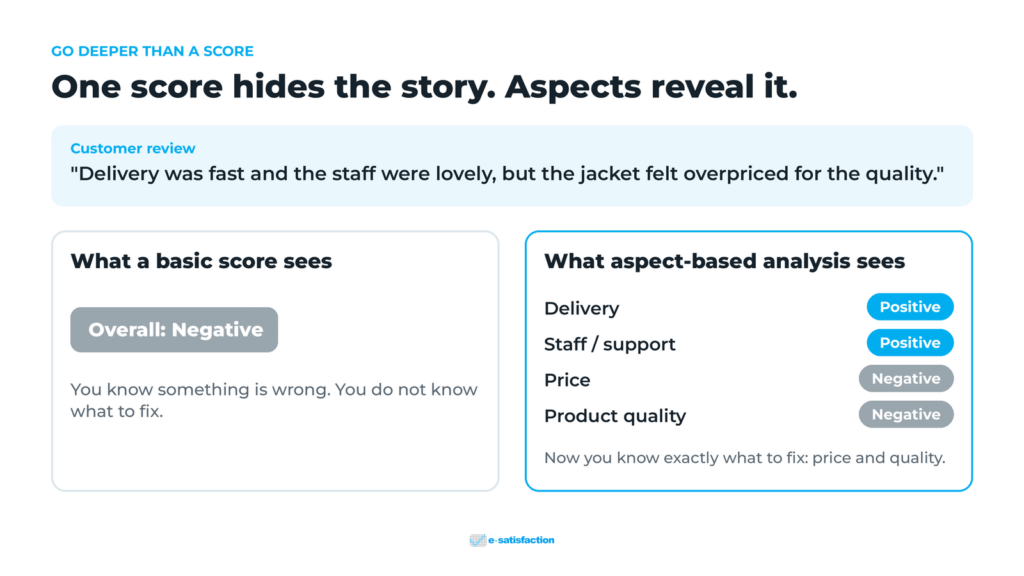
A basic score calls that negative. Aspect-based analysis sees four separate signals: delivery is positive, staff is positive, price is negative, and quality is negative. Now you know exactly where to act. Pairing sentiment with topic detection is what turns a mood reading into a to-do list.
If your current setup gives you scores but no answers, see how brands read feedback at the aspect level.
Which Channels Can It Analyze, and How Much?
A strong platform reads both text and voice: reviews, support chats, emails, surveys, social posts, and call transcripts. It processes all of it, not a sample. That is the real difference between a platform and a person with a spreadsheet.
The scale gap is huge. Manual review methods for contact centers typically cover less than 5% of total call volume. The other 95% goes unread. An AI platform reads every message, every day.
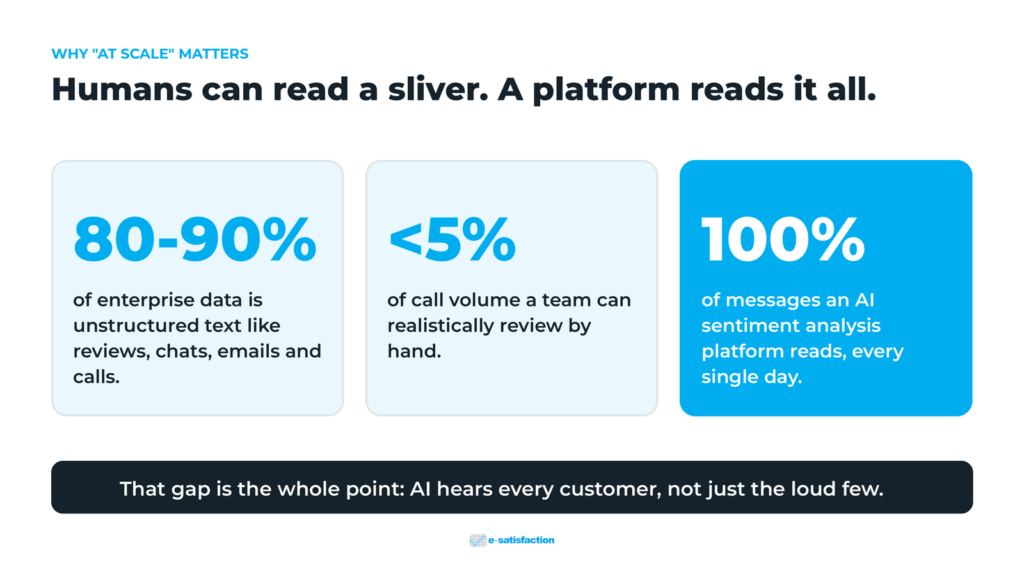
Reading chats and calls well takes conversational analytics, which is built for the messy back-and-forth of real dialogue. When that runs continuously, you get real-time customer insights instead of a report that arrives a month too late.
What Separates a Platform From a Basic Sentiment Feature?
Plenty of tools slap a positive or negative label on text. Four things separate those features from a real platform.
Coverage comes first. A platform listens across every channel, not just one. Second is depth: aspect-level scoring, so you learn what to fix, not just that something is off. Third is accuracy that improves as the model learns your products, slang, and customers. Fourth, and most important, is action.
A score that sits in a dashboard changes nothing. A proper AI Voice of Customer platform routes each finding to the right team and closes the loop. The measure of a platform is not how well it labels feeling. It is whether that feeling reaches someone who can do something about it.
How Reliable Is AI Sentiment Analysis at Scale?
It is reliable enough to guide real decisions, though not perfect. AI is strong on clear language and gets sharper as it learns your data. It still struggles with sarcasm, slang, and mixed emotions in a single sentence.
At scale, that trade-off works in your favor. One misread message barely moves a trend built from thousands of others. The aggregate picture stays reliable even when a single label is wrong. For sensitive or high-stakes cases, most teams keep a human in the loop to confirm before acting. The AI does the reading; people make the judgment calls.
The Takeaway
Three ideas are worth keeping. First, scale is the whole point: a platform hears every customer, not just the loud few. Second, aspects beat scores, because knowing what to fix is more useful than knowing that something is broken. Third, a platform only earns its place when insight turns into action.
Understanding customers at scale is no longer a nice-to-have. It is how AI in customer experience separates the brands that adapt from the ones that guess. Ready to hear what all of your customers are really saying? Request a demo and see sentiment analysis at scale in action.
Frequently Asked Questions
What is an AI sentiment analysis platform used for?
It is used to read customer feedback at scale and turn it into insight. Brands use it to spot rising complaints, track how customers feel about products or service, compare channels, and decide what to fix first. It replaces slow manual review, which can only cover a small sample of feedback.
What is the difference between sentiment analysis and aspect-based sentiment analysis?
Sentiment analysis gives one label per message: positive, negative, or neutral. Aspect-based sentiment analysis breaks the message into topics, like price or delivery, and scores each one separately. The second approach is far more useful because it tells you exactly what to act on, not just the overall mood.
Can an AI sentiment analysis platform handle multiple languages and channels?
Yes. Modern platforms read text and voice across reviews, chats, emails, surveys, social posts, and call transcripts, and many support multiple languages. The value grows with coverage, since sentiment from one channel rarely tells the full story of how customers feel.
How is an AI sentiment analysis platform different from a survey tool?
A survey tool asks structured questions and collects scores. A sentiment platform reads open, unstructured feedback wherever customers already leave it. Surveys tell you what you thought to ask. Sentiment analysis tells you what customers chose to say, including things you never asked about.
How long does it take to see value from an AI sentiment analysis platform?
Many brands see useful patterns within the first weeks, once the platform connects to their channels and starts reading historical feedback. Accuracy on your specific products and customers improves over the following months as the model learns your data.