

How AI Enables Hyper-Personalized Customer Experiences Without Increasing Costs
Most brands assume hyper-personalization means bigger budgets and bigger teams. It doesn’t have to. AI personalization for customer experience works best when it’s built on feedback you already collect, not a new data platform or a bigger service team. This post breaks down why AI-driven customer service often raises costs instead of cutting them, and how a feedback-powered approach delivers one-to-one experiences without the added spend.
Here’s what nobody tells you about AI personalization customer experience projects: most of them get more expensive, not less. Boards approve AI budgets expecting savings. Eighteen months later, technology spend has doubled and the headcount hasn’t moved.
That’s not a reason to skip personalization. It’s a reason to be more careful about how you build it. The brands getting real value from AI personalization customer experience initiatives aren’t the ones buying the biggest platform. They’re the ones reusing the customer feedback they already have: reviews, surveys, support conversations, and NPS responses, and letting AI turn that into individual-level relevance. No new data team required.
This matters most for retail and e-commerce leaders comparing AI investments right now. If you’re already evaluating where your budget should go, see how e-satisfaction turns feedback into personalization without adding headcount.
What Is AI-Driven Hyper-Personalization in Customer Experience?
AI-driven hyper-personalization uses machine learning and real-time customer data to tailor every touchpoint, product suggestions, messaging, timing, and service responses, to the individual, not the segment. It goes beyond inserting a first name into an email. It adapts the entire experience based on what a customer has said, done, and felt.
Companies that execute this well see the payoff show up on the balance sheet. Companies that excel at personalization generate 40 percent more revenue from those activities than average players, according to McKinsey’s research on personalization at scale. That’s not a marginal gain. It’s the difference between personalization as a nice-to-have and personalization as a growth engine.
Why Most AI Investments Increase CX Costs Instead of Cutting Them
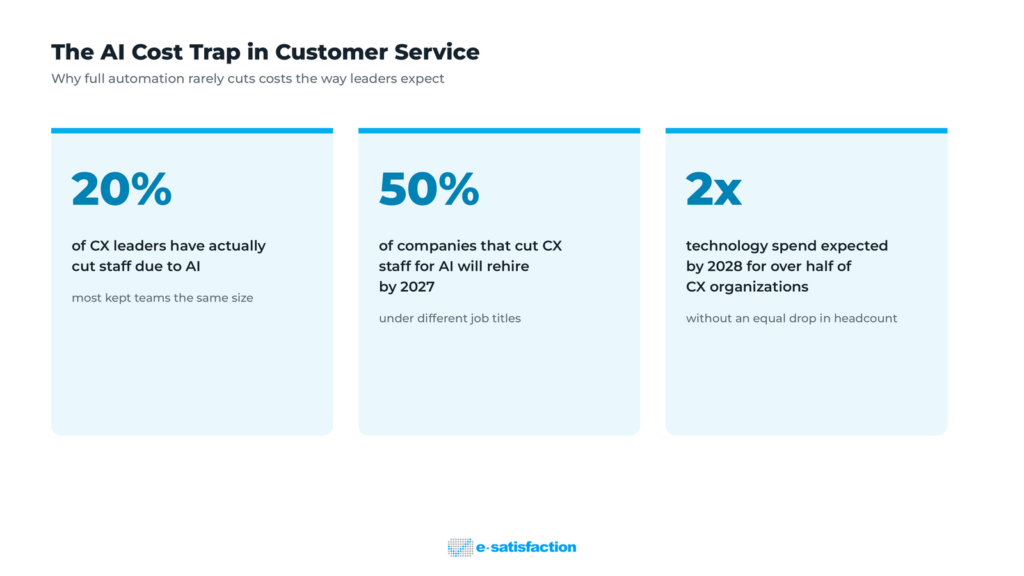
The instinct to cut costs with AI is understandable. It’s also, according to the data, mostly not happening the way leaders expect. Gartner surveyed 321 customer service and support leaders in late 2025 and found only 20% of leaders have reduced agent staffing due to AI, while 55% report stable staffing levels while handling higher customer volumes.
The bigger problem is what happens next. Gartner also predicts that by 2027, 50% of companies that attributed headcount reduction to AI will rehire staff to perform similar functions, often under different job titles. Layer on top of that a separate finding that over 50% of customer service organizations will double their technology spend by 2028 without an equivalent reduction in talent, and the cost-cutting case for AI in service starts to look shaky.
None of this means AI fails at personalization. It means the version of AI that promises headcount savings in customer service is the wrong place to look for cost efficiency. The right place is upstream, in how you use the feedback data you’re already sitting on.
How Feedback-Powered Personalization Avoids the Cost Trap
Here’s the answer capsule: feedback-powered personalization avoids added cost because it runs on data your team already collects, reviews, surveys, support chats, and NPS responses, instead of requiring a new customer data platform or extra engineering headcount. The infrastructure already exists. AI just makes it usable in real time.
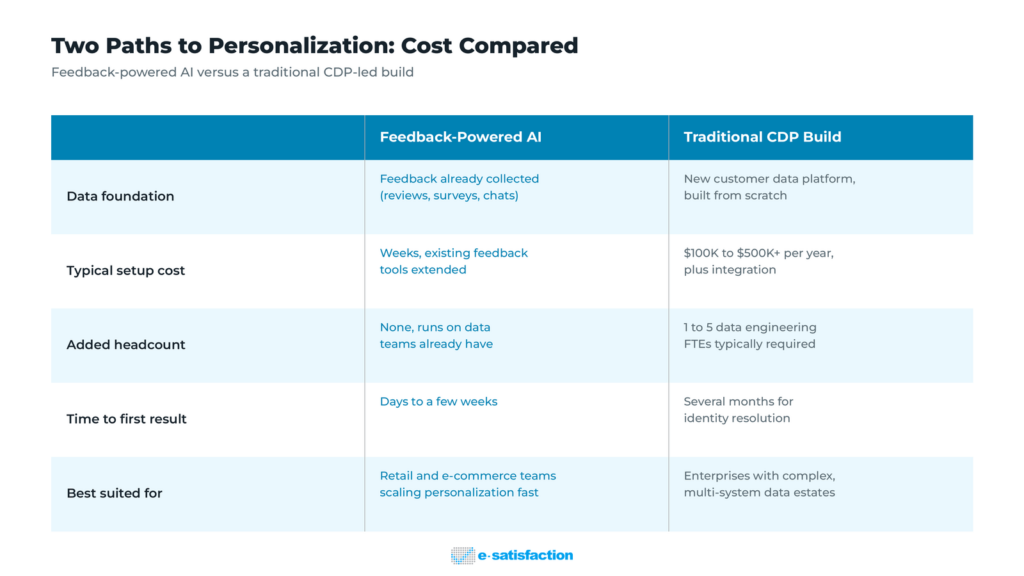
Compare that to the traditional route. A typical enterprise customer data platform costs $100,000 to $500,000 or more per year, plus 1 to 5 data engineering FTEs once you factor in integration and identity resolution work. That’s a heavy lift before personalization even starts. A voice of customer platform that’s already ingesting feedback across channels skips most of that build entirely, because the customer feedback analytics layer is already in place.
If this cost trap sounds familiar, here’s how brands like yours are personalizing without the budget blowout.
What Does Cost-Neutral Hyper-Personalization Look Like in Practice?
In practice, cost-neutral hyper-personalization means four things happening on top of your existing feedback data: unifying it into one profile, scoring sentiment automatically, detecting recurring topics without manual tagging, and using all three to personalize the next action. Nothing here requires new customer acquisition or a rebuilt data warehouse.
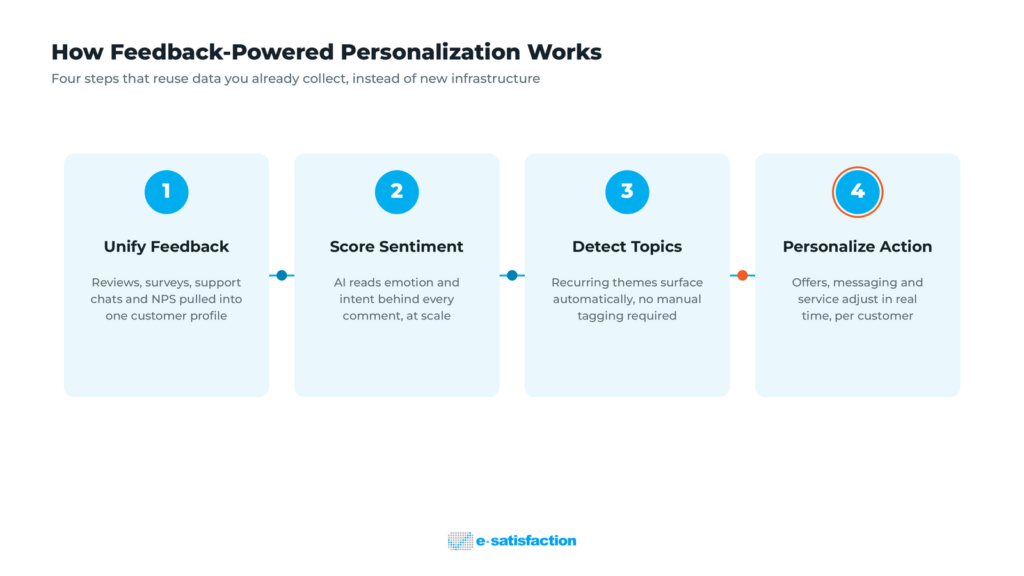
AI sentiment analysis is what makes step two possible at scale. Instead of a person reading through thousands of reviews, AI reads emotional tone and intent across every comment, then routes that insight into personalization decisions instantly. AI-powered topic detection handles step three, surfacing what customers are actually talking about so your team isn’t manually coding open-text feedback every week.
AI Personalization vs Traditional CDP-Led Personalization: Which Costs Less?
The short answer: feedback-powered AI personalization costs less to start and less to run, because it extends tools you already own instead of standing up new infrastructure. A traditional CDP-led build asks you to unify identity across systems from scratch. Feedback-powered personalization asks you to make better use of data you already have permission to use.
This distinction matters more once you’re moving past pilots. Real-time customer insights let personalization respond within hours of a customer’s feedback instead of at the next quarterly review. And because everything runs through one AI voice of customer platform, there’s no second system to reconcile, no duplicate profiles, and no extra vendor contract to justify to finance.
How to Start Without Blowing Your Budget
Start with the feedback channel generating the most volume, usually post-purchase surveys or product reviews, and get AI sentiment and topic detection running there first. Prove the personalization lift on one channel before expanding to others. This mirrors what Gartner recommends more broadly for AI CX projects: narrow scope first, broad rollout second.
Track the outcome that actually matters for the budget conversation: incremental revenue per customer segment, not vanity engagement metrics. If you want the full breakdown of which numbers to report to finance, this guide to AI CX ROI covers the metrics that hold up in a budget review.
Conclusion
Hyper-personalization doesn’t require a bigger team or a new data platform. It requires using the feedback you already collect more intelligently, and AI is what makes that possible without adding cost. The brands winning here treated personalization as a data reuse problem, not a headcount problem.
Ready to see what your existing feedback data could do for personalization? Request a free demo and we’ll show you where the opportunity already sits in your data.
Frequently Asked Questions
Does AI personalization always require a new customer data platform?
No. A dedicated CDP helps in complex, multi-system enterprises, but many retail and e-commerce brands can build effective personalization directly from unified feedback data (reviews, surveys, support chats) without one. The typical CDP build runs $100,000 to $500,000 or more per year plus dedicated engineering staff, so it’s worth confirming feedback-based personalization first.
Why do AI customer service projects often cost more than expected?
Because the savings usually come from reduced headcount, and that reduction rarely materializes as planned. Gartner found only 20% of CX leaders actually cut staff due to AI, and predicts half of companies that did will rehire similar roles by 2027. Technology spend rises even when headcount stays flat.
What’s the difference between personalization and hyper-personalization?
Personalization typically segments customers into groups and tailors messaging to each group. Hyper-personalization uses real-time, individual-level data, often powered by AI sentiment and behavioral analysis, to tailor the experience to a single customer rather than a segment.
How quickly can a retail brand see results from feedback-powered personalization?
Because it builds on existing feedback infrastructure rather than a new platform, initial personalization use cases can go live in weeks rather than the several months typically needed for CDP-based identity resolution and data unification.
Does hyper-personalization require collecting more customer data?
Not necessarily. Most retail and e-commerce brands already have significant unused feedback data sitting in reviews, support tickets, and surveys. AI sentiment analysis and topic detection make that existing data usable for personalization, often before any new data collection is needed.