

How AI Improves Customer Retention and Reduces Churn
AI customer retention works by spotting at-risk customers before they leave. It reads feedback, support chats, and behavior to predict churn weeks in advance, then triggers the right outreach. The payoff is large: small retention gains compound into outsized profit. This guide explains how AI predicts churn, how to act on the signals, and the results brands can expect.
You already know AI can help you keep customers. The real question is how, and how much. AI customer retention is not a single tool. It is a loop that listens to every customer signal, predicts who is about to leave, and acts before they do.
Most teams still work the other way around. They wait for a complaint, a cancellation, or a drop in revenue. By then the customer has already decided. The math makes this painful. According to Bain & Company, a 5% lift in retention can raise profits by 25% to 95%, and Harvard Business Review reports winning a new customer costs five to 25 times more than keeping one.
So the prize is clear. What changes with AI is timing. You stop reacting and start preventing. Here is how that works in practice.
What Is AI Customer Retention?
AI customer retention is the use of machine learning to predict which customers are likely to churn and to trigger timely, personalized action to keep them. It analyzes feedback, support conversations, and usage patterns in real time, then flags risk early enough for your team to respond.
Think of it as an always-on early warning system. Traditional retention relies on lagging signals like missed payments or support escalations. Those surface risk too late. AI reads leading signals instead: a dip in engagement, a frustrated tone in a chat, a survey score sliding down. It connects dots no human could track across thousands of accounts. This is the foundation of modern AI in customer experience, where prediction replaces guesswork.
Why Do Customers Churn Before You Notice?
Most unhappy customers never complain. They quietly disengage, then leave for a competitor when the moment is right. Your dashboards stay green while loyalty erodes underneath. This silent churn is the single biggest blind spot in retention.
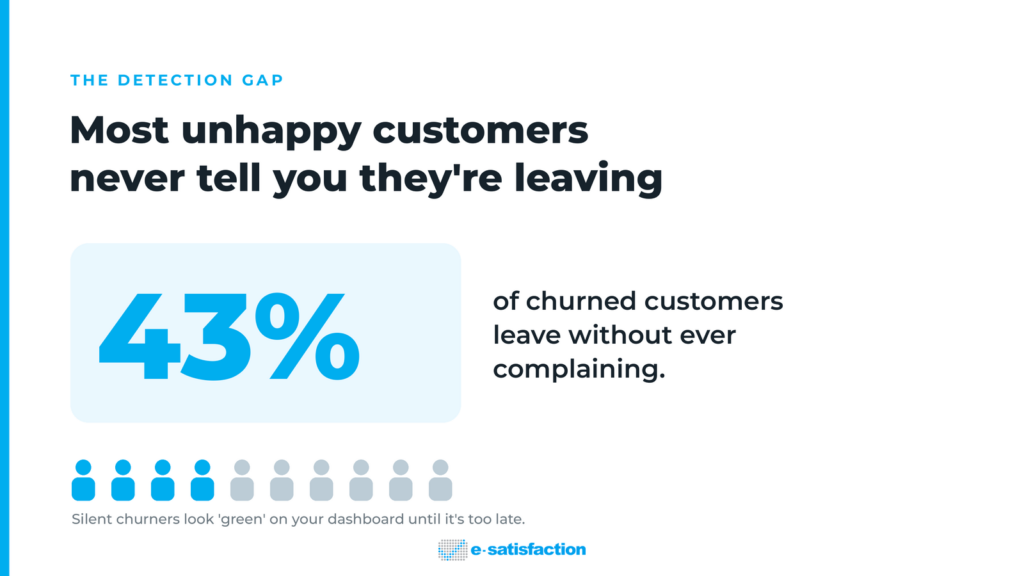
Gartner’s guidance on churn prevention stresses the same point: spot issues before they become problems, because a complaint is already a late signal. The customers who say nothing are often your highest risk. They simply weigh the effort of switching against the value they feel, and decide.
AI closes this gap by listening where customers actually express themselves. AI sentiment analysis reads emotion in open-text feedback and reviews. Conversational analytics surfaces frustration buried in support chats. Together they catch the quiet signals long before a cancellation.
How Does AI Predict Customer Churn Before It Happens?
AI predicts churn by scoring each customer on their likelihood to leave, often 30 to 90 days ahead. It learns from past churners, weighs hundreds of behavioral and feedback signals, and updates the score as new data arrives. High-risk customers get flagged for action automatically.
McKinsey describes this as a layered model approach: propensity models score the chance a customer churns, channel models pick the best way to reach them, and value models weigh the revenue at stake. A customer flagged as high risk can be pulled from promotions and moved into a tailored retention journey instead.
The fuel for these models is unified data. A strong AI Voice of Customer program feeds the model real-time signals from surveys, behavior, and conversations, so predictions stay sharp.
Turning Early Warnings Into Retention Action
A prediction only matters if it triggers action. This is where many programs stall. They build accurate churn scores, then leave them sitting in a dashboard while the customer drifts away. The model is the easy part. Closing the loop is the work.
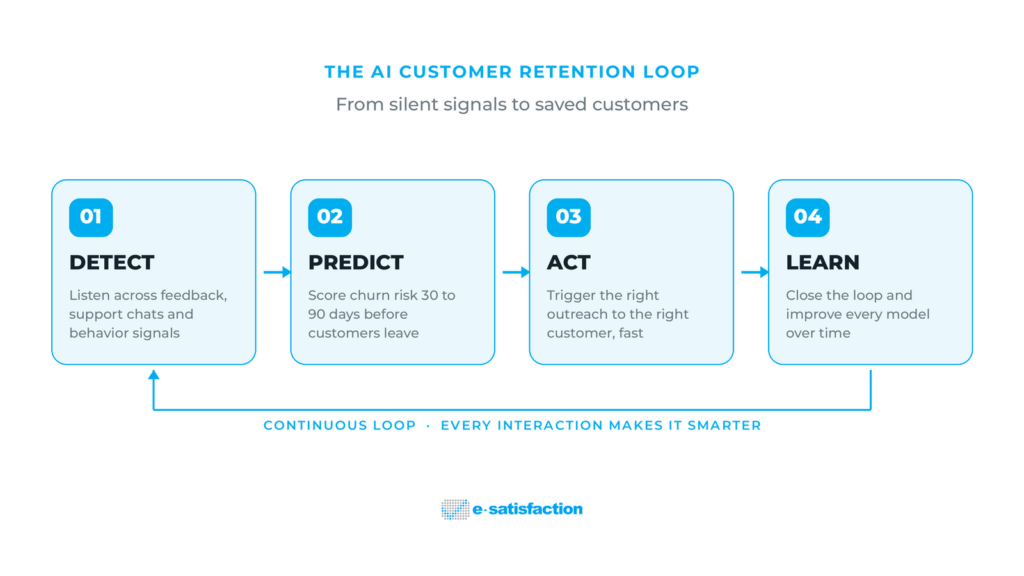
The strongest retention engines run a continuous loop. Detect the signal. Predict the risk. Act with the right outreach. Learn from the outcome. Each cycle makes the next prediction smarter. The action itself should fit the customer: a proactive check-in for a confused user, a value reminder for a quiet one, a fast fix for a frustrated one.
This is where AI-powered CX solutions turn insight into outcomes. They route the right play to the right customer, automatically, so your team spends time on saves instead of spreadsheets. If you are tired of finding out about churn after it happens, see how brands catch at-risk customers in time.
How Much Can AI Customer Retention Reduce Churn?
The gains are real and measurable. McKinsey reports that an analytics-driven approach can cut churn by as much as 15%. Paired with Bain’s profit math, even a single-digit retention improvement can move your bottom line in a big way.
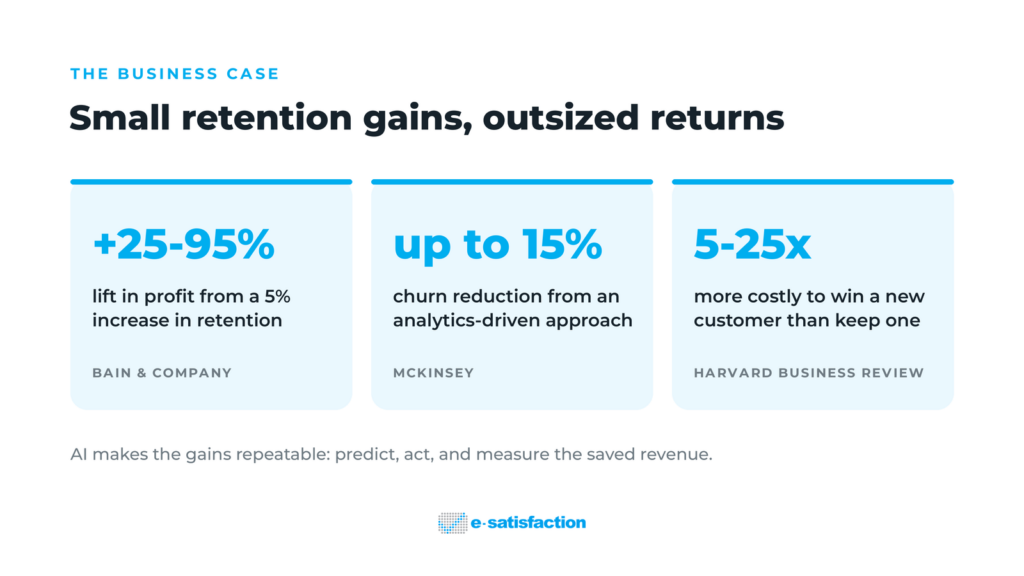
The results show up beyond churn, too. CMSwire reports that brands using predictive AI in customer experience are seeing tangible gains in satisfaction and efficiency. The pattern is consistent: predict early, act fast, and the saved revenue compounds.
The key is to measure it. Set your baseline retention, churn, and lifetime value first. Then you can prove what AI saves, not just assume it.
Building an AI Customer Retention Engine That Lasts
You do not need to boil the ocean. Start with your highest-value segment, where a single save pays for the effort. Get clean data flowing from feedback, support, and behavior. Build one churn score. Wire it to one clear action. Then expand.
The brands that win treat retention as a system, not a campaign. They turn customer feedback analytics into standing alerts, assign owners to at-risk accounts, and review what worked every cycle. The loop tightens over time.
This is also where the field is heading. As you plan ahead, it helps to track the future of customer experience and the latest AI and CX trends, so your retention engine keeps pace with how customers expect to be heard.
Conclusion
AI customer retention shifts your team from reacting to predicting. It catches the silent signals, scores risk early, and turns each save into a repeatable play. The economics are hard to ignore: small retention gains compound into outsized profit, and acting early costs far less than winning a lost customer back.
The starting point is not more software. It is unified customer signals and one clear loop: detect, predict, act, learn. Build that, measure the saved revenue, and expand from there.
Ready to stop finding out about churn after it happens? Book a demo and see how e-satisfaction predicts at-risk customers in time to keep them.
Frequently Asked Questions
What is AI customer retention?
AI customer retention is the use of machine learning to predict which customers are likely to leave and to trigger timely, personalized action to keep them. It analyzes feedback, support conversations, and behavior in real time, flagging risk early enough for your team to respond before a customer churns.
How does AI predict customer churn?
AI scores each customer on their likelihood to churn, often 30 to 90 days ahead. It learns from past churners and weighs hundreds of signals, from declining usage to negative sentiment. As McKinsey notes, propensity models estimate churn risk while channel and value models decide how and where to act.
How much can AI reduce churn?
Results vary by industry and starting point, but McKinsey reports that an analytics-driven approach can cut churn by as much as 15%. Because Bain & Company found a 5% retention lift can raise profits by 25% to 95%, even modest churn reductions deliver outsized returns.
Why do most customers churn without complaining?
Most unhappy customers never raise a ticket. They quietly disengage and leave when a better option appears, so dashboards look healthy until revenue drops. AI catches this silent churn by reading sentiment in feedback and conversations, surfacing risk that traditional metrics miss.
What data does AI need to predict churn?
AI churn models work best on unified, real-time data: survey and feedback scores, support and chat conversations, product or purchase behavior, and account history. The cleaner and more connected the data, the earlier and more accurate the churn prediction.