
Customer Satisfaction: 5 ways to start measuring it

Customer retention, loyalty and profitability: what do they have in common? They are the results of a brand’s efforts to measure and improve its customer satisfaction. But what is the starting point for gauging your customers’ sentiment? Well, it all starts with asking and collecting customer feedback, which you will then analyze and use to strengthen satisfaction levels.

Customer retention, loyalty and profitability: what do they have in common? They are the results of a brand’s efforts to measure and improve its customer satisfaction. But what is the starting point for gauging your customers’ sentiment? Well, it all starts with asking and collecting customer feedback, which you will then analyze and use to strengthen satisfaction levels.

In this post, we will talk about the methods that you can use to make feedback collection and analysis a staple of your customer success strategy. 

1. Net Promoter Score (NPS)

Net Promoter Score (NPS) is a customer satisfaction metric that was developed by Fred Reichheld, Bain & Company, and Satmetrix in 2003. It works by asking a quick and easy question, using a 0-to-10 scale:

“How likely is it that you would recommend our company to a friend or a colleague?”

NPS measures customer loyalty and helps to distinguish those who have negative feelings from promoters. And if you opt for a customer feedback software, like e-satsifaction.com, you can get the most out of NPS surveys.

2. Social Media Monitoring

Your customers are social creatures and you should follow their lead… Ignoring their mentions, comments and DMs on your social media accounts does not only aggravate them but it costs you in terms of the insights that you can find there. Plus, feedback through social media is usually given by the customers without you lifting a finger to ask for it and it’s free!

3. SMS/Viber Surveys

Asking for feedback via SMS or Viber works well for surveys concerning the evaluation of a purchase, the delivery process or the quality of product/service (after-sales). Plus, this method is cheaper compared to other alternatives.

4. Email Surveys

Emails can go hand in hand with customer engagement and feedback generation and leave plenty of room for experimentation. The time you send them, their subject lines, tone of voice and choice of content (visual and written) can be optimized to offer you a better response rate. Also, you can try personalizing your emails, a practice that makes customers feel unique and adds to their satisfaction. 5. Customer Satisfaction Score (CSAT)

Customer Satisfaction or CSAT is the metric that tracks how satisfied customers are with their experiences with a brand, product or service. 

The question usually used in CSAT surveys is this:

“How satisfied are you with your e-shop?”

Although the word “satisfied” can mean different things to different respondents, CSAT scores paint a pretty coherent picture of how happy or unhappy your customers are. CSAT surveys should also be set up and implemented with a customer feedback software that can help you streamline your process and have all your results in one place for subsequent analysis. 

5. Customer Effort Score (CES)

The newest player in the CX metric field, Customer Effort Score (CES) starts with the following question:

“How easy was it for you to (e.g. complete your transaction)?” 

At first sight, you may not see the correlation between effort and satisfaction, but according to Gartner, 96% of customers that report high effort experiences become disloyal, compared to 9% of customers with low effort experiences. So, it’s no wonder that CES is a very important metric that you should consider using.

—-

Measuring and analyzing may seem like a daunting task at first, but with the right customer feedback software and a set of clear objectives and expectations, your efforts will pay off in due time. If you want to see how www.e-satisfaction.com can help you go from theory to practice through an easy-to-use interface and a number of features, make sure to fill the form below.
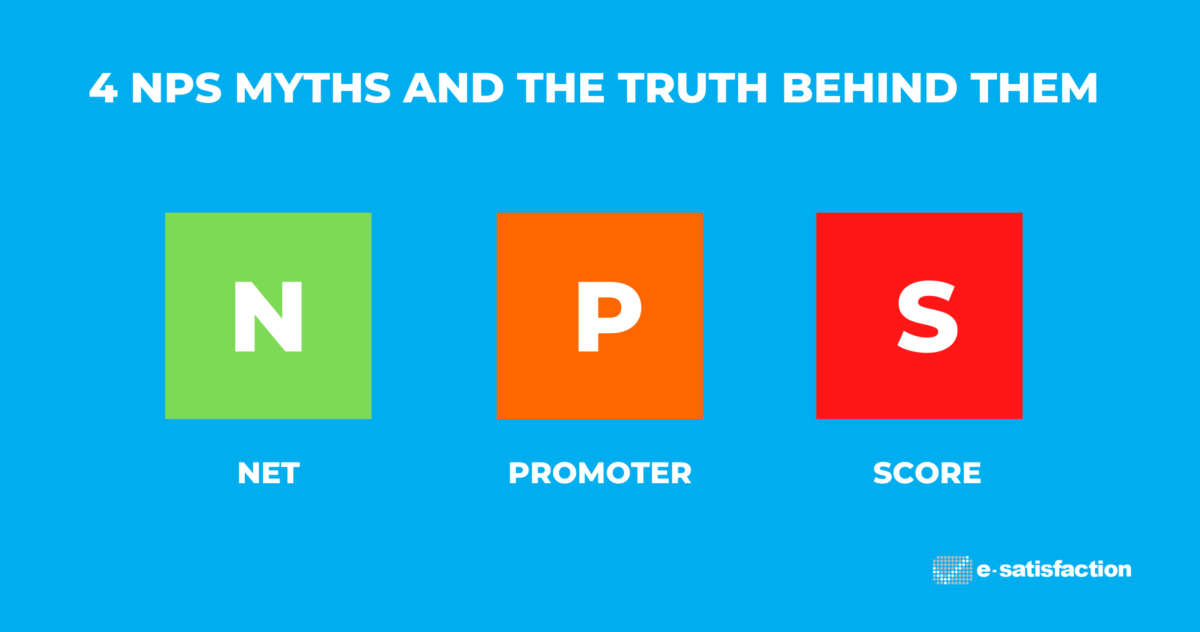
4 NPS Myths and the Truth Behind Them

Net Promoter Score or NPS is a star among CX metrics. And, as it happens to real-life stars, there are inevitably several misconceptions regarding this metric’s use, potential and benefits.

Net Promoter Score or NPS is a star among CX metrics. And, as it happens to real-life stars, there are inevitably several misconceptions regarding this metric’s use, potential and benefits.

Since it is a widely used metric and a popular way to collect and analyze customer feedback, it is important to have clear expectations of what it can do for us. False or exaggerated claims about NPS are dangerous when taken at face value because they paint a skewered picture of a brand’s customer satisfaction level and may lead to actions that will not have the expected results.

It is now time for some serious NPS myth-busting!

Myth #1: NPS can solve every problem a brand faces with its customer experience!

Oh, NPS as a cure-all for brands that seek to improve their customer satisfaction is one persistent myth that doesn’t seem to go away. 

The Truth: NPS is arguably a good way to gauge customer loyalty and categorize your audience into promoters, passives and detractors but is by no means the only metric that you need to boost engagement and foster loyalty. The generic wording of an NPS survey question (“How likely are you to recommend our brand/product/service to a friend”) does not leave room for more insights on other aspects of the customer journey. Even when paired with an open end question that invites customers to justify their score, NPS will not magically solve all your problems and that is why you should also incorporate other metrics (CSAT, CES) on your customer feedback collection strategy.

Myth #2: NPS is the number one growth predictor!

Well, that myth has stuck because its premise is very alluring and convenient. If only it were, true…

The Truth: Although NPS has been proven to be a valid predictor of repeat purchases, referrals, revenue, and growth, it is a stretch to call it the #1 growth prediction metric. New studies and data appear every day and there is an on-going discussion on the role of each CX metric, especially with the advent of CES (Customer Effort Score) as the newest player in the game. NPS has been celebrated for its many advantages but does not reign supreme over other metrics.

Myth #3: NPS is the only way to measure customer loyalty!

Don’t we all wish that customer loyalty would be tracked through the use of just one metric? Well, this collective wish has not been granted yet…

The Truth: NPS is only one way to measure customer loyalty and if you do not follow it up with more questions that will shed light on other aspects of customer experience, it cannot work wonders for your customer loyalty. NPS scores are great but the more data on your disposal the better the chances that you can use them as diagnostic tools and plan actions that will improve and solve problems for your customers.

Myth 4: You should send NPS surveys as often as you can!

There is a right time and a right place for everything. Same goes with NPS surveys…

The Truth: Sending NPS surveys once a year or every few weeks will just not cut it! The frequency with which you ask customers to share their experience with a product and service and answer whether they would recommend them to a peer plays a significant role not just on the results but also on the response rate. Ask once a year and you may miss trends and changes in customer behaviour. Ask too often and you may end up with customer fatigue or -worse- disturbed customers. Use the data from your NPS surveys to hit the sweet spot where customers will want to respond to your questions and keep wanting to offer you their feedback.

We are sorry to have burst some common NPS bubbles, but understanding the true nature of this metric is paramount to making the most of it. If you’re looking for a tool that will help you optimize your NPS surveys, www.e-satisfaction.com offers you a range of features that will help you take your customer feedback collection and analysis efforts to the next level.

Is there a right time to send an NPS Survey?

There is a right time for everything and this could not be more true than in the case of NPS surveys! Sending them too soon or too late can influence response rate and tamper the quality of the ratings. Sending them too often can annoy customers and sending them once in a blue moon may result in missing out on important feedback. How do you strike a balance, then?

There is a right time for everything and this could not be more true than in the case of NPS surveys! Sending them too soon or too late can influence response rate and tamper the quality of the ratings. Sending them too often can annoy customers and sending them once in a blue moon may result in missing out on important feedback. How do you strike a balance, then?

Setting the right timing is one of the ways you can make the most of your NPS surveys. To do this, there are a number of simple steps you need to follow to make sure that your surveys will reach the customers at the point where they are ready and willing to provide you with useful feedback:


Step #1: Set clear objectives for your NPS Surveys


What do you wish to achieve via your survey? More specifically, what type of feedback do you wish to collect? Do you want to know whether your customers would recommend your brand after a recent transaction or based on the quality of your products or the efficiency of your support team? Your answer to this question not only formulates the phrasing of your questions but also dictates a different time when you need to hit “send”. 


Step #2: Segment survey recipients based on their latest interaction


Think about user actions that can trigger an NPS survey to create different customer segments. Each segment must receive a customized survey after they complete their action.  Here is an example of basic customer segmentation:

  • Users who have just completed check-out
  • Users who have received the product
  • Users who have had time to familiarize themselves with a product


Step #3: Opt for frequent, short and to-the-point surveys


Annual and quarterly NPS surveys have been the go-to frequency for a large number of brands and companies and even though they work in the cases of business with an established customer base (e.g. subscription services), most of them are lengthy and come at random times, when a customer may not be inclined to respond. Shorter and to-the-point NPS surveys that solicit answers from customers that have recently had a meaningful interaction with a brand, product or service produce meaningful feedback and have a better response rate.


Step #4: Use a customer feedback platform to optimize survey timing


Thankfully, you don’t need to be alone on your quest for a successful survey program! Customer feedback platforms, like www.e-satisfaction.com, can help you pinpoint the right moments for sending your surveys and offer you automation tools that streamline feedback collection and customer segmentation. 

Black Friday: How to make the most of it with e-satisfaction.com?

Black Friday is a first-class opportunity for every retailer who wants to drive sales and boost customer engagement and retention. If you wish to be prepared for November 27th, the e-satisfaction.com team is always ready to give you the tools and the ideas that will help you get the most of your customer satisfaction efforts.


Black Friday was originally one day in November, where huge crowds of shoppers and tourists went to the city and used to unofficially (or officially) be the start of holiday shopping season. In the course of time and with the rise of online retail, Black Friday has morphed into a week of sales and special offers, with other events, such as Cyber Monday, creating a frenzy of deal-searching that extends well beyond a 24hour timeframe. 

Download for FREE our Black Friday specific e-book with tips & actionable advice on how to increase sales & boost customer satisfaction during this period.

This frenzy and the sheer volume of traffic on the day itself can create a number of setbacks for any brand: from an increased Call Center workload to having to deal with impatient, difficult to satisfy customers, Black Friday is probably the most challenging period for online retailers.

A way to cope with the day’s demands and create opportunities for successful customer engagement is to have a clear plan and timeframe of actions. At e-satisfaction.com, we have divided the process of Black Friday customer engagement in three stages. Each stage comes with a set of mechanisms that you can activate through our platform and get the most out of this year’s Black Friday.

Stage #1: What to do BEFORE Black Friday?


There are a number of ways to prepare your audience during the period that leads to Black Friday. You can try the following:

  • When a user is browsing your website, a pop-up window can invite potential customers to create their account beforehand and be ready when Black Friday comes. This helps them skip the account creation stage and go straight to purchasing on the day that your prices would be simply irresistible. Alternatively, you can ask them to provide their email addresses so that they will get your Black Friday newsletter in time and become aware of your upcoming offers before everyone else.
  • You can go with a similar approach on your thank you pages, whether during check out or on the after sales stage, and redirect your customers to a page where they can share their personal info with you in order for them to receive any Black Friday related news and updates
  • Another way to remind your customers that Black Friday is coming and get them to think of their needs, is to add a relevant question in your surveys, regarding their intentions and expectations about this year’s Black Friday. You can formulate your questions using the following examples: “What are you planning on buying on Black Friday?” or “Which product is on your Black Friday shopping list?”

Stage #2: What to do DURING Black Friday?

Regardless of any actions you may have taken before the main event, you shouldn’t miss the chance to engage with your customers on what is probably the busiest day of the year. Here is a list of best practices:

  • Add a question on your check out or after-sales survey asking your customer to evaluate your Black Friday offers.
  • Create and set up Thank You pages that mention the day’s singularity. These dedicated Thank You pages also give you the chance to ask for your customers’ understanding by acknowledging, even in a mildly humoristic style, the usual setbacks that go hand in hand with Black Friday, like the increase of delivery time or the more sluggish page load time.
  • You can also add some extra character on your Thank You pages by offering some fun facts about your brand or an invitation for customers to follow you on your social media pages.
  • Consider Black Friday as a good opportunity to ask for google reviews, especially from customers that will go with the store pick up option. 
  • As we mentioned before, Black Friday has spawned a week-long offer period, so a refer a friend campaign can be activated using the incentive of a discount on/free shipping for future purchases. 

Stage #3: What to do AFTER Black Friday?


The big day has come and gone and -hopefully- has left you with satisfactory results and a considerable number of new customers. Let’s now see what you can do to boost your customer engagement and make sure they keep on being satisfied from your brand. 

  • Collect and analyze all the Black Friday-generated raw data and feedback. This analysis will not only provide valuable insights on how to be better prepared for Black Fridays to come, it will also highlight any need for fine tunings that should be implemented regardless of whether a sales period is looming.
  • Send an ad hoc survey to your Black Friday customers as a means to engage them and generate data. The survey can include questions concerning the evaluation of the buying process, a prompt for google reviews, an invitation for recipients to leave a product review or an incentive -in the form of a reward or a significant benefit- for the customers to repurchase during January and February, a period that sales tend to be on the low side. 
  • Black Friday shopping means impulsive purchases for a lot of people, so it is natural if some of them change their minds and wish to return their products. Make sure that your return policy does not “punish” them and deters them from ever coming back to your brand. A simple return process can boost customers’ trust, as showcased by two interesting statistics from Return Magic:

72% of consumers said they would spend more and buy more often with merchants that make the return experience simple.

89% of repeat customers who had a good return experience are likely to buy again.


Black Friday is a first-class opportunity for every retailer who wants to drive sales and boost customer engagement and retention.

If you wish to be prepared for November 27th, the e-satisfaction.com team is always ready to give you the tools and the ideas that will help you get the most of your customer satisfaction efforts.

Case Study: L’Artigiano

How L’Artigiano achieved a 39% Response Rate with the help of e-satisfaction.com, while their customers keep on eagerly offering them feedback!

How L’Artigiano achieved a 39% Response Rate with the help of e-satisfaction.com, while their customers keep on eagerly offering them feedback!

About L’ Artigiano


L’Artigiano is one of most renowned Greek franchise chains in the italian food delivery sector with 20 restaurants, more than 400 employees and a presence that spans well over 25 years.

L’Artigiano + e-satisfaction.com


With a customer-centric approach and a wish to maintain a constant and open dialogue with their audience, L’Artigiano has dynamically invested in digital solutions and tools, and as of late, the company has focused its attention in attracting younger audiences, aged 20-35. 

So it has been almost a year now since L’Artigiano has started working together with e-satisfaction.com, making the most of the platform’s ready-to-use feedback collection and engagement mechanisms, in an effort to further boost their customer-driven efforts.  

Objectives  & Challenges


L’Artigiano had come prepared, having been aware from the outset of the value embedded in CSAT (Customer Satisfaction Score) and NPS (Net Promoter Score), as well as that of other relative metrics that measure the quality of a product delivered to a customer. Their intention and objective was and still is the methodical measuring and monitoring of said metrics, a process that results in illuminating the weaker areas in need of improvement and the strong points that are fit to be communicated. 

However, the initial customer response was not the expected one, so it became clear that fresh and creative ideas would be the secret ingredient for perfecting the recipe for the right type of communication, at the right time!

Solutions


The collaboration between Anastasia and Maria from L’Artigiano and e-satisfaction’s Customer Success team yielded the desired results! Through the implementation of best practices that correspond to the needs of L’Artigiano’s audience and the activation and measuring of an extra metric, that of Customer Effort Score (CES), Response Rate was gradually improved, the amount of feedback multiplied and customer engagement is getting stronger everyday, without having to retort to incentive-based tactics. 

The 5 practices that skyrocketed Response Rates (RR)


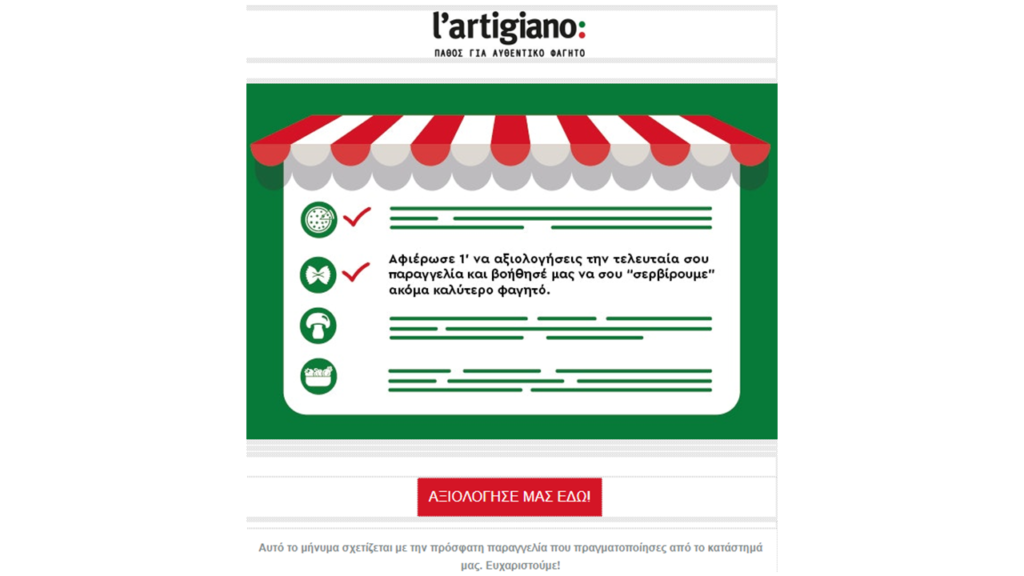
  • Enticing and to-the-point subject lines and email body texts that capture customers’ attention and get them to answer the questionnaires.
  • Straightforward questions that effortlessly communicate the objective and reason for the customers’ participation.
  • Evaluation of the frequency of asking for feedback so that the customers will not feel “spammed”, thus helping them to find value in their responses.
  • Aesthetically pleasing questionnaires and branded assets on every customer touchpoint (emails, surveys, thank you pages).
  • Mobile optimization, since a considerable number of customers have opted for communication with brands via smartphone.

How Customer Effort Score (CES) contributed in gathering valuable feedback?


L’Artigiano knows that their customers’ experience begins with an order. Naturally, they wanted to find out what customers think about their website’s navigation.

This particular need led to the activation of Customer Effort Score (CES). CES is a valuable metric when it comes to the evaluation of the efficiency of customer service teams. Eventually, CES has also proven to be equally effective in self service experiences, such as website navigation and check-out process completion

The question typically used to measure CES is along the lines of “How easy was it for you to complete your order?” 

Having already passed the test of Response Rate increase with flying colours, feedback collection through CES was impressive, right from the start. By posing the aforementioned question and gathering the scores generated by customer responses, L’Artigiano is now able to shine a light on the “effort” made by visitors when browsing their website. And this piece of intel can only lead to one thing: a continuously enhanced experience that will boost customer satisfaction! 

Results


Coherent questions, optimized positioning (on desktop and mobile alike) and a brief but highly targeted questionnaire combined with an already satisfying level of customer experience from previous L’Artigiano surveys, to produce a 39% Response Rate!

This number surpassed all expectations, especially considering that -based on international CX reports- the highest expected Response Rate is estimated at 25%, while 10%-20% Response Rates are classified as reasonable. 

And the most significant result? Customers continue to provide answers and share their experiences with L’Artigiano! 

Furthermore, the feedback generated through CES surveys is already being used in the process of L’Artigiano’s website redesign! 


Key Takeaways


Making the most of the data gathered through the e-satisfaction.com online platform, L’Artigiano executes effectively targeted and segmented promotional campaigns via an array of marketing tools like e-mails, social media posts, rewards etc.

What has become apparent, through trial and error, is that when brands decide to pay serious attention to their customers’ experiences and act on their comments, then: 

  • Engagement is considerably enhanced and this positively affects the customers’ intent to keep participating in questionnaires.
  • A Response Rate increase has been proven to occur.
  • Customer feedback can serve as the basis for the process of improving a brand’s products and services. 

To sum up, L’Artigiano’s case proves that customers are… hungry to share their opinions through questionnaires, providing that a solid strategy has been set up and a customer satisfaction platform has been employed to ensure an effortless and successful implementation.


Discover how you can collect feedback and enjoy a fruitful, long-lasting communication with your customers with e-satisfaction.com!