
What Is Customer Effort Score (CES) And Why Is It Important?

If your daily routine revolves around CX metrics, chances are you have already come across CES or Customer Effort Score. You also probably know that it’s quite important for customer loyalty, but you haven’t incorporated it in your strategy yet. So, where does one start with CES?

If your daily routine revolves around CX metrics, chances are you have already come across CES or Customer Effort Score. You also probably know that it’s quite important for customer loyalty, but you haven’t incorporated it in your strategy yet. So, where does one start with CES?

What is Customer Effort Score (CES)?


CES is a fairly recent CX metric that, along with NPS (Net Promoter Score) and CSAT (Customer Satisfaction Score), can provide insights on customers’ satisfaction and the quality of their relationship with a brand/store. 

The question used to measure CES is along the lines of “How easy was it for you to (e.g. complete your transaction)?” An index from 1 to 5 or from 1 to 7 (1 standing for “very difficult” and 5 or 7 for “very easy”) that measures the effort that customers put into a transaction/interaction with a company. Answers between 5 and 7 are considered a good CES, although an industry benchmark has not been set yet.
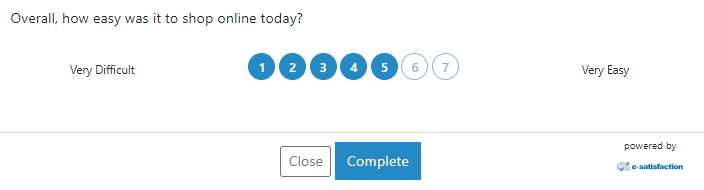
So, CES has emerged to shine a light on how easy it is for customers to get involved with a brand or a store. The origins of CES can be traced back to 2010 and a Harvard Business Review article named “Stop Trying to Delight Your Customers”. Its writers presented a case against the established notion that delight leads to loyalty. Their conclusion? The easiest way to increase customer loyalty is not through “wowing your customers,” but rather through making it easier for them to get their job done.

What is the difference between CES and CSAT?


CSAT has evolved to serve as the primary metric for companies that wish to evaluate their customer experience. But what happens when we talk about customer loyalty? Harvard Business Review research has shown that CES provides more accurate future loyalty predictions that CSAT. This is due to the fact that CSAT measures customer satisfaction for a specific interaction/transaction, while CES paints a more comprehensive picture of a customer’s relationship with a brand/store. 

But let’s take a look at the numbers… According to Gartner, 96% of customers that report high effort experiences become disloyal, compared to 9% of customers with low effort experiences.

Impressive as these numbers may be, that does not mean that CES has come to take other metrics’ place! On the contrary, metrics synergy is the key to bringing more value to overall CX measuring. 

And even though most CX experts see CES as highly valuable in measuring customer service departments’ performance, it has also been proven effective in the self-service sector, where we can also place the process of online shopping.

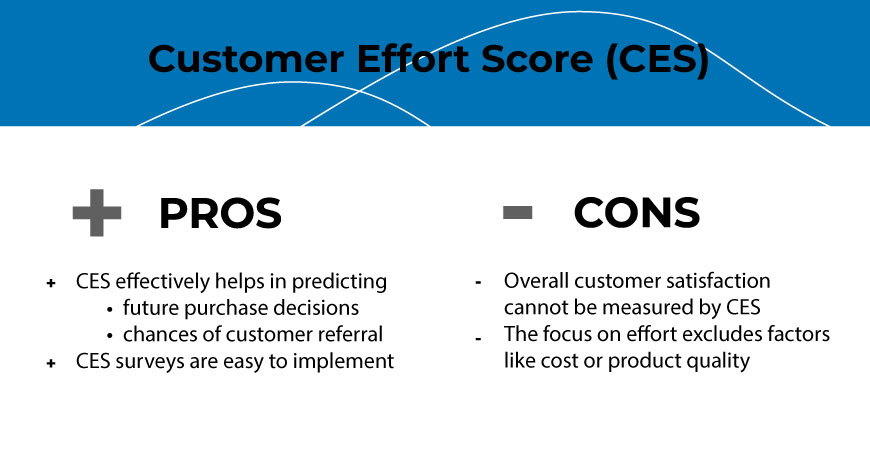
What are the Pros & Cons of CES?


As is the case with every kind of metric or indicator, CES comes with its own set of pros and cons:
What is the best way to measure CES? 


CES may be a relatively fresh metric, but the debate on its measuring has been raging! According to the Corporate Executive Board (CEB) consulting firm, when a client moves from 1 to 5 on the CES index, his loyalty is increased by 22%. But if a customer moves from 5 to 7 on the index, then the loyalty increase is estimated at just 2%. These numbers naturally lead to an important question: do you need to measure averages or study the answers’ distribution when it comes to CES?

And the answer is… distributions, not just averages! Only by factoring both into your analysis, can you be in a position to estimate whether your customers have a difficult or an effortless experience and identify customer segments that you need to focus your energy on, in the hopes of making their interaction with your brand easier.

Measuring CES… in action!


Taking into account your objectives and the type of feedback that you wish to collect, maybe it’s time to consider activating CES and measure your customers’ effort, whether it concerns the navigation of your website/e-shop, the process of completing their transactions or how easy it is for them to use your services/products. Check out how L’Artigiano successfully took advantage of this metric using e-satisfaction’s tools for some much-needed CES inspiration!


    Is there a solution to a low response rate?

    Questionnaires are all set and running, but your customers’ response is not what you would call enthusiastic? Time to get to the root of the problem and collect the feedback that you crave!

    Questionnaires are all set and running, but your customers’ response is not what you would call enthusiastic? Time to get to the root of the problem and collect the feedback that you crave!


    Before we delve into the practices that have been proven to increase response rate, it’s important to talk a little about what an average response rate is. So, let’s start from the basics and work our way from there.

    What is Response Rate?


    When you run surveys, the response rate is simply the percentage of people who answered your questions. To calculate it, the number of the people who answered needs to be divided by the number of people that you sent your survey. Then, you multiply the result by 100 to get the percentage.

    A considerable response rate is important, because a higher number of answers means more reliable metrics and more actionable feedback.

    What is the average Response Rate?


    The average response rate is a rather relative number that ranges across industries and depends on a list of factors, one of them being the type of survey used (e-mail, online or in-app surveys). 

    From a data analysis that e-satisfaction.com performed, we came up with two interesting figures:

    • Estimated Response Rate on Check Out Surveys: 20%
    • Estimated Response Rate on After Sales Surveys: 10%

    Now, according to international CX reports, the highest expected Response Rate is estimated at 23-25%, while 10%-20% Response Rates are classified as reasonable. 

    Of course, averages are meant to be surpassed… Check out how L’Artigiano achieved a 39% Response Rate with the help of e-satisfaction.com!

    What can you do to boost your Response Rate?


    If your response rate is on the low side, then you need to rethink your approach, survey-wise. Whether you have set up online or e-mail questionnaires, there are a number of ways to tweak, improve them and reap the benefits. 

    What follows is a list of best practices that will set you on the right path towards a higher response rate:

    • Mention the objective of your survey! Customers are more willing to provide answers when they know the reason you’re asking them questions in the first place and what it means for them. If you also add the estimated time they will need to complete the survey, then you are setting an inviting atmosphere that leads to more respondents. 
    • Keep the whole affair short and to-the-point! Time is the most precious commodity nowadays and people don’t like to spend it on answering surveys that seem to go on forever. Don’t forget that if you want to delve deeper and ask further questions, you always send them a follow-up questionnaire.
    • Used branded questionnaires! They contribute to a higher response rate since they draw customers’ attention and show that you went the extra mile and did not use a generic template. 
    • Keep your tone of voice consistent! If your brand uses a friendly or relaxed tone to communicate with your audience in all of its assets, you don’t want your surveys to come out as flat or uninspired. You can keep your spark and wit, but make sure that your message is clear.
    • Optimize for mobile! OK, this one is practically a no-brainer and it should be on the top of your list when it comes to improving your surveys. Almost 50% of customers use their smartphones for online purchases and web browsing. Wouldn’t it be a shame if you lose their precious answers because they find it difficult to answer your questionnaires through their mobile devices?
    • Check your frequency! Nobody likes a spammer and you should be careful about how often you reach out to your customers. They need to feel that you care about their opinion and not that you are begging for it.

    —-

    Always keep in mind that a higher response rate is not something that will happen overnight. You need to try different things, measure their impact and keep adjusting and tweaking until you reach that sweet spot with your audience, the one where they eagerly share their feedback with you.

    And it always helps if you use a platform like e-satisfaction.com, that allows you to streamline the whole process: from the set up of a questionnaire to the ways with which it can yield results!


    You got 15 minutes? Let our team show you
    how we can help your business grow!

      Request a 15min Demo


      BOOK A FREE DEMO NOW

      Greek eCommerce: First reaction to COVID-19

      covid-19 survey ecommerce

      Στην πρωτόγνωρη κατάσταση που ζούμε το βασικό αίσθημα που είναι διάχυτο στην αγορά είναι η αβεβαιότητα, η προσαρμογή σε νέες μεθόδους λειτουργίας και η αναζήτηση του τρόπου που ο καθένας μας μπορεί να βοηθήσει για να ξεπεράσουμε τη δύσκολη αυτή κατάσταση. 

      Tο ηλεκτρονικό εμπόριο τους επόμενους μήνες θα αποτελέσει το βασικό και πιο ασφαλές κανάλι μέσω του οποίου το καταναλωτικό κοινό θα επιλέγει να εξυπηρετείται. Η νέα κατάσταση αποτελεί ευκαιρία για πολλούς αλλά απαιτεί οργάνωση, πολλές αλλαγές και γρήγορες αποφάσεις. 

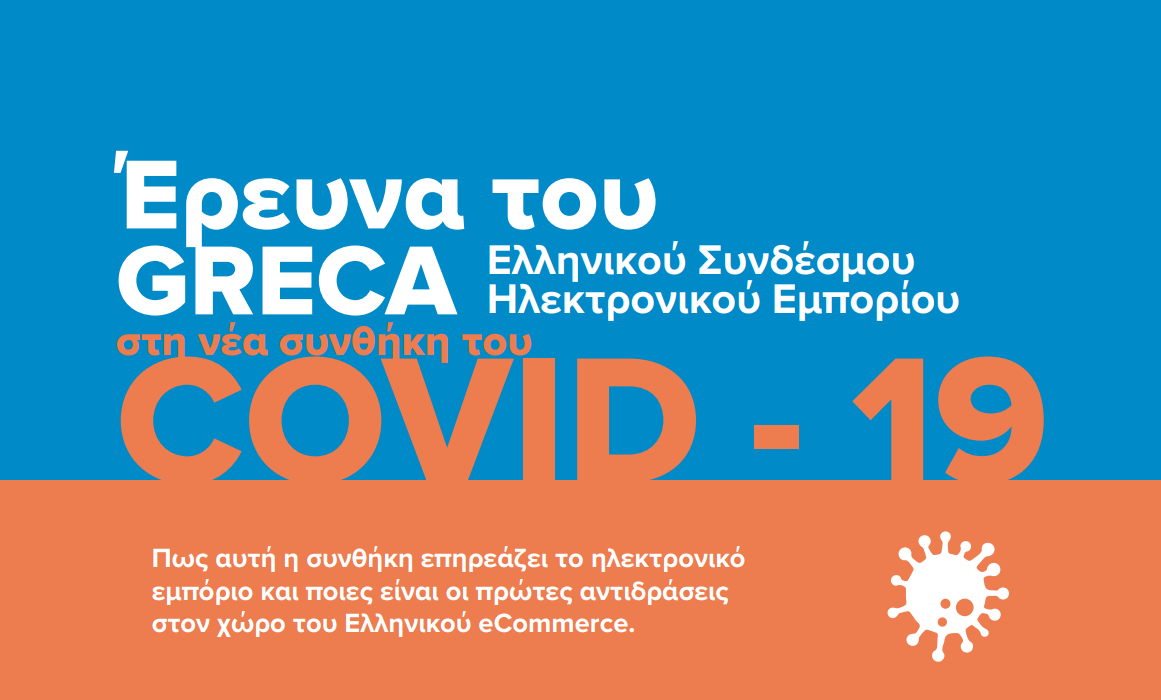
      Προκειμένου να κάνουμε μια πρώτη αξιολόγηση στη νέα συνθήκη του COVID-19, ξεκινήσαμε στις 18 Μαρτίου μια έρευνα σε συνεργασία με τον Ελληνικό Σύνδεσμο Ηλεκτρονικού Εμπορίου GRECA και με την υποστήριξη των BestPrice και του Skroutz

      Η έρευνα είχε διάρκεια 18/03 – 21/03 και συμμετείχαν 307 επιχειρήσεις που δραστηριοποιούνται στο ηλεκτρονικό εμπόριο. Πιστεύουμε ότι τα συμπεράσματα αποτελούν χρήσιμη πηγή πληροφοριών τόσο για την Ε.Ε. όσο και για εθνικές αποφάσεις με σκοπό την υιοθέτηση καλύτερης δυνατής προσέγγισης για έναν τομέα που θα έχει καίριο ρόλο σε αυτήν την κρίση.

      >>Κατεβάστε τα αποτελέσματα εδώ<<


      How to Increase Revenue From your Loyal Customers

      It took 50 days for Maison Marasil to have 118 new orders and 3% revenue increase by using e-satisfaction’s Refer a Friend mechanism and without spending extra money on a referral program.

       Leverage with Refer a Friend Campaign


      The Maison Marasil – Fragos S.A. company, which operates in the children’s clothing industry, in collaboration with e-satisfaction, created a campaign with the aim of rewarding satisfied customers and also attracting new customers in maisonmarasil.com (Refer a Friend campaign). The campaign yielded pleasant and encouraging, for other e-shops as well, results.

      Objective

      The Refer a Friend campaign has the objective of rewarding the satisfied customers of Maison Marasil and especially the ones that would recommend the e-shop to their friends and colleagues (the so-called promoters). E-satisfaction targets this segment of loyal customers through Net Promoter Score metric (known as NPS in international references). A 5% discount coupon acted as a motive for their next purchase and also resulted as a reward for the customer.

      Another objective of this campaign was, to create a new path that will attract easily and quickly new customers to the e-shop, by providing them with a 5% discount coupon for their first purchase.

      Automations

      This campaign is displayed only to the customers of Maison Marasil that are willing to promote the e-shop to a friend or colleague. Namely, these clients had rated with 9 or 10 (in a scale out of 10) the following question “How likely are you to recommend our e-shop to your friends or colleagues”.

      After the completion of their order, the customer-promoter can fill in the e-mail of a friend in order to receive automatically two different newsletters with unique discount coupons of 5% discount for their next purchase.

      Results

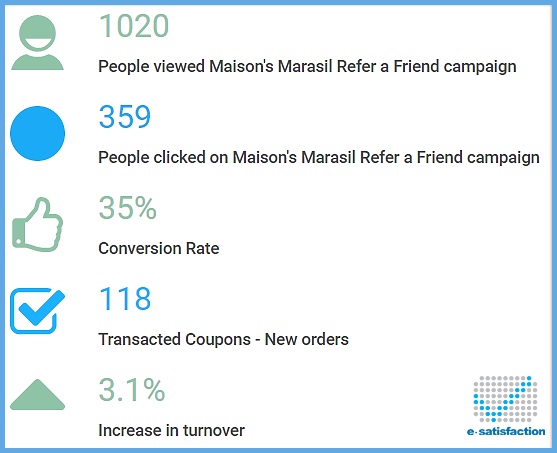
      The Refer a Friend campaign yielded remarkable results and created new paths for both Maison Marasil and e-satisfaction, as resulted in just 50 days of function in bringing 118 new orders, by
      using e-satisfaction’s free marketing mechanism!

      In more detail, from the 1.020 customers who viewed the campaign, 359 clicked on it (Conversion Rate 35%). Furthermore, the 118 new orders resulted in the following:

      • Increased average number of items per order
      • 3.1% increase in turnover was achieved!

      refer a friend automation, refer a friend campaign, refer a friend campaign for maison marasil

      What is e-satisfaction?

      e-satisfaction is the #1 Humanized Marketing Platform for e-Business that combines customer feedback with actual automated marketing mechanisms that aim to recover or retain your customers. e-satisfaction is used by hundreds of e-businesses, helping them to go one step closer to customer centricity.

      Click here to create your FREE acount

      3 Tips to enhance the value of your Black Friday Sales

      Black Friday is at the corner!! Here are 3 useful tips that will help you enhance the value of your Black Friday sales while using e-satisfaction’s features!!

      Black Friday is almost here and you have prepared great offers and discounts for your clients, following one of the most known customs in the e-commerce world. It is a major-peak-sales day and discounts will attract all lights and attention of your clients. But how will you get something more out of Black Friday? How can you gain from the awareness that your offer will bring and most important…How can you turn your Black Friday offers to a marketing tool and enhance their value?

      The question is easy to be answered if you take some time to think that the clients who take the Black Friday Deal you offer are the best possible evangelists of your brand and that this deal can be used to create (or re-establish) your relationship with them! Some tactical actions that you can follow to go down the humanized marketing road are the following:

      1: Ask them to Refer you or your Deal

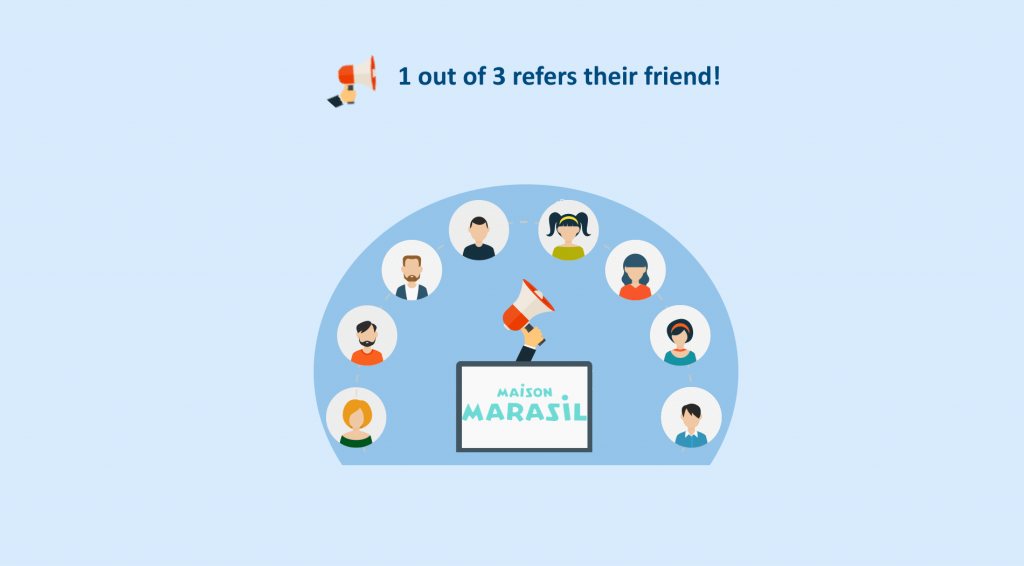
      By examining how effective e-satisfaction’s Refer A Friend marketing automation is, we have seen that 35% of satisfied customers will refer you to friends, if you ask them to do it! Just think how happy your customers are on Black Friday and how willing they will be to share your offer with their friends!

      Cost – free awareness is so easy to be achieved after all!

      2: Reward your loyal and happy customers

      Bring the light to the happy customers of your e-shop!! Find who your loyal and happy customers are and reward them with Black Friday deals, especially made for them, showing them how much they mean to you!

      3: Encourage social share

      Ask your customers to like your Facebook Page and your Black Friday Post. Even the ones that have forgotten about Black Friday, will be immediately informed and they will be willing to order again as not to lose your incredible sales!

      To conclude…

      Creating bonds with your clients and maintaining a frequent communication channel is the best way to amplify every promotional activity you are doing. Every contact moment with your clients is a new chance to remind them how important they are for you and this is when you can ask them to show how happy they are.

      What is e-satisfaction?

      e-satisfaction is the #1 Humanized Marketing Platform for e-Business that combines customer feedback with actual automated marketing mechanisms that aim to recover or retain your customers. e-satisfaction is used by hundreds of e-businesses, helping them to go one step closer to customer centricity.

      Click to create your FREE account