

How AI Is Improving Patient Experience Across the Healthcare Journey
AI patient experience tools are closing the gap between what patients expect and what healthcare actually delivers, from booking an appointment to staying engaged long after discharge. AI now removes friction in scheduling, helps care teams communicate more clearly, turns raw patient feedback into action, and flags dissatisfaction before it turns into a lost patient. This post walks through each stage of the healthcare journey and shows where AI is making the biggest difference today.
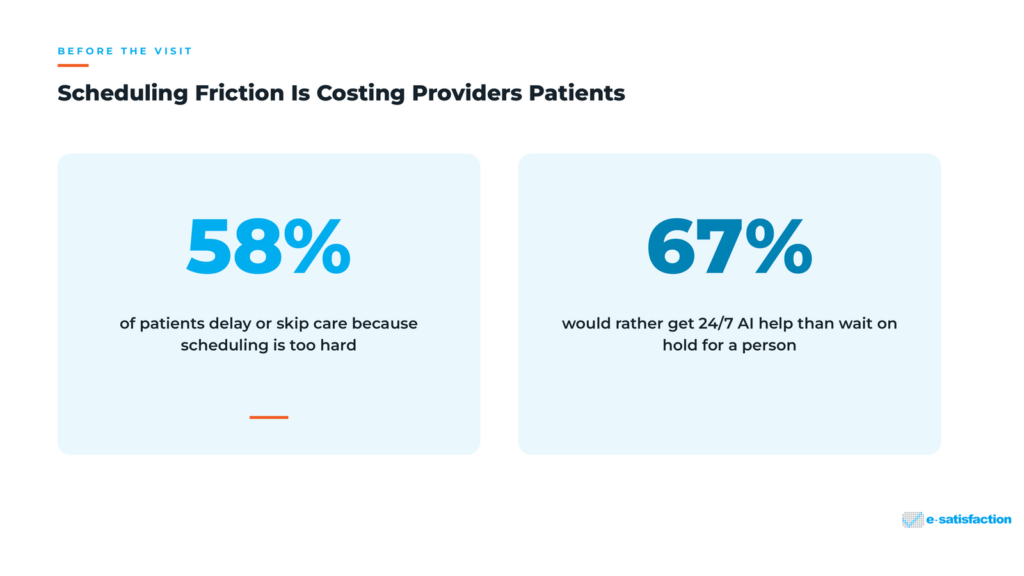
Patients now expect healthcare to feel as easy as everything else in their lives. It rarely does. Over half of patients say they delay or skip care altogether because scheduling is too hard, and two thirds would rather get help from AI around the clock than sit on hold for a human agent, according to Salesforce’s Connected Health Consumer Report. That gap between what patients expect and what they actually get has been building for years, quietly, in the small moments nobody puts in a satisfaction survey: the hold music, the third form asking for the same allergy list, the portal message that never gets a reply. AI patient experience tools exist to close that gap, not by adding another app to the pile, but by removing the friction that was never supposed to be part of getting care in the first place.
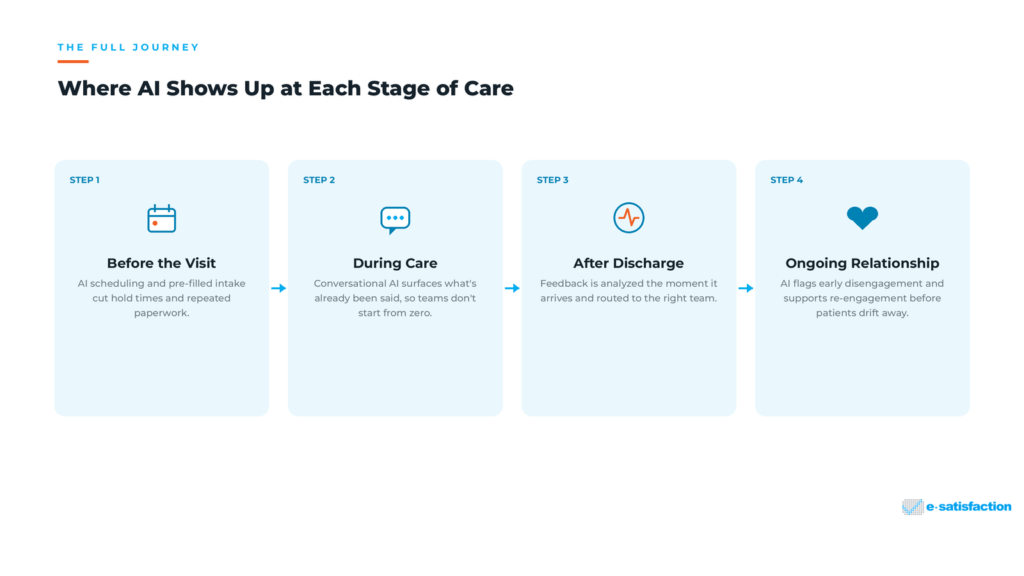
This isn’t about replacing clinicians. It’s about removing the friction that sits between patients and the care they need, at every point in the journey: before the visit, during care, after discharge, and in the months that follow. Each of those stages has its own failure points, and each one responds differently to AI, which is exactly why a single fix rarely moves the needle on its own. Below, we break down how AI is reshaping each stage, and what healthcare leaders should watch for as adoption accelerates and patient expectations keep climbing.
What Is AI Patient Experience, and Why Does It Matter Now?
AI patient experience refers to the use of artificial intelligence, like natural language processing, predictive analytics, and conversational tools, to make healthcare interactions easier, faster, and more personal at every touchpoint. It covers everything from scheduling and intake to post-visit feedback and long-term engagement, and it typically works quietly in the background: routing a message, flagging a pattern, pre-filling a form, so the person on the other end barely notices the technology at all. That’s actually the point. The best AI patient experience work is invisible to the patient and obvious in the outcomes: shorter waits, fewer repeated conversations, and faster responses when something goes wrong.
It matters now because patient tolerance for friction has dropped, and it dropped fast. Patients compare their healthcare experience to their banking app or their favorite retailer, not to the hospital down the street, and they carry that comparison with them into every appointment, every phone call, and every portal login. That shift in expectations is well documented in customer experience research across industries, and healthcare is catching up fast, even if unevenly: 75% of U.S. health systems now use or plan to use an AI platform, and half of those already run three or more AI applications at once, per a Fierce Healthcare survey of health system executives. Adoption at that scale means the conversation has shifted from whether to use AI in patient experience to how well it’s being used, and that’s a much harder question to answer.
Before the Visit: AI Removes Friction from Scheduling and Intake
The patient journey usually breaks down before care even starts, which is easy to overlook because it happens away from the clinical setting where most healthcare organizations focus their attention. Long hold times, repetitive intake forms, and confusing scheduling portals push patients to delay care or give up entirely, and by the time anyone notices, the patient has either rescheduled three times or quietly gone somewhere else. This stage rarely gets measured the way clinical quality does, yet it’s the first, and sometimes only, impression a new patient forms of an organization.
AI-powered scheduling assistants now handle appointment booking, rescheduling, and reminders through chat and voice, without a patient ever waiting on hold, and they do it around the clock instead of during a narrow call-center window. Intake forms pre-fill from existing records, so patients stop repeating their medical history at every single visit, which sounds like a small convenience until you consider how many patients cite exactly that repetition as a reason they stopped trusting a provider’s coordination of their care. These same friction points show up across AI-driven customer experience solutions in retail and finance, where fixing the “front door” experience consistently lifts satisfaction before anything else changes, simply because it’s the first thing every customer touches. In healthcare, the stakes are simply higher: friction here doesn’t just lose a sale, it delays a diagnosis, and that difference in consequence is why this stage deserves more attention than it usually gets.
How Does AI Improve Communication During Care?
AI improves communication during care by giving providers a fuller, faster picture of what a patient has already said, asked, or struggled with, so the conversation picks up where it left off instead of starting over every single time. Conversational AI tools can also answer routine questions in real time, whether that’s a medication instruction or a billing question, freeing clinical staff to focus on higher-value conversations that actually require a human’s judgment and attention.
This works the same way conversational analytics works in any customer relationship: capturing what people actually say, in their own words, instead of forcing them into a rigid survey format that flattens nuance into a five-point scale. Applied to healthcare, that means a nurse or care coordinator can see, at a glance, what a patient already raised with someone else on the team, rather than asking the patient to repeat themselves for the fourth time that week. Programs built around a true Voice of the Customer approach apply the same logic: listen continuously, not just at scheduled checkpoints, so nothing important gets lost in the handoff between shifts, departments, or systems.
After Discharge: Turning Patient Feedback Into Action
Most patient feedback historically arrived too late to matter: a survey mailed weeks after discharge, read by someone with no way to act on it, filed away in a spreadsheet that nobody revisits until the next quarterly review. By the time a pattern becomes visible in that kind of data, dozens more patients have already had the same frustrating experience. AI changes that by analyzing feedback the moment it comes in, across channels, whether that’s a text message, a call transcript, or an online review, and routing it to the right team instantly instead of letting it sit in a queue.
This is where customer feedback analytics earns its place in a patient experience strategy. Natural language processing can scan open-ended comments and automatically group them by theme, whether that’s billing confusion, discharge instructions, or wait times, turning a pile of unstructured complaints into a short list of things worth fixing this week. A well-tuned topic detection engine can surface a spike in complaints about, say, a specific department’s communication style, days before it would show up in a satisfaction score, which is often the difference between a quiet fix and a public complaint.
If your organization is still relying on quarterly survey reports to catch problems, here’s how real-time feedback analysis closes that gap.
Can AI Detect Emotional Distress or Dissatisfaction Before It Escalates?
Yes. AI sentiment analysis can detect frustration, confusion, or anxiety in patient messages, calls, and reviews, often before a patient files a formal complaint or leaves a negative review, simply by picking up on tone, word choice, and shifts in how someone is communicating compared to their earlier messages. This gives care teams a chance to step in early instead of reacting after the fact, when the relationship is already damaged and the patient has mentally moved on.
This is the same discipline behind AI sentiment analysis platforms used in customer experience more broadly: reading tone and emotion, not just keywords, and connecting that signal to real-time customer insights that a team can act on the same day rather than discovering the problem in next month’s report. In healthcare specifically, this matters because negative experiences carry real consequences, and patients rarely give a second chance the way they might with a retailer. Two thirds of patients report having had a negative healthcare experience, and over a third of those patients say they switched providers or treatment as a result, according to an Accenture survey covered by Becker’s Hospital Review. Catching the warning signs early, before a patient reaches that breaking point, is what separates organizations that retain patients from ones that quietly lose them one bad interaction at a time.
Building Long-Term Trust: AI and the Ongoing Patient Relationship
Patient experience doesn’t end at discharge, even though most measurement programs are built as if it does. The organizations getting the most value from AI treat it as an ongoing relationship, not a single encounter, using AI to spot early signs of disengagement, a missed follow-up, a skipped refill, a pattern of unanswered messages, and re-engage patients before they drift away entirely and quietly find care somewhere else.
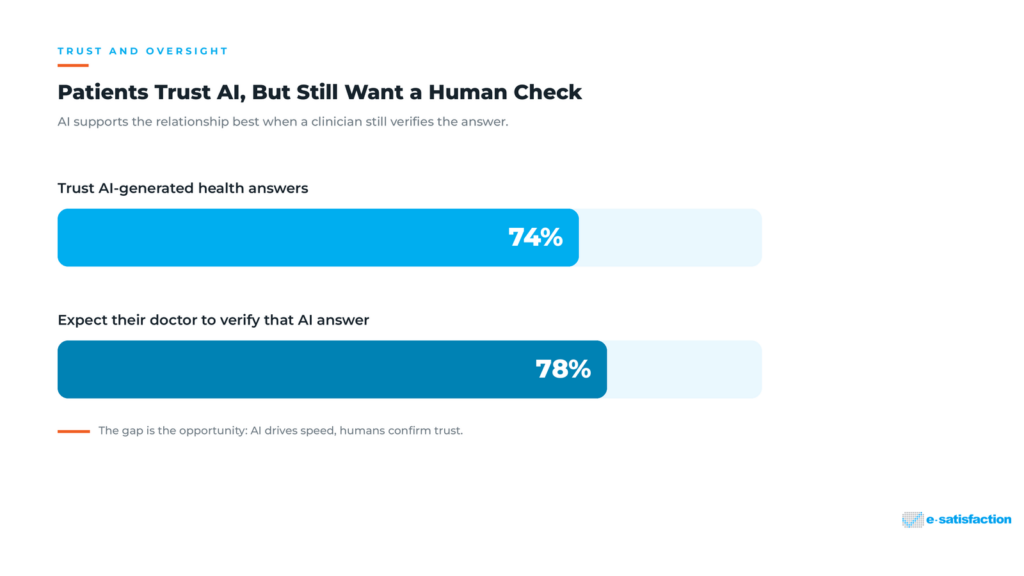
That’s the same principle behind AI-driven customer retention: catching the early signals of dissatisfaction while there’s still time to fix them, rather than waiting for a patient to formally leave before anyone notices something was wrong. A unified customer intelligence platform that connects feedback, sentiment, and engagement data gives healthcare organizations one place to see the full relationship, rather than fragments spread across scheduling, billing, and clinical systems that never talk to each other. Trust still needs a human check, though, and that nuance matters more in healthcare than almost anywhere else: 74% of patients say they trust AI-generated health answers, yet 78% still expect their doctor to validate that information, according to Wolters Kluwer’s 2026 Future Ready Healthcare survey. AI earns trust by supporting the relationship, not replacing the people in it, and that distinction is worth holding onto as adoption accelerates across every stage of the journey.
Where AI Patient Experience Is Headed Next
The direction is clear: less friction, faster listening, and earlier intervention, applied consistently across the entire journey rather than at a single touchpoint that happens to have an executive sponsor. Organizations that treat AI patient experience as a full-journey strategy, not a point solution bolted onto one department, are the ones seeing measurable gains in loyalty and retention, because friction removed at one stage tends to resurface at the next if nobody’s looking at the whole picture. That mirrors what’s already playing out across the broader AI CX landscape: platforms that unify listening, analysis, and action are pulling ahead of single-purpose tools that solve one problem while leaving three others untouched.
Conclusion
AI patient experience isn’t one tool. It’s a thread that runs through scheduling, communication, feedback, and long-term engagement, and it works best when every stage feeds the next, when what’s learned at intake informs the conversation during care, and what’s heard after discharge shapes how the relationship continues. Patients notice friction fastest at the start of the journey and remember how they were treated long after it ends, and both of those moments matter more than most measurement programs give them credit for. Getting both right is what separates organizations patients stay loyal to from the ones they quietly leave without ever filing a complaint.
Ready to see what a unified view of patient feedback and sentiment looks like in practice? Book a demo and see how it fits your organization.
Frequently Asked Questions
What is AI patient experience?
AI patient experience is the use of artificial intelligence, such as natural language processing, sentiment analysis, and predictive analytics, to reduce friction and improve communication across every stage of a patient’s interaction with a healthcare provider, from scheduling to post-care follow-up.
How does AI improve patient scheduling and intake?
AI-powered scheduling tools handle bookings, reminders, and rescheduling through chat or voice, cutting hold times and no-shows. Intake forms can also pre-fill from existing patient records, so patients stop repeating their medical history at every visit.
Can AI really detect patient dissatisfaction before it becomes a complaint?
Yes. AI sentiment analysis tools scan patient messages, calls, and reviews for signs of frustration or confusion, often catching early warning signs before a patient files a formal complaint or leaves a negative review.
Does using AI in patient experience reduce trust in care?
Not when it’s used to support, not replace, the clinical relationship. Research shows most patients trust AI-generated health information but still expect their doctor to validate it, according to Wolters Kluwer’s 2026 healthcare survey. AI works best as a support layer behind human judgment.
What’s the biggest opportunity for AI in patient experience right now?
Turning fragmented feedback, scheduling, and engagement data into one continuous view of the patient relationship. Most healthcare organizations already collect this data. The opportunity is connecting it so teams can act on it in real time instead of days or weeks later.