

How Real-Time Customer Intelligence Is Changing CX Strategy
Real-time customer insights are moving CX strategy off the quarterly calendar and onto a live loop. When you can see what customers feel as it happens, the old rhythm of surveys, reports, and annual plans starts to cost you customers. This post explains what real-time customer intelligence is, why periodic strategy is already out of date, and how to close the gap between an insight and an action.
Most CX strategies still run on a calendar. You collect feedback, wait for the report, and adjust the plan next quarter. That rhythm made sense when data was slow. It doesn’t anymore. Real-time customer insights now arrive the moment a customer acts, and that single change is quietly rewriting how CX strategy gets set.
The shift is bigger than faster dashboards. It changes when decisions get made, who makes them, and how a brand competes. Gartner reports that 91% of customer service and support leaders feel executive pressure to adopt AI, much of it aimed at acting faster on what customers are telling them. This is the same current pulling CX toward a more predictive, real-time future. Here’s what that means for how you plan.
What are real-time customer insights?
Real-time customer insights are findings drawn from customer signals the moment they happen, then delivered fast enough to influence a decision while it still matters. They come from surveys, reviews, chats, calls, and behavior, read continuously rather than reviewed after the fact.
The key word is “act.” Fast reporting is not the same thing. A chart that refreshes quickly but arrives after the customer has already left is still a rear-view mirror. Real intelligence means the signal reaches a person who can do something about it, in time to change the outcome. That’s the difference between watching churn and preventing it. It’s also why AI in customer experience has become central: no human team can read every signal as it lands.
Why quarterly CX strategy is already out of date
Strategy built on last quarter’s data is describing customers who have already moved on. An insight is worth the most the instant a customer sends the signal, and its value decays fast. By the time it reaches a quarterly review, the moment to act has usually passed.
This is a decision-speed problem, not a data problem. McKinsey found that only 37% of organizations say their decisions are both high quality and high velocity, and that speed and quality together track closely with company performance. Slow decisions don’t just annoy customers. They compound into lost revenue while faster competitors adjust.
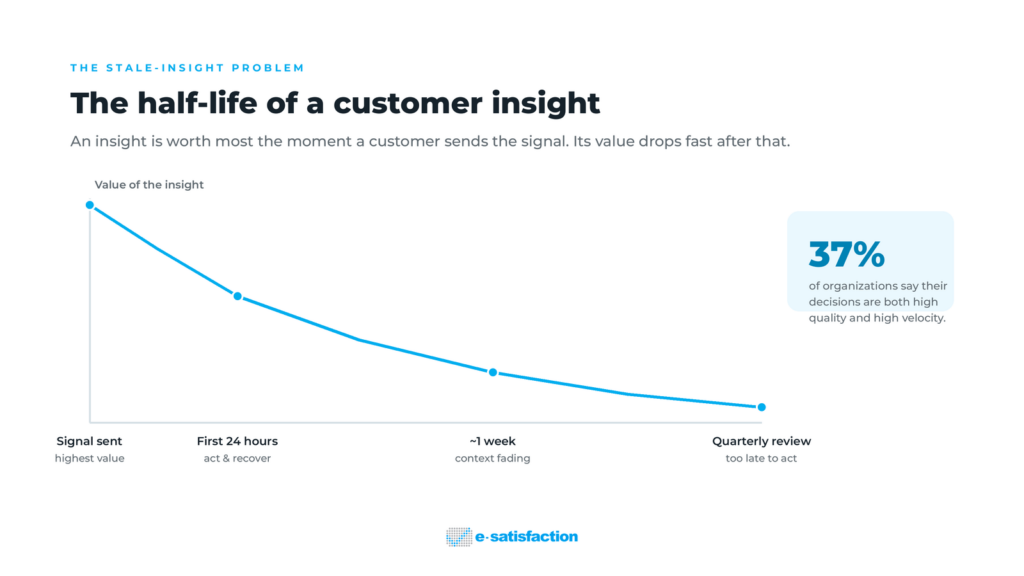
The pattern shows up everywhere in CX. A frustrated customer signals in a chat, a review, or a support call. The signal sits in a queue. A week later, the theme surfaces in a report. A quarter later, it becomes a slide. By then the customer is gone, and so are the others who felt the same way but never said a word.
How do real-time customer insights change CX strategy?
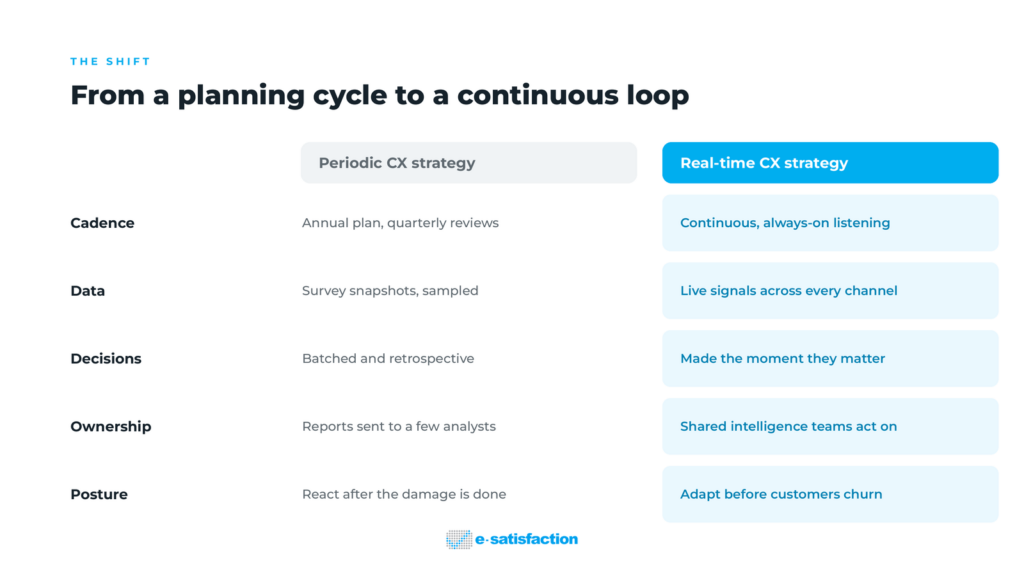
Real-time customer insights turn strategy from a periodic plan into a continuous loop. Instead of setting direction once a quarter and hoping it holds, teams listen constantly, decide in the moment, and adjust as customer reality shifts. Strategy becomes something you run, not something you file.
That changes the operating model, not just the tooling. Cadence moves from annual to always-on. Data moves from sampled snapshots to live signals. Decisions move from batched and retrospective to made when they count. Ownership moves from a report seen by a few analysts to shared intelligence a whole team acts on.
None of this is optional at the platform level anymore. Gartner now treats real-time activation as table stakes for the systems that power customer data. The brands pulling ahead have stopped treating feedback as a report and started treating it as a live input into daily decisions.
If your team is still waiting for the next review cycle to act on what customers are saying, see how brands run this as a continuous loop instead.
What signals feed real-time customer intelligence?
Real-time customer intelligence pulls from every channel where customers leave a trace: survey responses, product reviews, live chats, support calls, and on-site behavior. AI reads all of it at once, scoring tone and grouping themes so nothing waits in a queue.
Most of this feedback is unstructured text and speech, which is exactly where teams used to drown. Modern customer feedback analytics reads open comments at scale, while AI sentiment analysis catches the shift from mildly annoyed to about to leave. Conversational analytics does the same across chats and calls. Together they form an AI Voice of Customer layer that never stops listening.
From dashboards to decisions: closing the insight-to-action gap
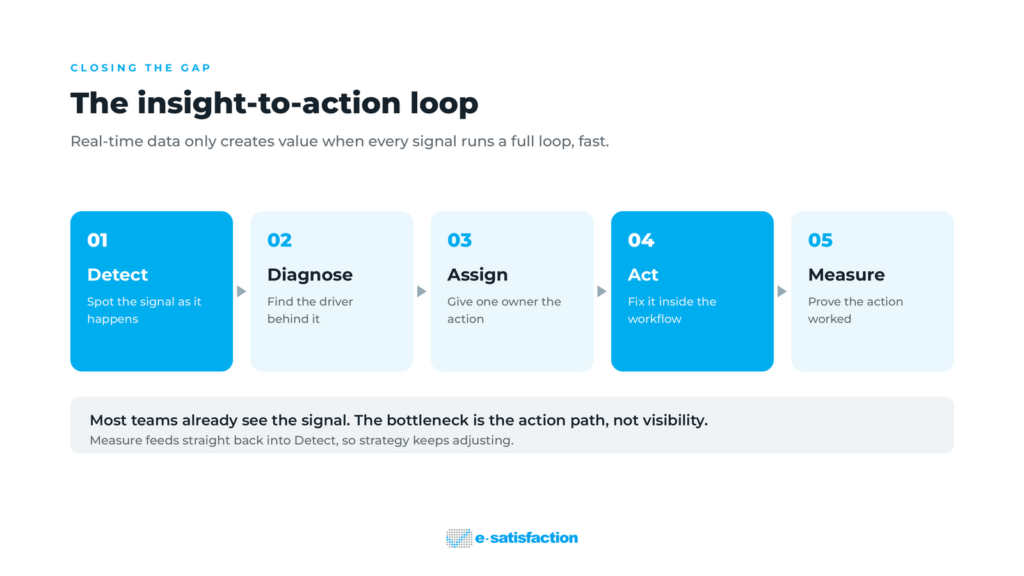
Here’s the uncomfortable truth: most teams already see the signal. As CX Today puts it, visibility is no longer the bottleneck. The gap sits downstream, in prioritization, ownership, and a clear path to act when the dashboard turns red.
The fix is a real loop: detect the signal, diagnose the driver, assign one owner, act inside the workflow, then measure whether the action worked. Feed that result back into detection and strategy keeps adjusting on its own.
AI carries the heavy parts of that loop. Gartner names real-time customer data insights and next-best-action recommendations among the most valuable AI use cases in service, because they help people act without hunting for answers first. Tools that surface emerging themes automatically do the diagnosis step, so an owner sees not just that something changed but why.
What real-time CX strategy looks like in practice
Running strategy as a loop reshapes the team, not just the reports. Insight stops living with a small analytics group and gets embedded where decisions happen, echoing McKinsey’s view of a data-driven enterprise where data informs every decision, interaction, and process.
In practice that means shorter cadences, clearer ownership, and fewer blind spots between “we noticed” and “we fixed it.” It shifts the whole posture from reactive to proactive, which sits at the center of most AI CX trends worth watching. Catch a rising frustration theme this week, act on it this week, and you protect customers before they churn instead of explaining the loss next quarter.
The takeaway
Real-time customer insights don’t just make CX faster. They change what strategy is. The plan stops being a document you revisit each quarter and becomes a loop you run every day.
Three things separate the brands getting this right. They treat feedback as a live input, not a report. They close the gap between insight and action with clear ownership. And they measure whether each action worked, then feed that back in. Do those three, and CX strategy stops chasing customers and starts moving with them.
Ready to run your CX strategy as a live loop instead of a quarterly review? Request a free demo and see real-time customer intelligence in action.
Frequently Asked Questions
What are real-time customer insights?
Real-time customer insights are findings pulled from customer signals the moment they happen, then delivered fast enough to shape a decision while it still matters. They draw on surveys, reviews, chats, calls, and behavior, read continuously instead of reviewed weeks later. The point is acting in time, not just seeing data sooner.
How is real-time customer intelligence different from a fast dashboard?
A fast dashboard refreshes charts quickly but can still surface information after the moment to act has passed. Real-time customer intelligence connects the signal to a person who can respond in time. As industry analysts note, insight only counts as real-time if teams can act before the moment passes.
Why is quarterly CX strategy no longer enough?
An insight loses value fast, so a signal reviewed a quarter later usually describes customers who have already moved on. McKinsey found only 37% of organizations make decisions that are both high quality and high velocity, and that both traits track with performance. A quarterly cadence is simply too slow for how quickly customer expectations shift.
What is the insight-to-action gap?
The insight-to-action gap is the delay between seeing a customer signal and doing something about it. For most teams visibility is no longer the problem; the bottleneck is prioritization, ownership, and a clear path to act. Closing it means running a loop: detect, diagnose, assign an owner, act, and measure the result.
Do I need AI for real-time customer insights?
For any real volume, yes. Customer feedback arrives faster than any team can read it, most of it as unstructured text and speech. AI reads every comment, scores sentiment, and groups themes as they land, so problems reach an owner while there’s still time to fix them.