

AI Healthcare CX: Reducing Wait Times and Increasing Patient Satisfaction
Wait times are the single biggest operational drag on patient satisfaction scores, and the research shows it is not just the clock that matters, it is the gap between what patients expect and what actually happens. AI healthcare CX tools close that gap by predicting demand before it becomes a bottleneck, triaging patients by real clinical urgency, cutting phone hold times, and keeping patients informed while they wait. This post breaks down exactly where wait times form, what the data says about why they hurt satisfaction so much, and how AI-driven customer experience tools are helping healthcare organizations fix the problem at its source rather than patching it after the fact.
Ask any hospital administrator what keeps them up at night and “wait times” will come up in the first five minutes. It is not a minor irritation. It is one of the most consistent predictors of how patients rate their entire care experience, and it shows up everywhere: on the phone trying to book an appointment, in the waiting room before a visit, in the emergency department during a surge, and even in how long it takes to get a callback about test results. AI healthcare CX has become one of the fastest-growing areas of investment for exactly this reason. Health systems are realizing that wait time is not just an operations metric buried in a dashboard somewhere. It is the experience, as far as most patients are concerned, and fixing it takes more than adding staff or hoping the schedule holds up.
This matters more now than it did even a few years ago. Patients compare healthcare to every other service they use, and every other service has gotten faster. A patient who waits 40 minutes past their appointment time does not benchmark that against other hospitals. They benchmark it against how quickly their food delivery arrived or how fast their bank resolved a dispute. That shift in expectation is part of why AI healthcare CX has moved from a nice-to-have pilot project to a board-level priority at many organizations.
Why Do Wait Times Have Such a Big Effect on Patient Satisfaction?
Wait times affect patient satisfaction because they shape a patient’s confidence in the provider before a single word of care is delivered. Research on ambulatory clinics has found that longer wait times are consistently associated with lower scores across nearly every dimension of patient experience, including how much a patient trusts their provider’s competence and how they rate the overall quality of care, not just how they rate the wait itself.
That finding matters because it means the damage from a long wait does not stay contained to one line item on a survey. It bleeds into how a patient interprets everything that happens afterward, from how thorough the exam felt to how much they trust the treatment plan they are handed on the way out. A study published in AJMC found this negative association held even when controlling for the provider’s actual performance, which suggests that the wait itself is coloring the patient’s perception of care quality, not just their patience level. For a health system trying to lift HCAHPS scores, this is the uncomfortable truth: you can have an excellent clinical team and still take a satisfaction hit if the front end of the visit runs long.
Does Perceived Wait Time Matter More Than Actual Wait Time?
Yes, and this is the detail most healthcare organizations miss. A clinical study on outpatient satisfaction found that actual wait time had no statistically significant direct effect on how satisfied a patient reported feeling. What did matter, significantly, was the gap between what a patient expected to wait and what a patient perceived they had waited.
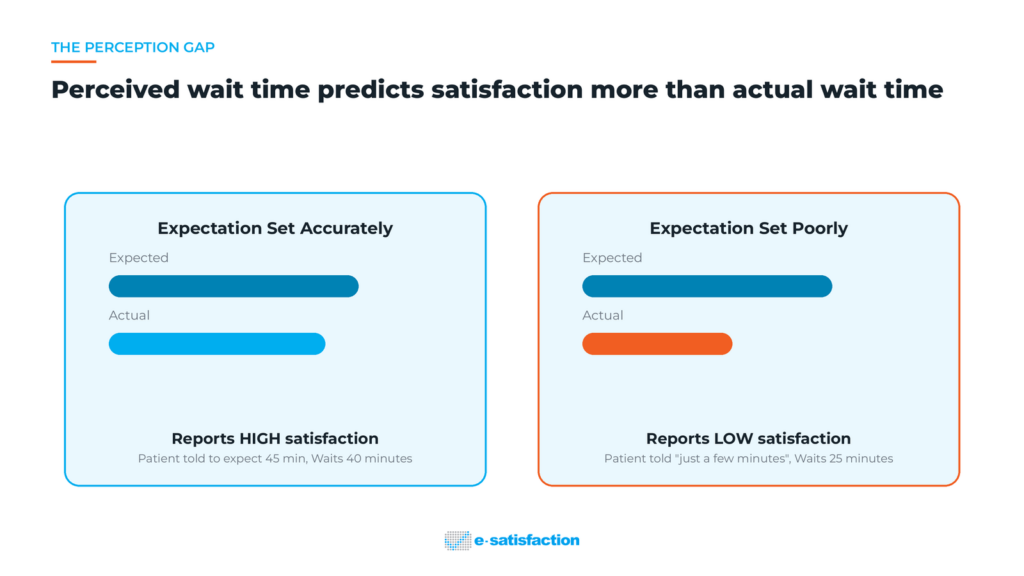
This distinction changes the whole strategy. If actual minutes on the clock were the only variable that mattered, the fix would simply be adding staff or trimming appointment slots, which is expensive and often impossible given clinician shortages. But the research on waiting time and outpatient satisfaction shows that objective wait time still matters, just indirectly: it shapes the subjective, perceived wait time, and it is that perception gap that predicts satisfaction. A patient who is told to expect a 45-minute wait and waits 40 minutes often reports feeling far more satisfied than a patient who was told “just a few minutes” and waited 25. This is precisely why AI healthcare CX tools that manage expectations, through accurate wait estimates, proactive updates, and transparent queue status, can move satisfaction scores even before a single operational bottleneck is fixed. It is also why a purely clinical view of patient experience, one that assumes better care alone will win the day, misses half the picture. Every touchpoint where a patient is left guessing how long something will take is a touchpoint where AI healthcare CX can quietly close an expectation gap that traditional scheduling systems were never designed to manage. This same principle shows up across AI-driven customer experience solutions in retail and travel, where a delivery tracker or a “your table will be ready in 12 minutes” notification does more for satisfaction than shaving a few actual minutes off the wait itself.
How Does AI Prevent Patient Wait Times Before They Happen?
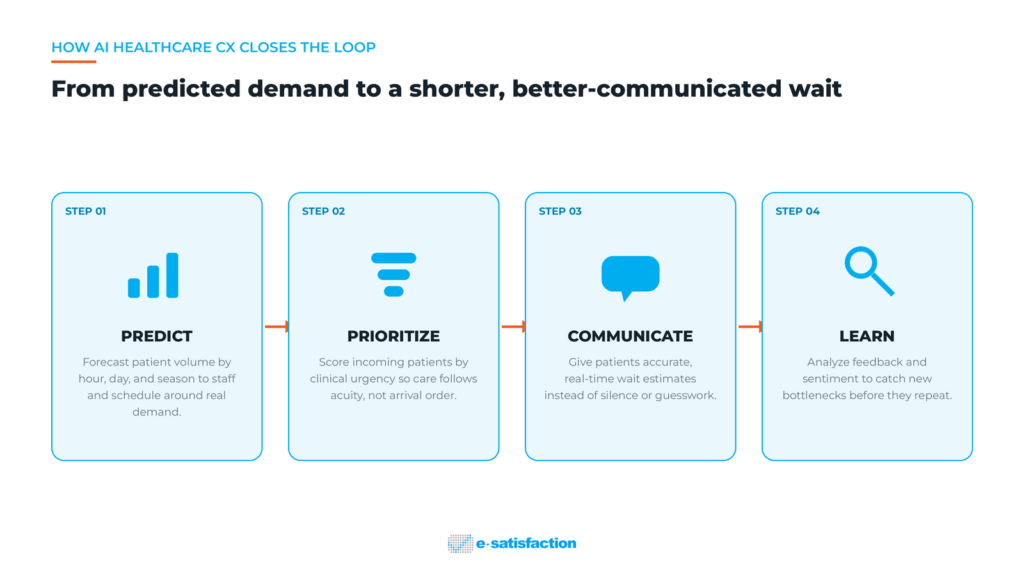
AI prevents patient wait times by forecasting demand before it turns into a bottleneck, using historical visit data, seasonal patterns, staffing levels, and even local event or illness trends to predict how many patients will need care on a given day and hour. Instead of building a schedule around average demand, predictive scheduling builds around expected demand, which is rarely the same thing.
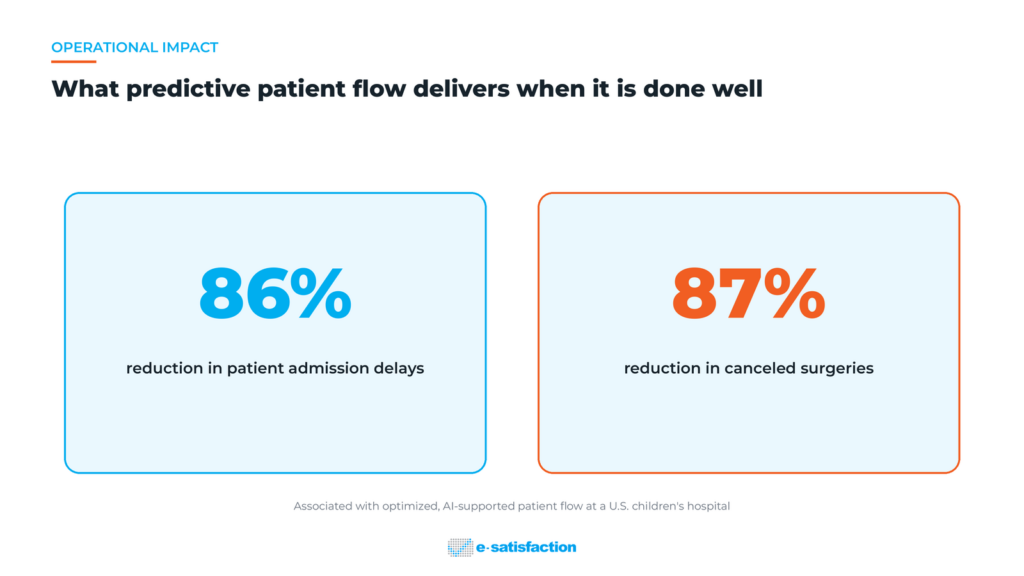
The results when this is done well are significant. One widely cited example comes from Children’s Mercy Kansas City, where optimizing patient flow with predictive tools was associated with an 86% reduction in patient admission delays and an 87% reduction in canceled surgeries, according to a 2026 industry forecast. Those are not marginal gains from tweaking a spreadsheet. They come from treating patient flow as a system that can be modeled and predicted, the same discipline that underpins real-time customer insights in any high-volume service business. National health systems are making the same bet at massive scale. The NHS recently committed a £10 billion investment specifically targeting technologies that reduce administrative burden and shorten waiting times, with officials projecting roughly £41 billion in benefits over the next decade from better resource use and shorter waits alone. Predictive scheduling will not eliminate every surge, emergencies do not follow a calendar, but it does mean fewer patients are stuck waiting simply because a system built its schedule around an average day rather than the day that actually happened.
If your organization is still building schedules around last year’s average rather than this week’s real demand, see how AI healthcare CX solutions close that gap before it shows up as a patient complaint.
AI Triage: Getting the Right Patient to the Right Care Faster
Emergency departments face a version of the wait time problem that clinics do not: patients cannot simply be seen in the order they arrive, because arrival order has nothing to do with clinical urgency. A minor injury that walks in at 2pm should not be seen before a chest pain case that walks in at 2:05pm, but a purely manual triage process, run by an overworked team during a surge, is prone to inconsistency.
AI-assisted triage models score incoming patients using vital signs, chief complaint, age, and other structured and unstructured intake data to predict acuity and likely disposition, admission, discharge, or specialist referral, within minutes of arrival. This is not about replacing the triage nurse’s judgment. It is about giving that nurse a consistent, data-backed second opinion the moment a patient walks through the door, so the sickest patients move through the queue faster and lower-acuity patients are not stuck waiting behind cases that turn out to need a different care pathway entirely. The operational upside compounds when this feeds into a broader Voice of Customer style program, one that listens continuously for where queue friction is building rather than waiting for a discharge survey to surface it weeks later. It is worth being clear about the limits here too. AI triage models support a decision, they do not make it, and every credible deployment keeps a clinician in the loop specifically because misclassifying a patient in either direction carries real cost. Used this way, though, triage AI shortens the single most anxiety-inducing wait in healthcare: the one where a patient does not know if anyone has recognized how serious their situation actually is.
Cutting Phone Hold Times Before the Visit Ever Starts
A huge share of patient frustration with wait times has nothing to do with the waiting room. It happens on the phone, before an appointment is even booked. Patients calling to schedule, reschedule, ask a billing question, or get a referral routed correctly are often met with long hold queues, and every minute on hold is a minute a patient associates with the brand, not just the front desk staff who happen to be short-handed that day.
This is a well-documented failure point. One health network described average hold times of 30 to 40 minutes before deploying an AI-driven call handling system, a wait so long it had already generated a negative public review before any fix was in place. After adopting AI call automation, the organization was able to resolve routine calls instantly rather than routing every single one through an already stretched front desk team. This mirrors what conversational analytics has already proven in retail and financial services: when AI can understand and resolve a routine request in natural language, staff are freed to handle the calls that genuinely need a human, and the patient never experiences the hold music in the first place. For a healthcare organization thinking about AI healthcare CX holistically, the phone system is often the lowest-hanging fruit and the highest-visibility win, because it is usually the very first interaction a patient has with the organization at all.
Turning Wait Time Complaints Into a Continuous Improvement Loop
Most healthcare organizations already know, in general terms, that wait times are a problem. What they usually lack is granular, real-time visibility into where in the process the wait is actually happening, at check-in, in the exam room, at discharge, or somewhere in between, and which department or shift is driving the trend.
This is where customer feedback analytics earns its place inside an AI healthcare CX strategy. Natural language processing can scan open-ended patient comments from surveys, messages, and reviews, and automatically cluster them by theme, separating a complaint about the checkout line from a complaint about waiting for test results back. A well-tuned topic detection engine can flag a spike in wait-time complaints tied to a specific department or shift days before it would ever surface in a quarterly satisfaction report, giving operations leaders a chance to fix a staffing gap before it becomes a pattern. Layered on top of that, AI sentiment analysis platforms can detect the frustration or anxiety in a patient’s language even when the patient never explicitly uses the word “wait,” picking up on tone in a way that keyword-based survey scoring never could. None of this replaces the operational fixes described earlier in this post. It is what tells you, with evidence rather than guesswork, whether those fixes are actually working and where the next bottleneck is quietly forming.
Building an AI Healthcare CX Strategy That Actually Moves the Needle
Reducing wait times is not a single project with a clean finish line. It is an ongoing discipline that touches scheduling, triage, front-desk operations, and feedback analysis all at once, and organizations that treat it as a one-time fix tend to see gains fade within a year as demand patterns shift again.
The organizations getting durable results tend to build around a single unified view of the patient experience rather than a patchwork of point solutions, one place where scheduling data, triage outcomes, call center metrics, and patient feedback all connect. That unified approach is also where the ROI on AI CX investment becomes measurable in terms leadership actually cares about: fewer canceled appointments, shorter average time-to-care, and satisfaction scores that hold steady even as patient volume grows. It also protects the gains already discussed, a predictive scheduling model or a new triage tool only keeps working if the feedback loop around it keeps catching the moments when reality drifts from the plan, and that requires the same continuous listening infrastructure that mature CX programs use to prevent churn in any other industry.
Conclusion
Wait times are not a soft, secondary metric buried below clinical quality in what patients care about. They shape trust, color perception of care, and directly move satisfaction scores that hospitals are now measured and reimbursed against. The research is clear that closing the gap between what patients expect and what they experience matters as much as shaving minutes off a clock, and AI healthcare CX tools, from predictive scheduling to intelligent triage to real-time feedback analysis, are how that gap gets closed at scale rather than one frustrated patient at a time. The health systems seeing the biggest gains are not the ones throwing more staff at the problem. They are the ones building a connected system that predicts, prioritizes, and listens continuously.
If wait times are showing up in your patient feedback more often than you would like, request a demo to see how an AI-powered CX platform can help you find exactly where the friction is building and fix it before it costs you a patient.
Frequently Asked Questions
What is AI healthcare CX?
AI healthcare CX refers to the use of artificial intelligence, including predictive analytics, natural language processing, and machine learning triage models, to improve how patients experience healthcare services. It covers scheduling, communication, triage, feedback analysis, and every other touchpoint a patient has with a health system.
Does reducing wait times actually improve patient satisfaction scores?
Yes. Research consistently shows longer wait times are associated with lower scores across nearly every dimension of patient satisfaction, including trust in the provider and perceived quality of care, as documented in studies on ambulatory clinic wait times. Reducing wait times, and managing expectations around them, has a measurable effect on satisfaction and HCAHPS-style scores.
Can AI eliminate wait times completely in a hospital or clinic?
No single tool eliminates wait times entirely, especially in emergency and unscheduled care settings where demand is unpredictable. AI reduces wait times by predicting demand more accurately, prioritizing patients by real clinical urgency, and managing patient expectations, which together shrink both the actual and perceived wait significantly.
Is AI triage safe to use in emergency departments?
AI triage models are designed to support, not replace, clinical judgment. They provide a consistent, data-backed risk score based on vital signs and intake data, which a triage nurse or physician reviews before making the final call, keeping a clinician in the loop at every step.
How does patient feedback data help reduce wait times over time?
AI-powered feedback analysis and topic detection can identify exactly where and when wait-time complaints are clustering, whether that is a specific department, shift, or process step, often days before the issue would surface in a formal survey. This lets operations teams fix the root cause instead of reacting to a satisfaction score after the damage is already done.