

Why Customer Experience Teams Are Investing in AI Analytics Platforms
CX teams are shifting budget toward a customer intelligence platform because manual feedback review can no longer keep pace with the volume and speed of customer signals. Tech budgets for customer experience are rising, buying committees are widening, and the platforms winning approval are the ones that turn raw feedback into decisions in real time. This post breaks down why the investment is happening now, what CX leaders look for during evaluation, and how to build the internal case for buy-in.
Customer experience teams are not buying software for the sake of it. When a CX leader brings a customer intelligence platform to the budget table this year, it is usually because something broke first: a spike in complaints nobody saw coming, a churn signal caught three weeks too late, or a board asking for proof that the feedback program actually changes outcomes.
That pressure is showing up in the numbers. A recent Gartner survey found that customer service leaders identified improving customer satisfaction, operational efficiency, and self-service success as their top priorities for 2026, with AI now central to how they plan to get there. Budget is following that priority. This post walks through why the investment case for AI analytics has gotten so much stronger, what actually triggers the buying decision, and what CX leaders should look for once they start evaluating vendors.
If you are already comparing platforms, see how an AI VoC platform compares to traditional feedback tools before you shortlist anyone.
What Is a Customer Intelligence Platform?
A customer intelligence platform collects feedback and behavioral signals from every channel, reviews, support tickets, surveys, chat, and social, then uses AI to turn that raw data into a single, structured view of what customers think and why. Unlike a basic survey tool, it works continuously, scoring sentiment and surfacing patterns without waiting for a quarterly report.
The distinction matters because most CX teams already collect plenty of feedback. What they lack is a system that reads all of it, connects it to business impact, and routes it to the right team automatically. That is the gap an AI-native VoC platform is built to close, and it is the reason “collecting feedback” and “understanding customers at scale” have become two very different capabilities.
Why Are CX Budgets Shifting Toward AI Analytics Right Now?
Three forces are converging. First, customer expectations keep rising while support and CX headcount mostly is not. Second, boards want measurable proof that experience investment protects revenue, not just goodwill. Third, the tools themselves have matured enough to justify the spend.
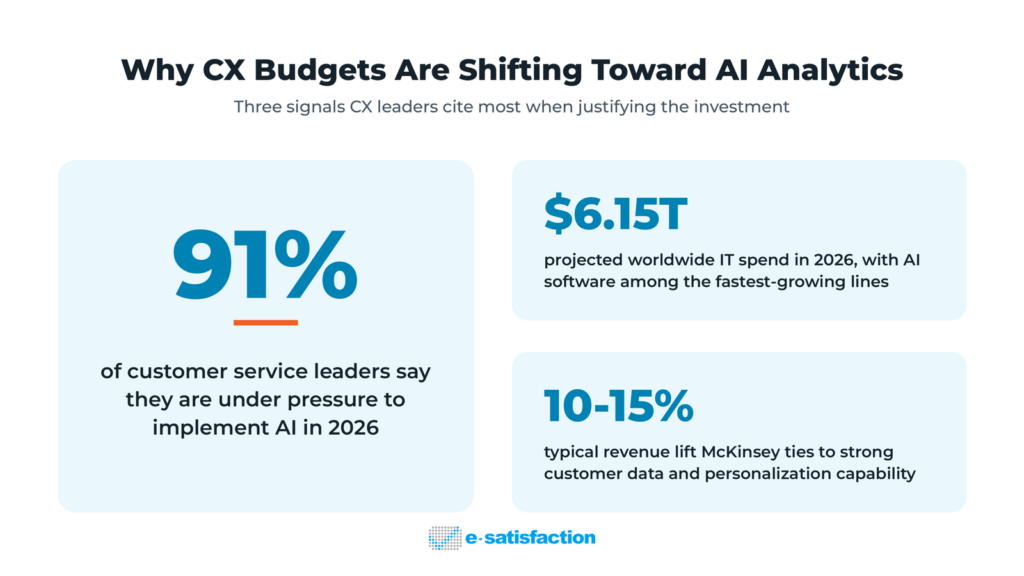
Gartner’s own forecasting reflects this shift at the macro level: worldwide IT spending is projected to grow into the trillions in 2026, with AI-related software among the fastest-growing categories. Inside that spend, customer service and CX technology is no longer treated as a discretionary line item. It increasingly competes for the same priority as core infrastructure, because leadership now views customer signal as a leading indicator for revenue, not a lagging satisfaction score. This is a large part of why AI CX trends for 2026 keep pointing toward consolidation around fewer, smarter platforms rather than a growing pile of point tools.
The Real Trigger Behind Most Buying Decisions
Budget approval rarely starts with a strategy memo. It starts with a team drowning in feedback it cannot process fast enough. Support tickets pile up faster than anyone can tag them. Review volume across marketplaces outpaces a human analyst’s capacity by an order of magnitude. Survey comments sit unread because nobody has time to code them by hand.
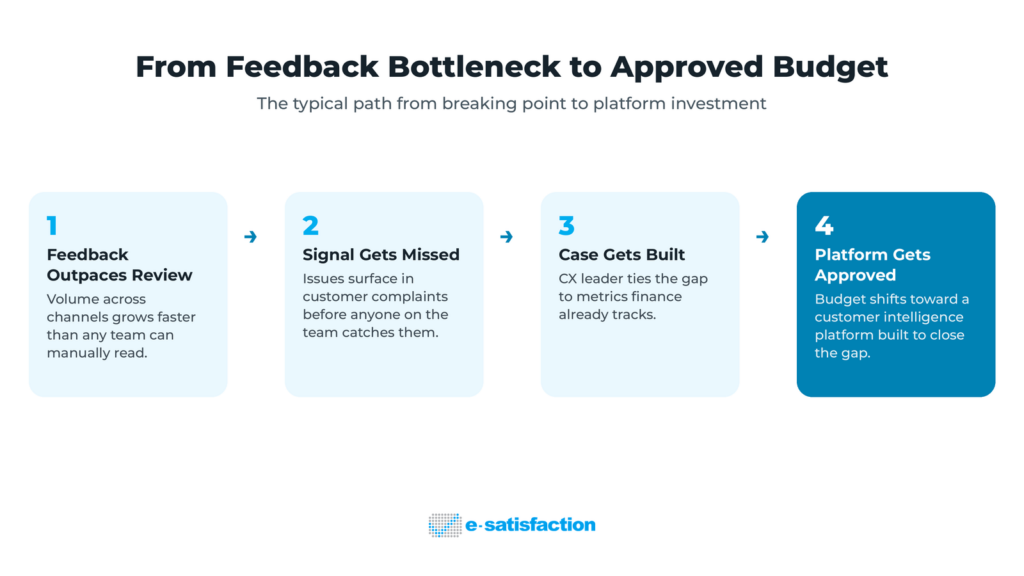
That bottleneck is precisely what AI-powered feedback analytics is designed to remove. Instead of a research team manually sorting comments into categories, the platform does it continuously, at whatever volume the business generates. Once a CX leader sees how much insight was sitting untouched in that backlog, the investment case tends to write itself.
If this bottleneck sounds familiar, see how brands remove it with real-time customer intelligence rather than a quarterly review cycle.
What Should CX Leaders Look for When Evaluating a Platform?
A strong customer intelligence platform combines four things: real-time processing so insight arrives while it is still actionable, sentiment analysis that reads emotion and context rather than just keywords, automatic topic detection that groups feedback by root cause, and integrations that route findings to the teams who can act on them.
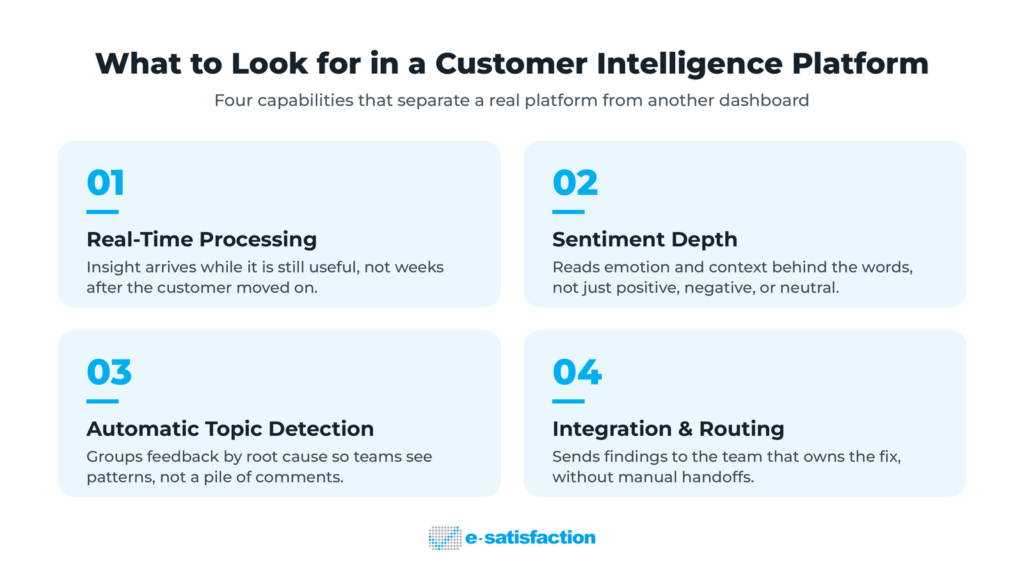
Skip any of the four and the platform becomes another dashboard nobody checks. Sentiment analysis built for CX teams should tell you not just that a customer is unhappy, but what specifically is driving that emotion. Pair it with automatic topic detection built for CX operations, and a team can move from “customers are frustrated” to “customers are frustrated with delivery tracking” in the same afternoon.
Building the Internal Business Case
Getting budget approved usually means convincing people outside the CX function. Finance wants a defensible return. Product wants proof that insight will change the roadmap, not just the dashboard. Leadership wants a shorter path from complaint to fix. That fragmentation is common.
That fragmentation is common. A recent Forrester survey found most B2C marketing leaders admit their marketing and loyalty technology still is not unified, which is exactly the kind of stack sprawl a consolidated customer intelligence platform is meant to fix.
The strongest business cases connect the platform to numbers those stakeholders already track: reduced time to detect an issue, fewer support hours spent manually tagging feedback, and a measurable lift in retention among the customers flagged as at risk. If you need help framing that math, this breakdown of AI CX ROI covers the metrics that hold up in a budget review.
Conclusion
The investment case for a customer intelligence platform is no longer theoretical. Feedback volume has outgrown manual review, budgets are shifting to match that reality, and the platforms earning approval are the ones that turn signals into action fast enough to matter. Start by naming your actual bottleneck, evaluate vendors against the four core capabilities, and build the business case around numbers your finance team already trusts.
Ready to see what a customer intelligence platform looks like in practice? Book a demo and we will walk through it with your own feedback data.
Frequently Asked Questions
What is the difference between a customer intelligence platform and a traditional VoC tool?
A traditional VoC tool mainly collects survey responses and reports scores after the fact. A customer intelligence platform analyzes feedback from every channel continuously, using AI to score sentiment, detect topics, and route insights in real time rather than waiting for a scheduled report.
How do I know if my team needs to invest in an AI analytics platform?
If your team spends more time collecting and tagging feedback than acting on it, or if issues surface in customer complaints before anyone on your team catches them, that is a strong sign manual review has hit its limit.
What should be included in the business case for a customer intelligence platform?
A solid business case ties the platform to metrics finance and leadership already track: faster issue detection, reduced manual analysis hours, and measurable retention gains among customers flagged as at risk.
Do smaller CX teams need an AI analytics platform, or is it only for enterprises?
Team size matters less than feedback volume. Even a small team can be overwhelmed if it operates across several channels, which is often where AI analytics delivers the fastest relief.
How long does it typically take to see value after investing in a customer intelligence platform?
Most teams see early signal within weeks, since AI analytics can process historical feedback immediately. Full ROI, including retention impact, typically becomes clear within one to two quarters as the team builds closed-loop habits around the insights.