

From Surveys to Conversations: The Rise of Conversational Analytics in Customer Feedback
Customer feedback used to mean surveys. Today, most of what customers tell you happens in chats, reviews, and calls. Conversational analytics reads that unstructured talk at scale and surfaces the themes, sentiment, and intent a score can never show. It doesn’t replace surveys; it completes the picture. Here is how feedback analytics evolved, how the technology works, and what to do with it.
Your customers are still talking. They have just stopped filling out your surveys. Response rates keep sliding, and the feedback that does arrive is often shallow or skewed. Conversational analytics flips the model. Instead of asking customers to rate you, it listens to what they already say across chats, reviews, calls, and open text.
This guide traces how customer feedback analytics moved from surveys to conversations. We will cover why the shift matters, how the technology works, and how to act on what it finds. The goal is simple: hear the whole voice of your customer, not just the slice that fills in a form.
What Is Conversational Analytics?
Conversational analytics is the use of AI to read unstructured customer interactions (chats, calls, reviews, emails, and open-ended survey replies) and turn them into clear insight. It detects the themes, emotions, and intent inside real conversations, not just the rating a customer leaves behind.
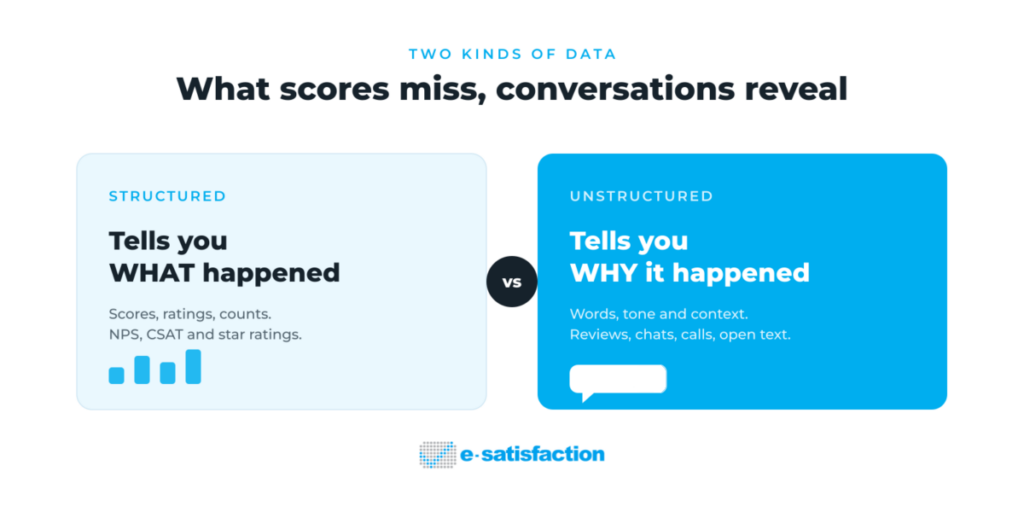
Traditional dashboards track structured data: scores, counts, and timestamps. They tell you what happened. Conversational analytics works on the words themselves, so it tells you why it happened. A 7 out of 10 is a number. The sentence next to it (“checkout was confusing and slow”) is the reason. Conversational analytics reads the reason at scale.
Why Are Traditional Surveys Falling Short?
Surveys still have value, but fewer people answer them. Survey fatigue, the exhaustion customers feel from constant feedback requests, has pushed response rates down across industries. The result is a small, often skewed sample that misses what most customers actually feel.
When customers go quiet, it rarely means they are happy. As one industry analysis put it, many customers have simply given up on surveys, and silence often signals churn rather than satisfaction. Meanwhile, real opinions pile up in support chats, product reviews, and call transcripts. To see the full picture, you need customer feedback analytics that works on those sources, not only the survey form.
How Did Customer Feedback Analytics Evolve From Surveys to Conversations?
The path runs through three eras.
Era one was surveys. Brands asked structured questions and tracked NPS, CSAT, and CES. Useful, but you only learn what you think to ask, and only from people who reply.
Era two was text and sentiment analytics. Software scanned open-text comments for keywords and tagged them positive or negative. A real step forward, but still shallow. A single label flattens a comment that is happy about delivery and angry about price.
Era three is conversational analytics. AI now reads whole conversations and holds context, emotion, and intent together.
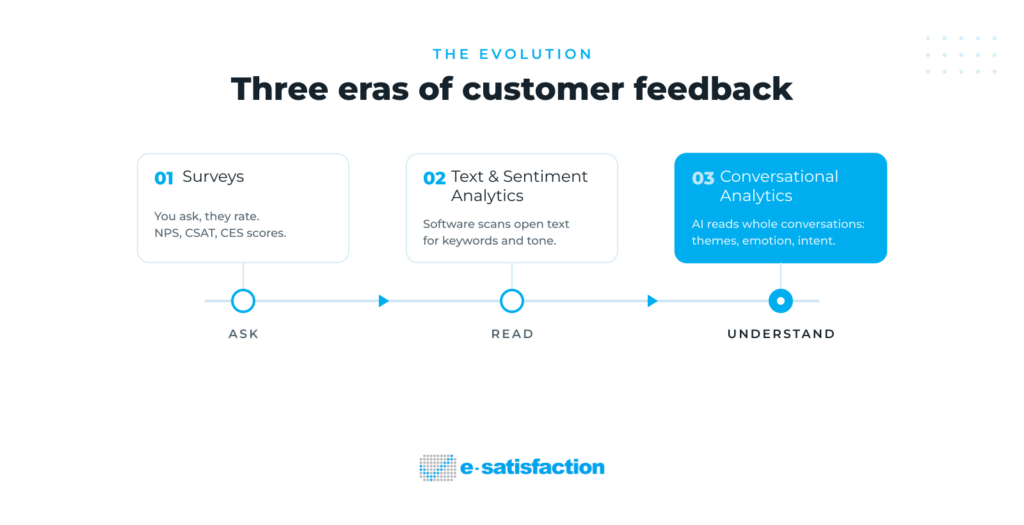
The push behind this shift is volume. Up to 80% of enterprise data is unstructured and mostly goes unused, locked inside messages, transcripts, and notes. Modern AI sentiment analysis reads tone and emotion in context, so that buried feedback finally becomes usable.
How Does Conversational Analytics Work?
Conversational analytics works in four steps: capture feedback from every channel, use natural language processing (NLP, software that reads human language) to group it into themes, detect sentiment and intent, then route the priorities to the right team.
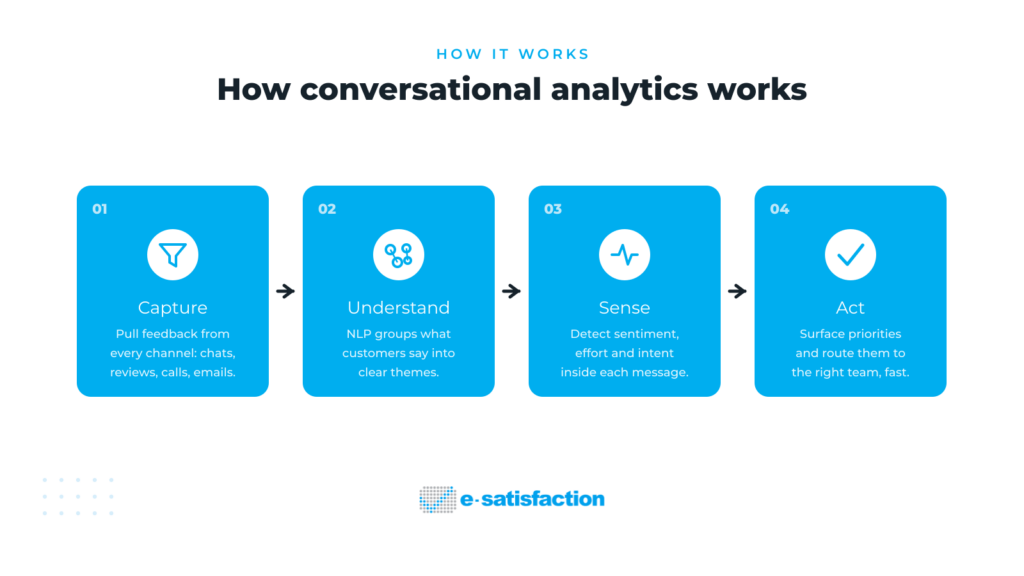
The capture stage matters most. A modern AI Voice of Customer program pulls from reviews, chats, calls, and open text in one place. NLP then clusters thousands of messages into a handful of clear themes. Sentiment scoring adds the emotional layer, and intent detection flags what the customer wants to do next, such as cancel, complain, or buy again.
Drowning in feedback you cannot read? See how leading retail and e-commerce brands turn scattered conversations into clear, ranked action: explore the approach.
What Can Brands Actually Do With It?
The value shows up in three moves.
First, catch churn early. Rising frustration and effort signals appear in conversations long before they show up in a score.
Second, prioritize by impact. Instead of reacting to the loudest complaint, you see which themes affect the most customers and revenue.
Third, act in real time. Insight reaches the right team while the issue is still fixable.
This is why listening pays off. Data-driven organizations are far more likely to acquire and retain customers, according to McKinsey research, and conversations are the richest data most brands already own. Feed those signals into your wider AI in customer experience strategy and feedback stops being a report. It becomes a daily input to decisions.
Is Conversational Analytics Replacing Surveys?
No. Conversational analytics complements surveys; it does not replace them. Structured scores tell you when something changed. Conversations tell you why. The strongest programs use both.
The balance matters. Forrester advises pairing AI-driven insight with proven human methods rather than handing customer research entirely to automation. Other CX predictions for 2026 warn against over-automating before the foundations are ready. Keep a short, well-timed survey for benchmarks. Use conversational analytics to explain the numbers and to hear everyone who never answers.
The Takeaway
Three points are worth keeping.
Feedback has moved from forms to free-flowing conversation, and your analytics needs to follow. Conversational analytics reads the unstructured talk you already collect and turns it into themes, sentiment, and intent. It works best beside surveys, not instead of them.
The brands that win will not be the ones with the most survey responses. They will be the ones that hear the whole conversation and act on it fast. Ready to turn scattered customer conversations into clear, ranked action? Book a demo and see your own feedback through purpose-built AI customer experience solutions.
Frequently Asked Questions
What is the difference between conversational analytics and sentiment analysis?
Sentiment analysis labels text as positive, negative, or neutral. Conversational analytics is broader. It reads full interactions to surface themes, intent, effort, and emotion together, then connects them to outcomes like churn or repeat purchase. Sentiment is one layer inside conversational analytics.
Does conversational analytics replace customer surveys?
No. It complements them. Surveys give you structured, comparable scores over time. Conversational analytics explains the reasons behind those scores and captures feedback from the majority of customers who never complete a survey. Used together, they give a fuller view.
What data does conversational analytics use?
It works on unstructured feedback: support chats, call transcripts, product reviews, emails, social messages, and open-ended survey comments. Anywhere customers use their own words, conversational analytics can read and organize what they say.
Is conversational analytics only for contact centers?
No. Contact centers were an early use case, but the same approach applies to e-commerce reviews, post-purchase feedback, app messages, and more. Any team that collects customer text or voice can use it, from CX and product to marketing.
How accurate is AI at analyzing customer conversations?
Modern NLP reads context and tone far better than older keyword tools, though accuracy varies by language, industry, and setup. The reliable approach is to pair AI analysis with human review for sensitive or high-stakes decisions, rather than trusting automation alone.