

How AI Sentiment Analysis Detects Customer Frustration Before It Escalates
Most frustrated customers never complain. They just leave. AI sentiment analysis reads tone, word choice, and behavior across calls, chats, and surveys to catch rising frustration in real time, so your team can step in before a customer escalates or churns. This guide covers how it spots frustration, why timing is everything, what the technology can and can’t do, and how to put it to work.
Here’s the uncomfortable truth about angry customers: the loud ones are the lucky ones. For every customer who complains, roughly 25 more stay silent and simply leave. AI sentiment analysis exists to close that gap. It listens to what customers actually feel, not just what they bother to say.
Frustration rarely arrives as a formal complaint. It shows up as a clipped reply, a second email about the same issue, a tone that hardens halfway through a call. People notice these signals. Software usually doesn’t. By the time frustration reaches a dashboard, the customer has often already decided to go.
This post explains how AI reads those early signals, why acting in the moment matters more than measuring after the fact, and how to turn sentiment into action.
What Is AI Sentiment Analysis?
AI sentiment analysis is technology that reads customer interactions and labels the emotion behind them, usually as positive, negative, or neutral. It uses natural language processing (NLP), the field that helps computers understand human language, to score tone across text and speech at a scale no human team could match.
Older tools just matched keywords. Flag the word “angry,” call it negative. Modern models go deeper. They read tone, context, and intent, which lets them catch sarcasm, mixed feelings, and the soft complaints that keyword lists miss.
The same approach powers AI-powered Voice of Customer programs, where feedback from every channel gets analyzed together instead of one survey at a time.
How Does AI Detect Customer Frustration Before It Escalates?
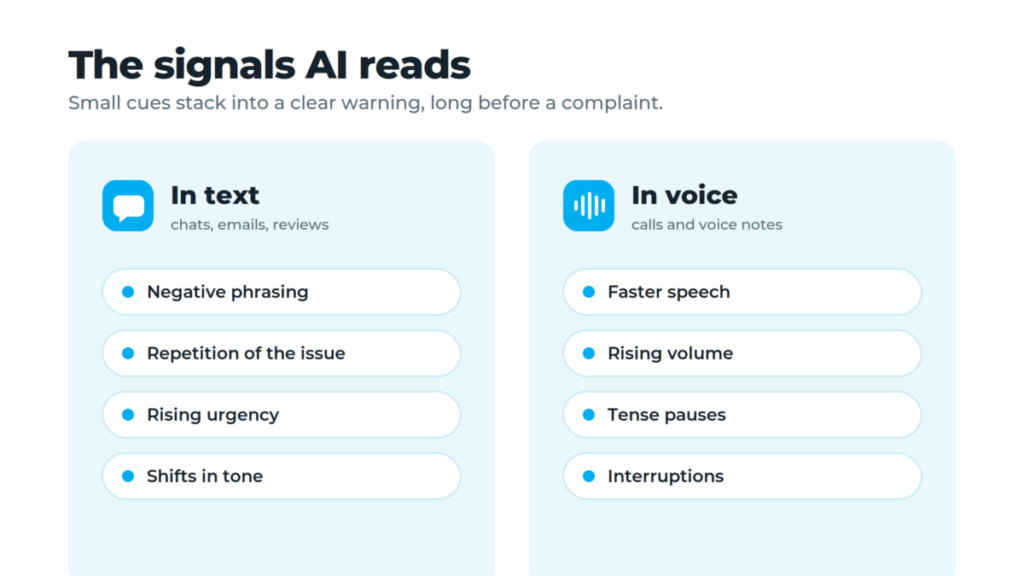
AI detects frustration by reading patterns that signal emotion, not just words. In text, it tracks negative phrasing, repetition, and shifts in tone. In voice, it picks up faster speech, rising volume, and tense pauses. Together these flag a customer heading toward a breaking point.
Think about how frustration actually sounds. A customer repeats the same point three ways because they don’t feel heard. Their sentences get shorter. The phrase “this is the third time I’ve asked” shows up. Each signal is small. Stacked together, they form a clear warning.
This is what predictive analysis does well: it spots trouble early enough to act. As one industry analysis put it, AI can help teams put out fires before they ignite. Pairing sentiment scores with customer feedback analytics turns scattered signals into one readable trend.
Why Most Frustrated Customers Never Tell You
This is the problem sentiment analysis was built to solve. Silent frustration is expensive, and it hides in plain sight.
The numbers are stark. Gartner’s 2024 CX research found that 43% of customers who churn never raise a single concern first. Worse, most companies discover the dissatisfaction only after the customer has already gone. Your dashboards stay green while the relationship quietly ends.
Loyalty metrics often fade before the exit. Bain & Company research shows NPS scores tend to slip months before a customer actually leaves. That slow decline is a signal, if you can see it in time.
The opportunity is just as clear. Microsoft found 77% of customers view a brand more favorably when it asks for and acts on feedback. Listening early isn’t only damage control. It builds loyalty.
Real-Time vs. After-the-Fact: Why Timing Decides Everything
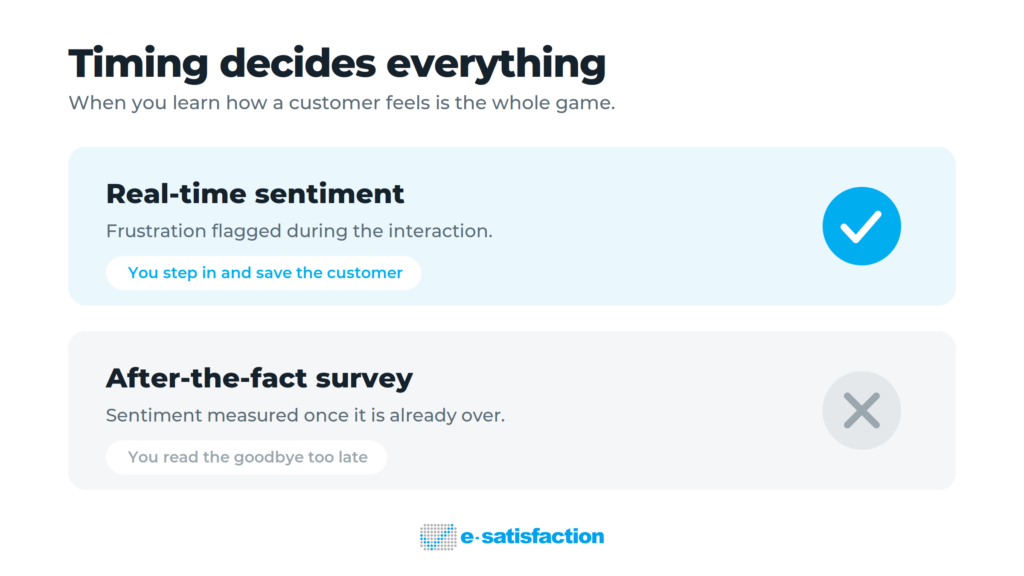
Real-time AI sentiment analysis tells you how a customer feels right now. Post-interaction surveys tell you how they felt after it’s over. For frustration, that gap is the difference between saving a customer and reading their goodbye.
A survey sent the next morning is a report card. Useful for trends, useless for rescue. Real-time analysis flags the moment sentiment drops, so a supervisor can step in, a case can route to a senior agent, or a recovery offer can go out while it still matters.
This shift from reactive to proactive pays off. Forrester reports proactive service strategies can cut churn by around 15%.McKinsey ties real-time voice-of-customer metrics directly to sustained revenue growth.
If you only learn how customers feel after they’ve gone quiet, the fix is to listen while it still counts. See how brands turn that feedback into action before it becomes a lost account.
What AI Sentiment Analysis Can (and Can’t) Do
AI sentiment analysis is powerful, but it isn’t magic. It reads emotion at scale, flags risk fast, and spots patterns humans miss. It still struggles with sarcasm, cultural nuance, and mixed messages where praise and complaint sit side by side.
A review that says “love the product, shame about the support” carries two emotions at once. Good models catch both. Weaker ones average them into a misleading “neutral.” Voice adds another layer, since tone can clarify the meaning of the same words, or flip it completely.
That’s why the smartest setups keep humans in the loop. AI surfaces the signal; people make the judgment call. This balance is a big reason AI is becoming essential for modern customer experience rather than a replacement for the team running it.
How to Put AI Sentiment Analysis to Work
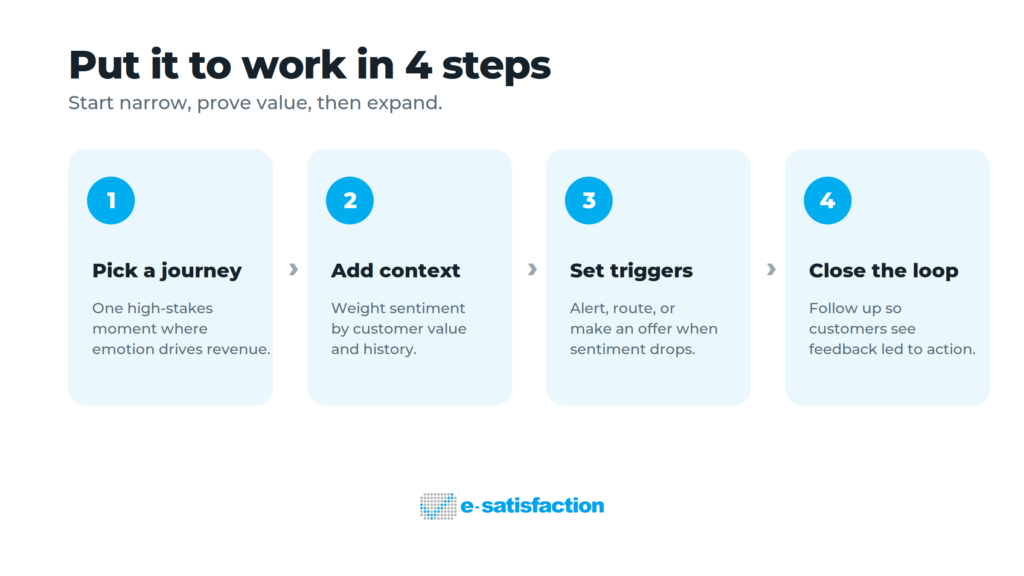
Start small and specific. Pick one high-stakes journey where emotion drives revenue, like cancellations, delivery issues, or repeat support tickets. Apply sentiment analysis there, set clear escalation triggers, and close the loop fast. Prove value in one place, then expand.
A few practical moves make it work:
- Combine sentiment with context. A negative score from a loyal, high-value customer deserves faster action than the same score from a one-time buyer.
- Set triggers, not just dashboards. Decide what happens automatically when sentiment drops: an alert, a route, an offer.
- Close the loop. Follow up so the customer knows their feedback led to action.
Retailers already do this well. See how one retailer acted on customer feedback to fix friction and protect loyalty. A connected AI customer experience solution ties these signals into one place so nothing slips through.
Conclusion
Frustration is the most valuable feedback you’ll never be asked for. AI sentiment analysis makes it visible, in time to do something about it.
Three things to remember. First, silence isn’t satisfaction; most unhappy customers leave without a word. Second, timing wins; real-time beats after-the-fact every time. Third, AI works best with humans, not instead of them.
The brands that grow are the ones that hear frustration early and act on it fast. Ready to catch customer frustration before it costs you the relationship? Request a demo and see real-time sentiment in action.
Frequently Asked Questions
What is AI sentiment analysis in customer service?
It’s technology that reads customer messages, calls, and survey responses, then labels the emotion behind them as positive, negative, or neutral. It uses natural language processing to do this at scale, helping teams spot unhappy customers they would otherwise miss.
How accurate is AI sentiment analysis?
Accuracy is high for clear positive or negative language and improves as models train on your data. It is weaker with sarcasm, slang, and mixed emotions. That’s why most teams use AI to flag risk, then let a human confirm before acting on sensitive cases.
Can AI detect frustration in text, not just voice?
Yes. In text, AI reads negative phrasing, repetition, urgency, and shifts in tone across chats, emails, reviews, and surveys. Voice adds extra signals like pace and volume, but text alone reveals plenty of early frustration.
What’s the difference between sentiment analysis and emotion detection?
Sentiment analysis sorts feedback into positive, negative, or neutral. Emotion detection goes further and names the specific feeling, such as anger, confusion, or delight. Many modern tools combine both for a fuller picture of how a customer feels.
How does AI sentiment analysis reduce churn?
It catches frustration in real time, before the customer gives up and leaves quietly. Early signals let teams step in with a fix, a faster route, or a recovery offer. Since most unhappy customers never complain, this early warning is often the only chance to save the relationship.