

Voice of Patient Programs: How AI Turns Healthcare Feedback Into Better Care
A voice of patient program is a structured way of collecting, analyzing, and acting on everything patients say about their care, not just a satisfaction score collected after discharge. AI is what makes this practical at scale: it reads free-text comments, PROMs, portal messages, and calls, scores sentiment by theme, and routes issues to the right team while they can still be fixed. This post breaks down what a voice of patient program actually includes, how AI changes the listening and action loop, and how it connects to HCAHPS and value-based reimbursement.
Ask a hospital executive if they listen to patients, and almost every one will say yes. Ask them to show you what happens to a patient’s comment about confusing discharge instructions, and the answer gets a lot less confident. That gap between collecting feedback and acting on it is exactly what a voice of patient program is built to close. Voice of patient, sometimes shortened to VoP, refers to the ongoing practice of capturing patient experiences, preferences, and concerns across every touchpoint of care, then feeding that information back into how care is delivered. It’s the healthcare-specific version of a discipline that most industries call voice of customer, adapted for the higher stakes and heavier compliance load that come with clinical settings.
What’s changed recently isn’t the idea of listening to patients. Hospitals have run satisfaction surveys for decades. What’s changed is the volume and variety of signals available, and the fact that AI can finally make sense of all of it fast enough to matter. This post walks through what a real voice of patient program looks like, why it’s a different animal from a quarterly satisfaction report, and how AI turns a pile of comments into a working feedback loop.
What Is a Voice of Patient Program?
A voice of patient program is a continuous system for collecting patient feedback across the care journey, from scheduling through post-discharge follow-up, and turning that feedback into specific actions. It combines structured data (ratings, scores, PROMs) with unstructured data (comments, calls, messages), then routes findings to the teams who can respond. Unlike a one-time survey, a voice of patient program keeps running in the background of the organization at all times.
The term itself has roots in patient advocacy. Long before AI entered the picture, clinicians and researchers argued that the patient’s own words, not just structured checkboxes, needed a bigger place in how care decisions get made. That argument holds up: research on patient-centered care has consistently found that consumer groups and advocacy organizations played a central role in pushing healthcare systems to formalize how patient input gets collected and used. A modern voice of patient program is the operational version of that idea: a system, not just a sentiment.
It’s also worth defining the word “patient” broadly. A voice of patient program shouldn’t only capture people mid-treatment. Anyone whose life is shaped by ongoing contact with a health system, including people managing chronic conditions, caregivers, and people navigating preventive care, generates signal worth capturing. Research on designing for patient voice makes the case that narrowing “patient” to only clinical encounters misses a large share of the people whose feedback actually reflects how a health system is performing.
Why Voice of Patient Is More Than Patient Satisfaction Tracking
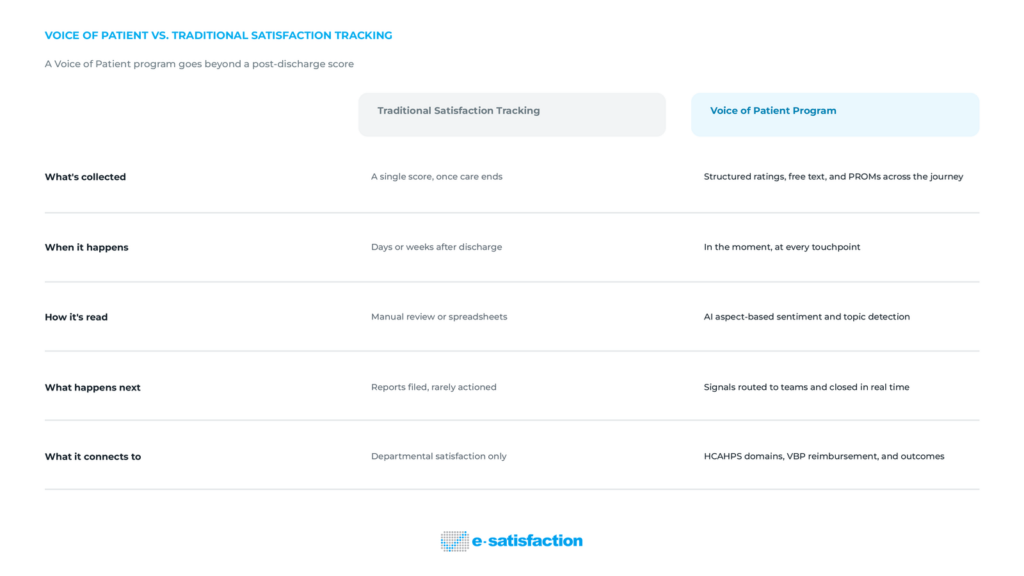
Here’s where a lot of healthcare organizations get stuck. They already run satisfaction surveys, so they assume they already have a voice of patient program. They don’t, and the difference matters more than it sounds.
A satisfaction survey asks how a patient felt about a single encounter, usually well after it happened. A voice of patient program asks a bigger question: across every interaction a patient has with the organization, what are they actually telling us, and what are we doing about it? That distinction isn’t just semantic. Patient experience surveys and satisfaction surveys are often confused for the same thing, but government researchers have been explicit that they aren’t: patient experience surveys measure whether specific things happened during care, like whether a nurse explained a medication clearly, rather than how satisfied a patient felt overall. That’s a meaningfully different, and more actionable, kind of data.
This is also where the scope of listening changes. Traditional patient satisfaction tracking usually lives inside one department and gets reviewed once a quarter. A voice of patient program pulls signal from scheduling, AI patient experience across the care journey, post-visit follow-up, billing, and even casual portal messages, and treats all of it as part of the same conversation. Some of the same operational pressures that drive AI adoption in healthcare CX, like reducing wait times and easing staff workload, also happen to generate some of the richest voice of patient data, because patients tend to comment on exactly the friction points that operations teams are already trying to fix.
What Are the Core Components of a Voice of Patient Program?
A working voice of patient program has four parts: multi-channel collection, structured and unstructured data capture, real-time analysis, and closed-loop action. Miss any one of these and the program stalls out as a data-collection exercise instead of an improvement engine.
Multi-channel collection means listening everywhere a patient might say something, not just where it’s convenient to ask. That includes post-visit surveys, but also PROMs (patient-reported outcome measures), PREMs (patient-reported experience measures), portal messages, discharge calls, and even social reviews. PROMs in particular deserve more attention than they usually get. They’re standardized, validated questionnaires that capture a patient’s own sense of their functional wellbeing and quality of life connected to a specific episode of care, which makes them a much richer input than a single overall rating.
Structured and unstructured capture means collecting both the numbers and the words. A five-point rating tells you that something went wrong. A comment tells you what and often why. Programs that only collect scores are flying with half the instrument panel dark.
Real-time analysis is where AI does its heaviest lifting, and it’s covered in more depth in the next section. Closed-loop action is the step that separates a functioning program from a well-intentioned one: every signal needs an owner, a response window, and a way to confirm the loop actually closed. Without it, patients notice that nothing changes after they speak up, which erodes the willingness to speak up again next time.
How Does AI Change the Way Healthcare Organizations Listen to Patients?
AI changes voice of patient programs by making it possible to read and categorize every piece of feedback at the volume healthcare actually generates, not just a manageable sample of it. Natural language processing extracts themes from open-text comments, sentiment models score how patients feel about each theme separately, and the results get routed automatically to whichever team owns that part of the experience.
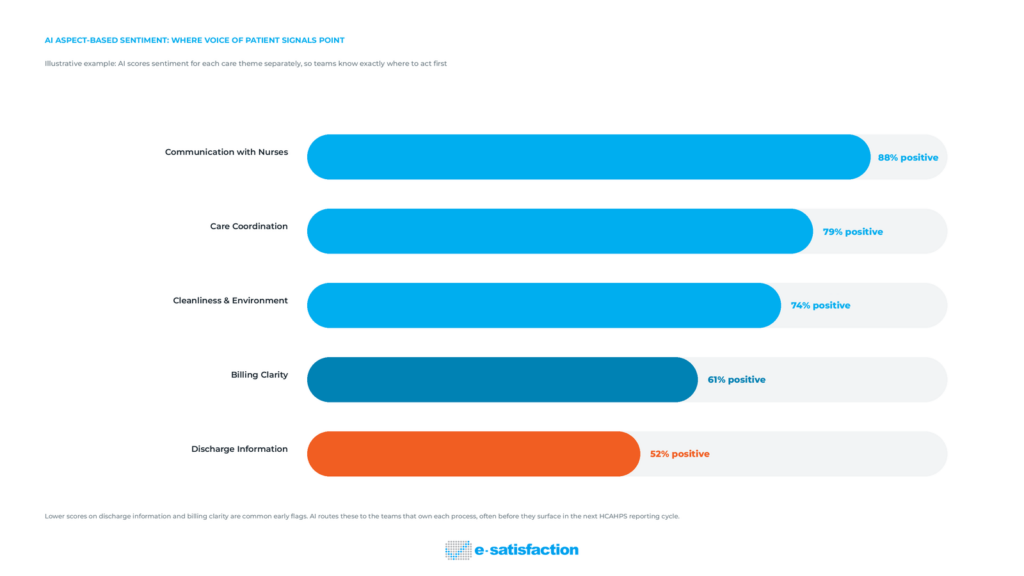
This aspect-based approach matters because overall satisfaction scores hide more than they reveal. A patient might rate their overall stay a nine out of ten while also mentioning that discharge paperwork was confusing and the bill made no sense. An aspect-based sentiment analysis platform catches that nuance by scoring communication, wait times, cleanliness, billing clarity, and discharge information as separate signals instead of collapsing them into one number. That’s the difference between knowing something is slightly off and knowing exactly which department needs to fix which process.
AI-powered topic detection does the categorization work underneath this. Instead of a human reading through thousands of comments to manually tag them by department or issue type, the model clusters similar feedback automatically and flags emerging patterns as they appear, sometimes before a formal complaint is ever filed. Academic researchers have already demonstrated how far this can go in specialized domains: one 2026 study found that an AI-enriched algorithm outperformed traditional expert-based methods at identifying patient-reported outcome and experience measures buried inside oncology clinical trial records, a task that used to require substantial manual review. The same principle applies at the scale of a single hospital’s daily comment volume, just with lower stakes and faster turnaround.
There’s a deeper shift happening here too. Researchers writing in Lancet Digital Health have argued that patient-reported outcomes shouldn’t just sit next to AI systems as a reporting layer, they should be built into how those systems function, so that a patient’s own account of their symptoms and wellbeing becomes an input the AI treats as seriously as a lab result. Voice of patient programs are the operational front door to that idea. The AI doesn’t replace clinical judgment. It makes sure the patient’s own words actually make it into the room where decisions get made.
Ready to see how this works with your own patient feedback data? Book a demo and walk through it with your team.
Connecting Voice of Patient Data to HCAHPS and Value-Based Reimbursement
In the US, voice of patient work doesn’t happen in a vacuum. It sits directly upstream of HCAHPS, the standardized survey CMS uses to measure patients’ perspectives of hospital care, and HCAHPS carries real financial weight. Since 2012, HCAHPS scores have been built into the Hospital Value-Based Purchasing program, which means a hospital’s Medicare payment is partly tied to how patients rate their communication with nurses and doctors, discharge information, responsiveness, and several other domains.
This is precisely why a voice of patient program earns its keep. HCAHPS is retrospective by design, administered between 48 hours and six weeks after discharge, so it tells an organization how it did months ago, not how it’s doing right now. A continuous voice of patient program surfaces the same underlying issues, communication gaps, confusing discharge steps, slow responsiveness, in near real time, long before those issues show up as a lower quarterly HCAHPS score. Teams get a chance to fix the process instead of just watching the score reflect it later.
It’s also worth being precise about what HCAHPS actually measures. Patient experience surveys are explicitly not the same thing as patient satisfaction surveys. They ask whether specific things happened, not how a patient felt in general, which is a distinction CMS itself draws clearly in how it designs and describes these instruments. A mature voice of patient program respects that same distinction: it tracks concrete, actionable events (did the nurse explain the medication, was the room clean, was the bill understandable) rather than settling for a single mood score that’s hard to act on. Understanding the ROI of AI in CX in this context means looking past software cost savings and toward what improved HCAHPS domains are actually worth in reimbursement terms.
From Feedback to Action: Closing the Loop on Patient Voice
Collecting patient feedback is the easy part. Most healthcare organizations already do it. The part that actually moves outcomes is closing the loop, making sure every signal ends with a specific action, owned by a specific team, within a specific window.
This is also where the human side of the electronic health record has historically fallen short. Physicians and researchers have pointed out that the patient’s own voice, meaning the actual words a patient uses in notes, messages, and other records, occupies a strikingly small footprint inside most EHR systems, even though it carries real diagnostic value. Research on the patient’s voice and the electronic health record argues that this underrepresentation isn’t a minor gap. Patient-reported symptoms are sometimes the only clue pointing toward the right diagnosis, and a system that doesn’t route that information to the right person loses it entirely.
Closing the loop well requires a few concrete habits. First, every negative or ambiguous signal needs an owner within hours, not days, which is only realistic when real-time patient insights are already flowing to the right team automatically. Second, patients need to know their input changed something, even something small, or they stop bothering to give it. Third, leadership needs a way to see whether loops are actually closing, not just whether tickets were opened. A voice of patient program that skips any of these steps will still generate reports. It just won’t generate improvement.
What Does a Mature Voice of Patient Program Look Like?
A mature voice of patient program has four characteristics: it listens continuously across every channel, it separates structured scores from unstructured comments, it uses AI to analyze both at the pace patients actually generate feedback, and it closes the loop with a visible, trackable action for nearly every signal that comes in. None of these are optional add-ons. Each one covers a gap the others can’t.
Organizations at this stage tend to stop treating patient feedback as a compliance exercise tied to a survey vendor’s contract and start treating it as an operational input, closer to how a hospital treats infection control data or staffing ratios. The comments, PROMs, and portal messages patients generate every day become a live diagnostic layer sitting underneath the clinical record, not a once-a-quarter report that lands on someone’s desk after the moment to act on it has already passed.
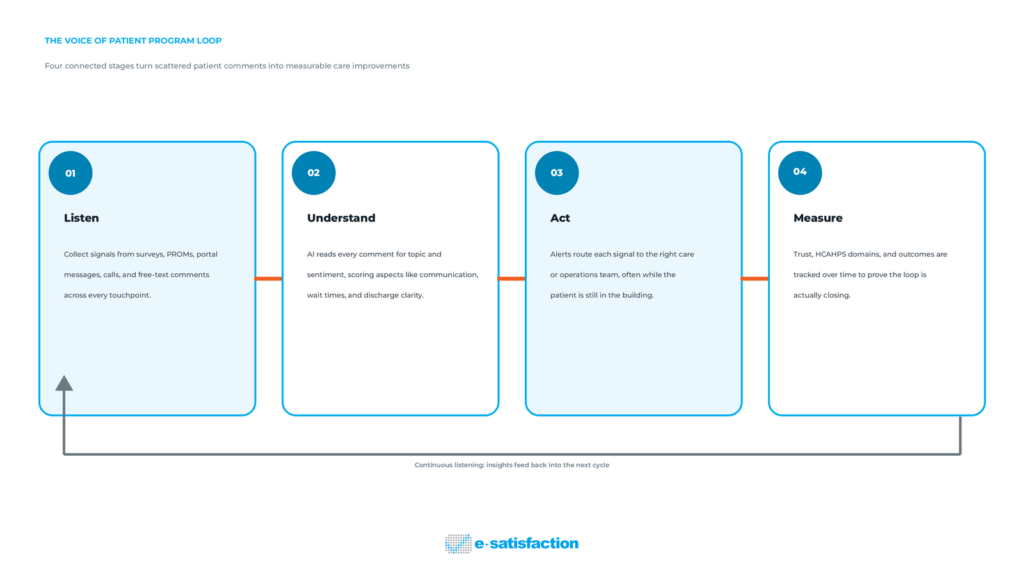
Voice of patient programs work because they treat what patients say as data worth analyzing in real time, not a satisfaction score to file away until the next quarterly review. AI is what makes that possible at hospital scale: reading every comment, scoring sentiment by theme, and routing what matters to the team that can actually fix it. The organizations getting this right aren’t just improving HCAHPS scores, they’re catching problems while there’s still time to solve them for the patient who reported them.
If you’re ready to see what a structured voice of patient program looks like on your own feedback data, book a demo and we’ll walk through it together.
Frequently Asked Questions
What is a voice of patient program?
A voice of patient program is a continuous system for collecting patient feedback, both structured scores and unstructured comments, across every stage of care, then analyzing and routing that feedback so specific teams can act on it. It differs from a one-time satisfaction survey because it never stops running and it’s built to trigger action, not just produce a report.
How is voice of patient different from patient satisfaction surveys?
Patient satisfaction surveys ask how a patient felt about one encounter, usually after the fact. A voice of patient program captures ongoing signals across the entire relationship, combines them with tools like PROMs and free-text comments, and uses AI to route findings in near real time instead of waiting for a periodic report.
Does a voice of patient program affect HCAHPS scores?
Yes, indirectly but significantly. HCAHPS measures patients’ experience of specific care events, and since 2012 those scores have factored into Medicare’s Hospital Value-Based Purchasing program. A voice of patient program surfaces the same communication, discharge, and responsiveness issues in near real time, giving organizations a chance to fix problems before they show up in the next HCAHPS reporting period.
What role does AI play in a voice of patient program?
AI reads and categorizes patient feedback at the scale healthcare actually generates it. It extracts themes from open-text comments, scores sentiment for each theme separately (aspect-based sentiment analysis), and automatically routes signals to the team responsible, replacing the manual review that used to make large-scale feedback analysis impractical.
What are PROMs and why do they matter for voice of patient programs?
PROMs, or patient-reported outcome measures, are standardized, validated questionnaires patients complete to describe their own functional wellbeing and quality of life related to an episode of care. They add a clinical-outcome dimension that a simple satisfaction rating doesn’t capture, and they’re increasingly treated as a direct input into AI models rather than a separate reporting exercise.