

Why Traditional Customer Feedback Programs Fail Without AI
Most customer feedback analytics programs fail for three reasons: they capture a thin, biased slice of reality, they analyze it too slowly, and they rarely close the loop. The bulk of feedback is unstructured text that never gets read. AI fixes the three breakpoints, scale, speed, and signal, so teams hear the silent majority and act before customers leave.
You run surveys. You track NPS. You have a dashboard. So why does nothing seem to change? The problem usually isn’t effort. It’s that traditional customer feedback analytics was built for a world that no longer exists, one where customers answered surveys and complaints arrived neatly through one channel.
Today they don’t. Customers vent in reviews, support chats, social posts, and open comment fields. They rate you a 9 and churn anyway. And only 1 in 26 unhappy customers ever complains, so the feedback you collect is the tip of a much larger iceberg.
This post breaks down exactly where legacy programs break, and what changes when AI does the listening. If you’re rethinking your customer experience strategy, start here.
Why do traditional customer feedback programs fail?
Traditional feedback programs fail at three points: incomplete data (they hear from a small, self-selected group), slow analysis (manual tagging takes days or weeks), and a broken loop (insights rarely trigger action). Each gap quietly caps the value of everything else you do.
Fix one and the others still leak. You can run more surveys, but if you only analyze structured scores, you still miss the “why.” Speed up reporting, but if you never act, faster reporting just means faster guessing.
What is customer feedback analytics, and why does it matter now?
Customer feedback analytics is the practice of collecting feedback across channels and turning it into insight you can act on: themes, sentiment, root causes, and priorities. Done well, it tells you not just what customers scored you, but why they feel that way and what to fix first.
It matters more now because volume has exploded. Studies estimate that 80% to 90% of corporate data is unstructured text, the kind that manual review simply can’t keep up with. Reading a few hundred comments by hand was possible. Reading hundreds of thousands is not.
The feedback you never see is the feedback that hurts most
Here’s the uncomfortable truth: silence is not satisfaction. Most dissatisfied customers don’t file a complaint. They quietly switch, often after rating you politely on the way out.
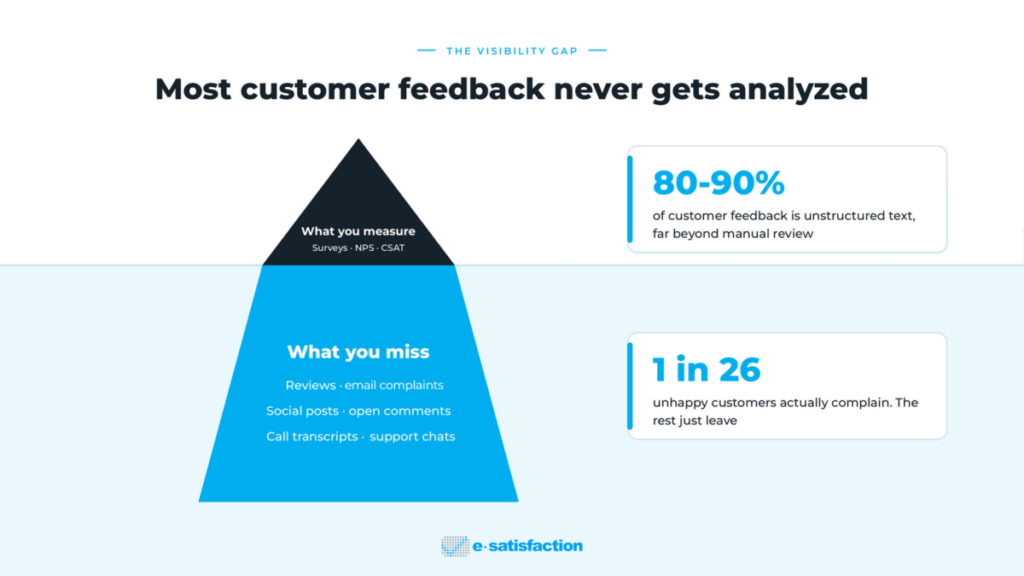
That hidden churn is expensive. Research summarized by Harvard Business Review shows emotionally connected customers are worth far more over their lifetime than merely satisfied ones, so losing them quietly costs more than a single transaction. The early-warning signals live in unstructured feedback: a frustrated chat, a lukewarm review, a one-line comment. Ignore that text and you’re flying blind on the issues that actually drive churn.
If this sounds familiar, see how a retail brand turned feedback into action and changed what they fixed first.
Why surveys alone no longer work
Surveys still have a role, but they can’t carry the whole program. Response rates are falling, fatigue is rising, and the people who answer tend to be your biggest fans or your angriest critics. That skews scores and hides the quiet middle.
Industry coverage notes that traditional metrics like NPS and CSAT only tell part of the story as buyers spread across more touchpoints. A score tells you the temperature. It rarely tells you the cause. And when fewer people respond, even the temperature reading gets noisy.
How AI changes customer feedback analytics
AI changes customer feedback analytics by reading unstructured text at scale, in real time. Natural language processing and customer sentiment analysis group thousands of comments into themes, flag emerging issues, and surface the root cause, all without manual tagging.
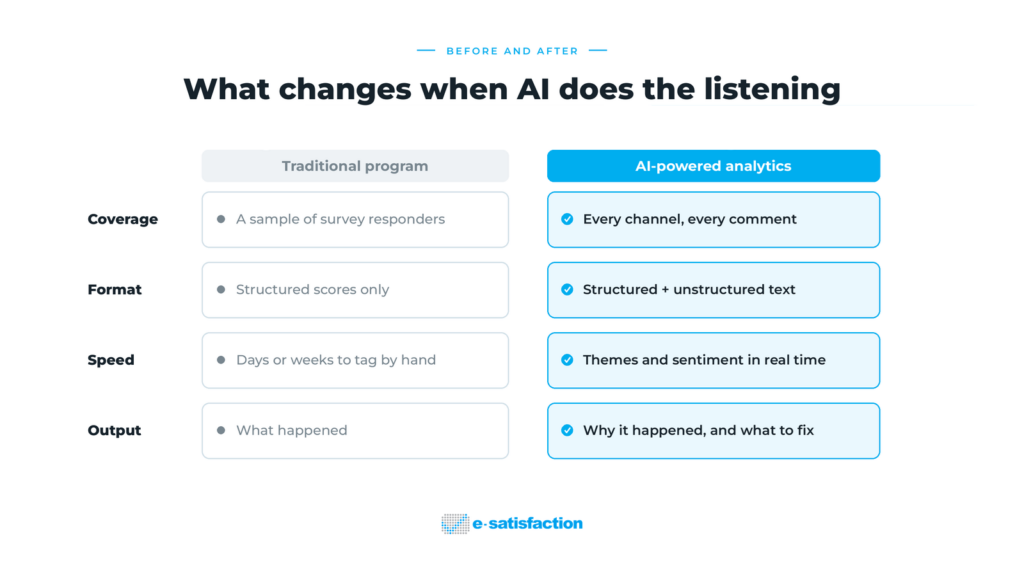
That shift does two things. It widens coverage, so you hear every channel instead of a sample. And it collapses time-to-insight from weeks to minutes. McKinsey describes AI systems that deliver continuous learning loops manual reviews could never match, including measurably shorter service interactions. See how real-time feedback analysis works in practice, and why a unified voice of customer platform beats stitching together scattered tools.
From insight to action: closing the loop
Analytics only matters if it ends in action. The strongest programs follow a simple loop: listen across every channel, analyze with AI, then act and route the result back into the next round of listening.
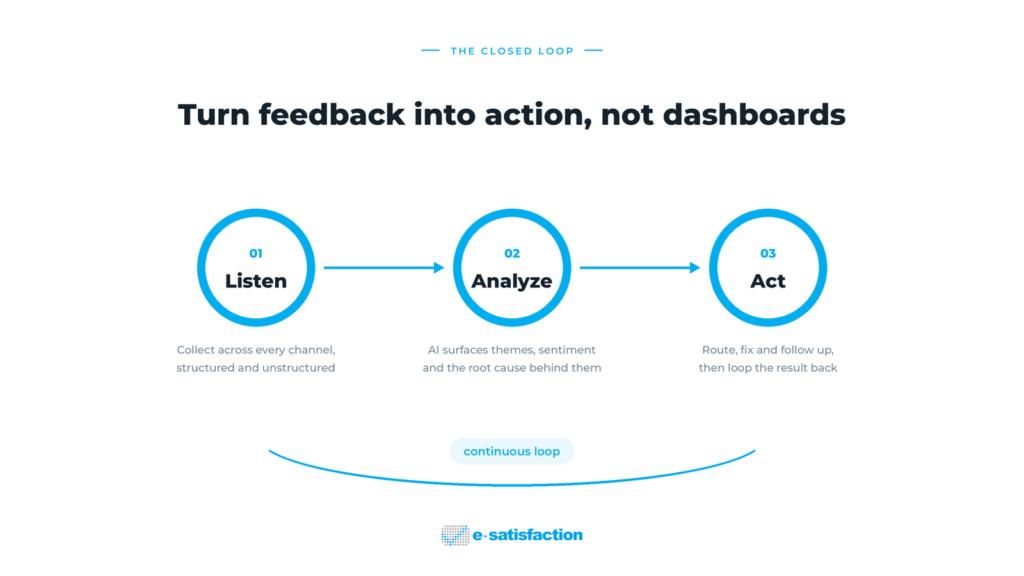
This is where most programs still stumble. A dashboard is not a decision. The point is to turn feedback into action, fix the highest-impact issue, follow up with the customer, and confirm the fix worked. Forward-looking teams are moving fast: industry analysts report most organizations are investing in real-time feedback systems precisely so they can close that loop sooner.
Traditional customer feedback programs don’t fail because teams stop caring. They fail because the old model can’t keep pace with how customers actually communicate. Three things change that: hearing every channel, not a sample; getting answers in real time, not weeks; and closing the loop so insight becomes action.
Get those right and feedback stops being a report you read after the fact. It becomes an early-warning system that protects revenue.
Ready to hear the silent majority before they leave? Book a demo and see your own feedback analyzed in minutes.
Frequently Asked Questions
What is customer feedback analytics?
Customer feedback analytics is the process of collecting feedback from across channels and turning it into insight you can act on, including themes, sentiment, and root causes. The goal is to understand not just what customers scored you, but why, and what to do next.
Why do most customer feedback programs fail?
They fail at three points: incomplete data from a small group of responders, slow manual analysis, and a broken loop where insights never lead to action. Most feedback is unstructured text that never gets analyzed, so the biggest issues stay hidden.
Can AI replace surveys entirely?
No. Surveys still provide useful baseline metrics like NPS and CSAT. AI broadens the picture by analyzing unstructured feedback from reviews, chats, and social, so surveys validate patterns rather than carrying the whole program alone.
How does AI analyze unstructured feedback?
AI uses natural language processing and sentiment analysis to read open-ended text at scale. It groups comments into themes, detects emotion and intent, and surfaces the root cause behind a score, in real time and without manual tagging.
What’s the difference between sentiment analysis and feedback analytics?
Sentiment analysis gauges the emotional tone of a comment, such as positive, negative, or neutral. Feedback analytics is broader: it combines sentiment with theme detection, root-cause analysis, and prioritization to guide what you actually fix.