

What Is AI Voice of Customer (VoC)? A Complete Guide for Businesses
AI voice of customer is the use of artificial intelligence to collect, read, and act on customer feedback in real time. It detects sentiment, surfaces themes, and flags churn risk across every channel at once. Traditional surveys can’t keep that pace. This guide covers what AI VoC is, how it works, the benefits, and how to get started.
Most unhappy customers never tell you they’re unhappy. They just leave. Research shows only 1 in 26 unhappy customers ever complain; the rest churn in silence. That silent exit is expensive, and old feedback methods rarely catch it in time.
This is where AI voice of customer comes in. It listens to what customers say across surveys, reviews, chats, emails, and calls, then turns that raw feedback into clear, timely insight. Instead of reading a quarterly report after the damage is done, you see problems as they happen.
The shift is already mainstream. 73% of B2B SaaS product teams now use AI to synthesize customer feedback at least weekly, up from 19% in 2023. Below, we break down exactly what AI VoC is and why it matters for your business.
What Is AI Voice of Customer?
AI voice of customer is a method that uses artificial intelligence to gather and analyze customer feedback automatically. It interprets language, scores emotion, and spots patterns across thousands of responses, so teams understand what customers feel without reading every comment by hand.
Traditional VoC relies on periodic surveys and manual tagging. AI VoC works continuously. It pulls feedback from many sources, unifies it, and produces insight in minutes instead of weeks. The goal stays the same: listen, understand, act. The speed and scale change completely.
How Does AI Voice of Customer Work?
AI voice of customer works in four steps: collect feedback from every channel, unify it in one place, analyze it with AI, and route insights to the right team. The analysis layer reads open text, scores sentiment, and groups comments into themes automatically.
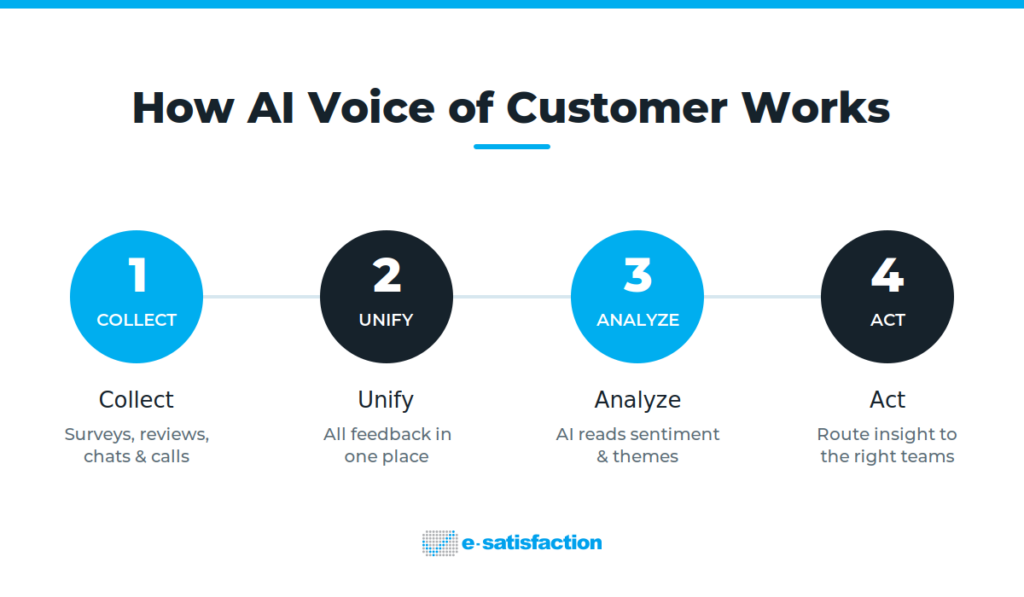
Here’s each stage in practice:
- Collect. Feedback arrives from surveys, reviews, support tickets, chats, and social posts.
- Unify. All of it lands in a single view, so nothing gets lost in separate tools.
- Analyze. AI text analytics reads qualitative comments, detects emotion, and links themes to your CX metrics.
- Act. Alerts and dashboards send the right insight to frontline, product, and management teams.
The big leap is in step three. AI reads the messy, open-ended comments that humans usually skip, and it does so across languages and channels at once.
Why Does Traditional VoC Fall Short?
Traditional VoC programs were built for a slower world. They lean on quarterly surveys, small samples, and analysts who tag comments by hand. By the time a report lands, the customer has often already moved on.
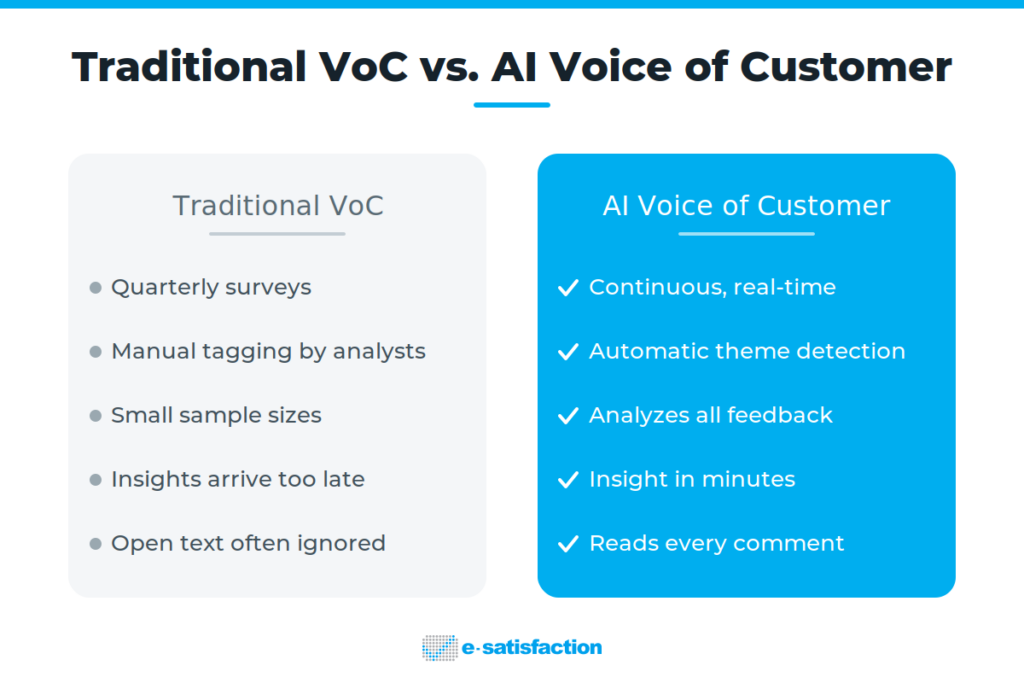
Three gaps stand out. First, timing: insights arrive too late to fix anything. Second, scale: teams review only a tiny fraction of available feedback. Third, depth: rich open-text comments get ignored because manual tagging is slow. AI closes all three gaps by reading everything, instantly, in the customer’s own words.
What Are the Benefits of AI VoC for Businesses?
The main benefits of AI VoC are real-time insight, churn prediction, lower manual effort, and measurable revenue gains. Because AI processes feedback as it arrives, teams act on problems early instead of reviewing them months later.
The numbers back this up:
- Revenue: Forrester reports that 84% of businesses improving CX saw revenue increase, and a one-point CX gain can add up to $1 billion for large firms.
- Retention: McKinsey found that a 10% reduction in churn can lift profit by 30% to 125%.
- Efficiency: AI handles tagging and sorting automatically, freeing teams to focus on fixes rather than data cleanup.
- Conversion: AI-native omnichannel feedback analysis has been linked to a 31% lift in conversion rates.
If silent churn and slow reports sound familiar, see how brands turn feedback into action before customers walk away.
What Can AI Analyze in Customer Feedback?
AI can analyze sentiment, emotion, recurring topics, and key drivers inside customer feedback. It reads free text, classifies each comment, and shows which issues most affect satisfaction, loyalty, and revenue, all without manual review.
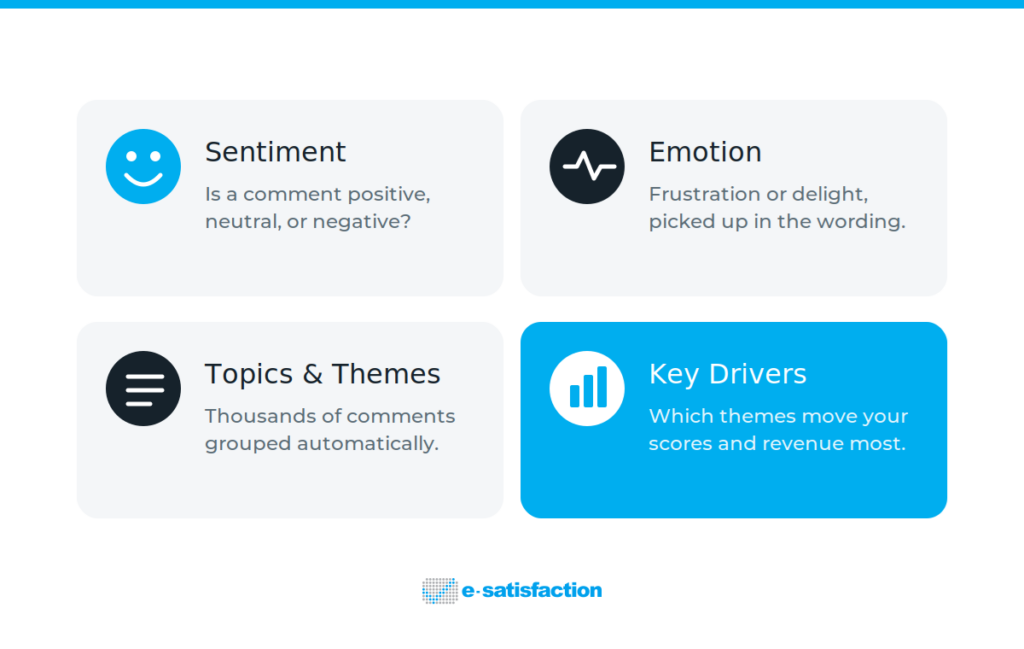
In practice, that means four layers of insight. Sentiment tells you if a comment is positive or negative. Emotion detection picks up frustration or delight in the wording. Topic detection groups thousands of comments into clear themes. Key driver analysis then ranks which themes move your scores most. The momentum is real: 79% of leaders expect generative AI to transform their organizations within three years, with customer operations a top value area.
How to Get Started With AI Voice of Customer
Starting with AI VoC does not require a full system overhaul. Begin small, then expand based on what works.
Follow a simple path. Connect your existing feedback sources first, since you likely already collect more than you analyze. A good platform can connect every feedback channel you use, online and offline. Next, let AI handle the analysis so themes and sentiment surface automatically. Then close the loop: send insights to the teams who can act, and track whether your scores improve. Done well, this loop helps you improve customer experience continuously rather than once a quarter.
The Bottom Line
AI voice of customer turns scattered, slow feedback into real-time insight you can act on. It reads what customers actually say, predicts who might leave, and points teams toward the fixes that matter most.
Two takeaways. First, silent churn is the real threat, and AI is the only practical way to catch it at scale. Second, the brands pulling ahead already treat feedback as a live signal, not a quarterly report. Companies that act on feedback see up to a 25% reduction in churn.
Ready to stop guessing and start acting on real customer feedback? Request a free demo of our AI-powered VoC platform.
Frequently Asked Questions
What is AI voice of customer?
AI voice of customer is the use of artificial intelligence to collect, analyze, and act on customer feedback automatically. It reads sentiment, detects themes, and highlights issues across surveys, reviews, chats, and calls in real time, so teams can respond before customers churn.
How is AI VoC different from traditional VoC?
Traditional VoC relies on periodic surveys and manual tagging, so insights arrive late and cover only a small sample. AI VoC runs continuously, reads open-text feedback at scale, and delivers insight in minutes. The purpose is the same; the speed and coverage are far greater.
Is AI accurate at reading customer sentiment?
Modern AI sentiment analysis is reliable enough to guide business decisions and improves as it learns your data. It also removes the bias and fatigue that affect manual review. Most teams use it to prioritize where humans should focus, not to remove human judgment entirely.
Does AI VoC replace customer surveys?
No. Surveys remain a valuable feedback source. AI VoC simply analyzes survey responses faster and combines them with reviews, chats, and other channels for a fuller picture. Think of AI as the analysis engine that makes every survey more useful.
How do I start an AI VoC program?
Start by connecting the feedback channels you already use, then let AI analyze sentiment and themes automatically. Route those insights to the teams who can act, and track whether your CX metrics improve. Begin with one or two channels and expand from there.